
Introduction: Why Businesses Need a Content Engine
A content engine is the foundation of consistent social media growth. While many businesses still approach social media one post at a time, high-growth brands use structured systems that continuously create, distribute, and optimize content. Instead of wondering what to publish every day, they rely on a repeatable process that drives awareness, engagement, leads, and revenue.
Many teams begin each day asking the same question:
“What should we post today?”
As a result, they often face content gaps, inconsistent publishing schedules, creative burnout, missed opportunities, and slow growth.
The issue is rarely a lack of ideas. More often, the problem is the absence of a scalable system.
The fastest-growing brands are not simply producing more content. Instead, they are building a content engine that turns content marketing into a predictable growth process.
For more strategies on scaling your marketing efforts, explore our Social Media Automation and Content Marketing Services resources.
What Is a Content Engine?
A content engine is a structured framework that consistently produces, distributes, measures, and improves content.
Unlike a simple content calendar, a content engine manages the entire content lifecycle.
It includes:
- Content strategy
- Content creation
- Repurposing
- Distribution
- Analytics
- Optimization
The goal is to create a repeatable system that generates measurable business outcomes.
Why a Content Engine Outperforms a Content Calendar
Many businesses believe they have a content strategy because they maintain a publishing calendar.
However, a calendar only answers one question:
“When should we post?”
A content engine answers much more:
- Why are we creating this content?
- How does it support business goals?
- Where will it be distributed?
- How can it be repurposed?
- How will success be measured?
Therefore, a content engine creates strategic alignment while a calendar simply organizes publishing dates.
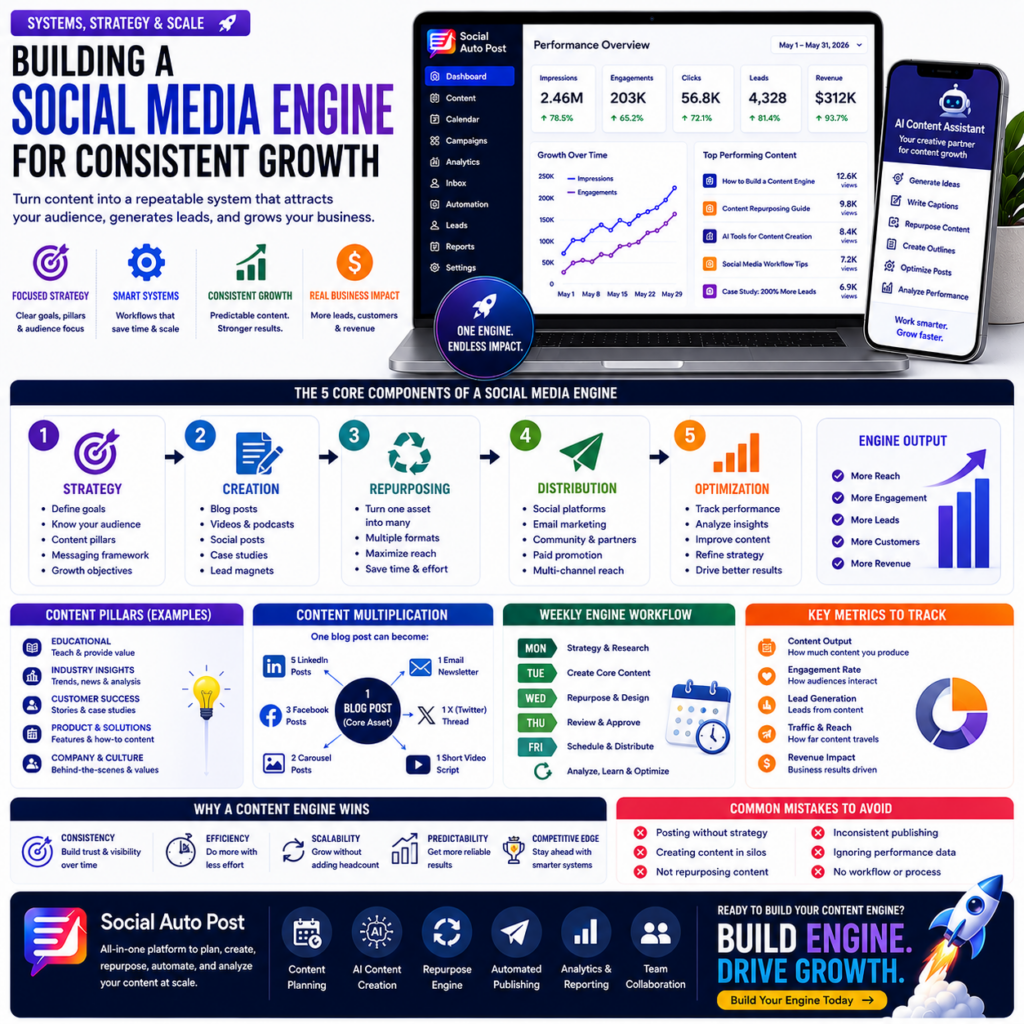
The Five Components of a Content Engine
Every successful content engine is built around five core components.
1. Content Engine Strategy
Strategy forms the foundation of the system.
Businesses should define:
- Target audience
- Business goals
- Brand messaging
- Content pillars
- Growth objectives
Without strategy, content becomes random activity rather than a growth asset.
2. Content Creation
This stage focuses on producing valuable assets.
Examples include:
- Blog articles
- Videos
- Podcasts
- Case studies
- Email newsletters
- Social media content
The objective is to create high-value content that can be reused across channels.
3. Content Repurposing
Repurposing dramatically improves efficiency.
For example, one blog article can become:
- Five LinkedIn posts
- Three Facebook posts
- One X thread
- One email campaign
- Two carousel posts
- Multiple short-form videos
As a result, a single idea can power an entire week of content.
4. Content Distribution
Even great content needs effective distribution.
Channels may include:
- X
- Email marketing
- Community groups
- Paid advertising
Furthermore, distribution ensures that content reaches the right audience at the right time.
5. Content Optimization
Every content asset produces valuable data.
Review metrics such as:
- Reach
- Engagement
- Clicks
- Leads
- Conversions
Consequently, future content becomes more effective over time.
How to Build a Content Engine Using Content Pillars
Content pillars provide structure and consistency.
Most businesses perform well with four to six pillars.
Examples include:
Educational Content
Teach industry concepts and solve common problems.
Industry Insights
Share trends, data, and expert analysis.
Customer Success Stories
Highlight real-world outcomes and case studies.
Product Content
Show features, benefits, and use cases.
Brand Building
Communicate company culture, values, and vision.
These pillars ensure consistent messaging across every channel.
Start Your Content Engine With Core Content
The most efficient content engines begin with a large content asset.
Examples include:
- Blog posts
- Research reports
- Webinars
- Podcasts
- Whitepapers
- Case studies
A single asset can become:
One Blog Post
↓
Multiple Social Posts
↓
Email Campaigns
↓
Video Content
↓
Lead Generation Assets
This approach creates leverage and maximizes content ROI.
Create a Weekly Content Engine Workflow
Consistency comes from process.
A simple workflow might look like:
Monday
Research and planning.
Tuesday
Create long-form content.
Wednesday
Design visuals and repurpose content.
Thursday
Review, approve, and schedule.
Friday
Analyze performance and identify improvements.
Repeating this workflow every week creates long-term momentum.
Using AI to Strengthen Your Content Engine
AI has become an important component of modern content marketing.
Today, AI can assist with:
- Topic generation
- Content outlines
- Caption writing
- Repurposing content
- Headline testing
- Performance analysis
However, AI works best as an accelerator rather than a replacement for human creativity.
Businesses looking to improve efficiency can also explore our AI Content Creation solutions.
Automate Your Content Engine for Greater Scale
Manual processes often limit growth.
Therefore, automation should handle repetitive tasks such as:
- Scheduling
- Publishing
- Approval workflows
- Notifications
- Reporting
- Content recycling
Automation creates more time for strategy and creative work.
Learn more about Marketing Automation strategies that support scalable growth.
Build a Content Library to Strengthen Your Content Engine
Many businesses forget their best-performing content.
A centralized library should store:
- Blog posts
- Videos
- Templates
- Campaign assets
- Social media posts
- Case studies
As a result, successful content can be reused and repurposed efficiently.
How to Measure Content Engine Performance
Most marketers focus only on individual post performance.
However, measuring the overall system is equally important.
Track metrics such as:
Content Output
How much content is produced each month?
Repurposing Rate
How many assets are generated from a single idea?
Publishing Consistency
Are publishing schedules maintained?
Lead Generation
How many leads originate from content?
Revenue Impact
How much revenue is influenced by content marketing?
These metrics reveal whether the content engine is functioning effectively.
Common Content Engine Mistakes to Avoid
Avoid these common mistakes:
- Creating content without strategy
- Publishing inconsistently
- Ignoring repurposing opportunities
- Lacking content pillars
- Operating without workflows
- Tracking only vanity metrics
- Failing to optimize performance
Each of these issues reduces efficiency and limits growth.
Why a Content Engine Creates Predictable Growth
Random posting produces random results.
A content engine creates predictable outcomes because it is built around repeatable systems.
A strong content engine helps businesses:
- Scale content production
- Improve consistency
- Generate leads
- Build authority
- Increase ROI
- Support long-term growth
Ultimately, the goal is not to publish more content. The goal is to create a system that continuously drives business results.
Recommended Tools for Building a Content Engine
Many organizations use tools such as:
- HubSpot for marketing automation
- Buffer for scheduling
- SEMrush for content research
- Google Analytics for performance tracking
These platforms can help streamline content operations and improve decision-making.
Final Thoughts
Social media success is no longer about individual posts.
Instead, it is about building systems that consistently generate results.
The companies achieving sustainable growth are not necessarily creating the most content. Rather, they are building the most efficient content engines.
A content engine transforms social media from a daily obligation into a scalable business asset. Once the system is established, growth becomes more predictable, measurable, and sustainable.