
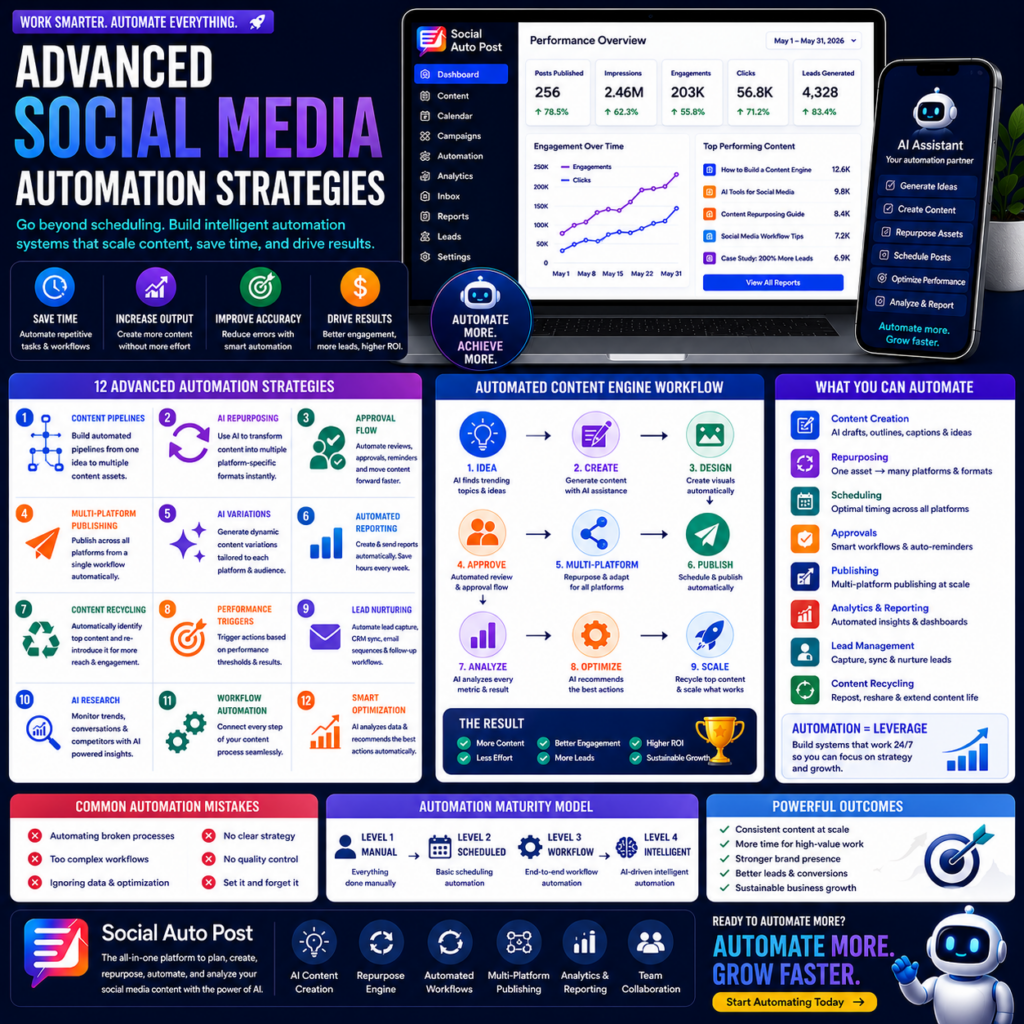
Introduction: Why Advanced Social Media Automation Strategies Matter
Advanced social media automation strategies have become essential for businesses that want to scale content marketing efficiently. While many organizations still associate automation with scheduling posts, modern marketing teams use automation across the entire content lifecycle.
Today, automation supports content creation, repurposing, approvals, publishing, reporting, performance analysis, lead nurturing, and content recycling.
As a result, teams can produce more content, maintain greater consistency, reduce manual work, and improve marketing ROI.
The competitive advantage is no longer simply posting more frequently. Instead, it comes from building systems that eliminate operational bottlenecks and create scalable workflows.
For businesses looking to improve efficiency, our Social Media Automation solutions can help streamline every stage of the content process.
Why Advanced Social Media Automation Strategies Go Beyond Scheduling
Many businesses have already automated publishing.
However, they still manage several important tasks manually, including:
- Content ideation
- Content reviews
- Asset organization
- Multi-channel distribution
- Performance reporting
Consequently, these manual processes create hidden inefficiencies that slow growth.
The modern objective is not simply to automate posts.
Instead, successful businesses automate the entire content lifecycle.
Build Automated Content Pipelines
One of the most effective advanced social media automation strategies involves creating content pipelines.
Traditional teams create content one asset at a time.
High-performing teams create systems.
For example:
Blog Post Published
↓
AI Extracts Key Insights
↓
LinkedIn Content Generated
↓
Facebook Variations Created
↓
Email Summary Produced
↓
Content Scheduled Automatically
↓
Performance Tracked
As a result, one content asset powers an entire marketing ecosystem.
Automate Content Repurposing for Greater Efficiency
Repurposing creates significant leverage.
Without automation, teams manually rewrite content for every channel.
With automation, one content asset can generate:
- LinkedIn posts
- Facebook updates
- X threads
- Email newsletters
- Carousel content
- Video scripts
Therefore, content output increases dramatically without requiring additional resources.
Businesses can also improve efficiency using our AI Content Creation solutions.
Create Advanced Approval Automation Workflows
Approval processes often become major bottlenecks.
Fortunately, workflow automation can streamline the process.
Advanced systems automatically:
- Assign reviewers
- Notify stakeholders
- Track progress
- Escalate delays
- Move content to the next stage
For example:
Draft Completed
↓
Editor Assigned
↓
Content Approved
↓
Manager Notified
↓
Final Approval
↓
Scheduled Automatically
This approach reduces delays and improves operational efficiency.
Automate Multi-Platform Content Distribution
Publishing content manually across multiple channels consumes valuable time.
Modern automation systems distribute content across:
- X
- Threads
- Email platforms
From a single workflow.
Consequently, teams reduce publishing errors while maintaining consistency across channels.
Use AI to Generate Platform-Specific Content Variations
Different audiences respond to different formats.
Therefore, advanced social media automation strategies increasingly use AI to create content variations.
Examples include:
Professional Version
Designed for LinkedIn audiences.
Conversational Version
Optimized for Facebook engagement.
Short-Form Version
Created for X and Threads.
Educational Version
Adapted for newsletters and email campaigns.
As a result, brands can personalize content at scale.
Build Automated Reporting Dashboards
Manual reporting often consumes hours every week.
Advanced teams automate:
- Weekly reports
- Monthly reports
- Campaign dashboards
- Executive summaries
Instead of gathering data manually, reports are generated automatically.
Furthermore, automation allows marketers to focus on strategy rather than administrative work.
Many organizations use Google Analytics and HubSpot to support automated reporting and campaign measurement.
Automate Content Recycling to Maximize ROI
Most content is published once and then forgotten.
However, advanced social media automation strategies identify:
- High-performing posts
- Evergreen content
- Seasonal content
- Top engagement assets
The system can then automatically reintroduce these assets into publishing schedules.
Consequently, businesses maximize content value while improving long-term ROI.
Trigger Automation Based on Content Performance
Modern automation systems can respond to real-time performance data.
For example, if a post exceeds predefined engagement thresholds, automation can:
- Repurpose content into additional formats
- Trigger paid promotion
- Add content to evergreen campaigns
- Distribute content to email subscribers
Therefore, workflows become performance-driven rather than purely scheduled.
Automate Lead Nurturing Workflows
Social media should support revenue generation.
An automated lead nurturing process may look like this:
Content Click
↓
Lead Capture
↓
CRM Entry
↓
Email Sequence Triggered
↓
Demo Invitation
↓
Sales Follow-Up
As a result, businesses reduce the risk of losing qualified opportunities.
Learn more about integrating social media with Marketing Automation systems.
Create AI-Powered Research Systems
Research often requires significant effort.
However, AI-powered systems can continuously monitor:
- Industry trends
- Competitor activity
- Customer conversations
- Emerging topics
Consequently, teams discover opportunities faster and make better strategic decisions.
Tools such as SEMrush can help identify content opportunities and search trends.
Build Workflow-Based Social Media Automation Systems
The future of automation is workflow orchestration.
A modern workflow may include:
Content Idea
↓
Content Creation
↓
Design Request
↓
Approval Process
↓
Scheduling
↓
Publishing
↓
Reporting
↓
Optimization
Each stage automatically triggers the next.
As a result, businesses create a scalable content engine that operates efficiently.
Automate Performance Optimization
The most advanced systems continuously improve.
AI can analyze:
- Posting times
- Engagement patterns
- Content formats
- Audience behavior
- Topic performance
Based on this analysis, the system can recommend optimization opportunities.
Therefore, performance improves over time through continuous feedback loops.
Understanding the Automation Maturity Model
Most businesses fall into one of four automation stages.
Level 1: Manual Operations
Everything is managed manually.
Level 2: Scheduled Publishing
Content publishing is automated.
Level 3: Workflow Automation
Approvals, reporting, and distribution become automated.
Level 4: Intelligent Automation
AI assists with optimization, scaling, and decision-making.
The largest gains typically occur between Levels 2 and 4.
Common Advanced Social Media Automation Strategy Mistakes
Avoid these common pitfalls:
- Automating poor processes
- Building overly complex workflows
- Ignoring quality control
- Failing to review performance data
- Treating automation as a replacement for strategy
Automation improves execution.
However, strategic thinking remains essential.
What High-Performing Marketing Teams Automate
The most efficient teams automate:
- Scheduling
- Content repurposing
- Approval workflows
- Notifications
- Reporting
- Content recycling
- Lead routing
- Performance analysis
Meanwhile, human teams focus on:
- Strategy
- Creativity
- Brand positioning
- Customer understanding
This balance creates sustainable growth.
The Future of Advanced Social Media Automation Strategies
By 2027, marketing teams will spend less time:
- Scheduling posts
- Managing approvals
- Creating reports
- Coordinating workflows
Instead, they will spend more time:
- Developing strategy
- Building campaigns
- Creating customer relationships
- Driving business growth
Automation will increasingly become the operational backbone of modern marketing.
Final Thoughts
Advanced social media automation strategies are no longer optional for businesses that want to compete efficiently.
Organizations that embrace automation can:
- Scale content production
- Reduce manual work
- Improve consistency
- Increase ROI
- Accelerate growth
Ultimately, the future belongs to businesses that build systems rather than relying solely on manual execution.
Automate More and Scale Faster
Stop relying on basic scheduling tools and disconnected workflows.