
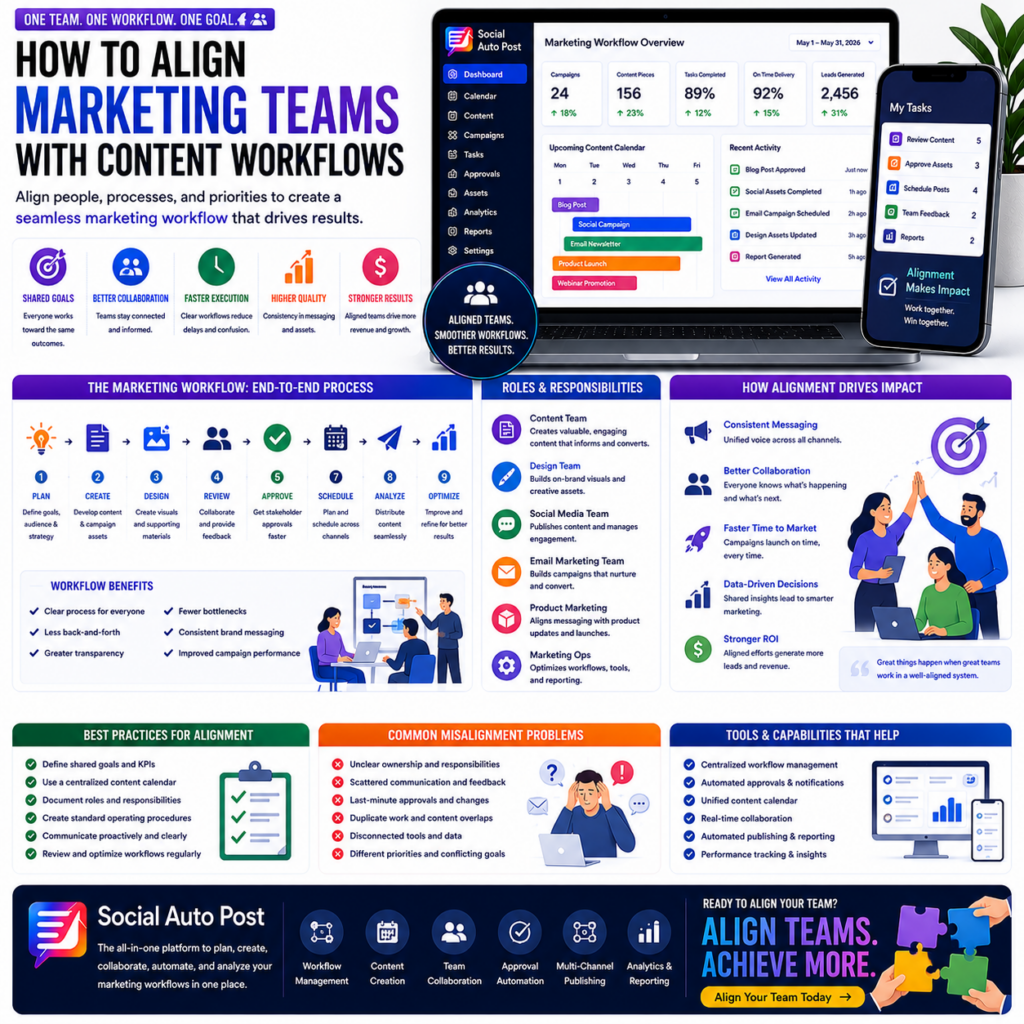
Introduction: Why a Marketing Workflow Is Essential for Team Alignment
A marketing workflow is the foundation of successful campaign execution and team collaboration. As marketing organizations grow, different departments often begin operating independently. Content teams create blog posts, social media managers schedule content, designers build creative assets, email marketers launch campaigns, and leadership sets strategic goals.
Although everyone is busy, they are not always aligned.
As a result, organizations often experience duplicate work, inconsistent messaging, missed deadlines, conflicting priorities, and slower campaign execution.
The highest-performing companies solve these challenges with a structured marketing workflow that aligns people, processes, and objectives across the organization.
After all, sustainable growth happens when teams work together toward shared goals rather than operating in silos.
Why a Marketing Workflow Matters More Than Ever
Modern marketing has become increasingly complex.
Today, a single campaign may involve:
- Blog content
- Social media campaigns
- Email marketing
- Design assets
- Landing pages
- Product messaging
- Analytics reporting
Without a marketing workflow, every handoff introduces friction.
Consequently, projects slow down and communication gaps begin to appear.
A well-designed marketing workflow improves:
- Efficiency
- Consistency
- Collaboration
- Accountability
- Campaign performance
Therefore, workflow alignment has become a competitive advantage for growing businesses.
The Hidden Costs of a Poor Marketing Workflow
Misalignment often creates operational waste that goes unnoticed.
For example:
Duplicate Content Creation
Sometimes multiple teams create similar assets without realizing it.
As a result, valuable time and resources are wasted.
Delayed Approvals
In many organizations, stakeholders review content at the last minute.
Consequently, deadlines are missed and campaigns launch late.
Inconsistent Messaging
When teams work independently, different channels often communicate different narratives.
Therefore, brand consistency suffers.
Missed Growth Opportunities
Departments frequently fail to support one another’s initiatives because they lack visibility into ongoing projects.
Over time, these inefficiencies compound and limit marketing performance.
Establish Shared Goals Within Your Marketing Workflow
Alignment begins with a shared destination.
Every team should clearly understand:
- Company objectives
- Revenue goals
- Growth priorities
- Campaign objectives
- Key performance indicators
Instead of asking:
“What is my team working on?”
Organizations should ask:
“What are we trying to achieve together?”
This shift encourages collaboration and improves strategic alignment.
Create a Unified Marketing Workflow Calendar
Visibility is one of the simplest ways to improve alignment.
A centralized calendar should include:
- Blog publication schedules
- Social media campaigns
- Product launches
- Email sends
- Events
- Promotions
- Webinars
As a result, teams can coordinate activities more effectively and avoid surprises.
A shared calendar becomes the operational heartbeat of the marketing department.
Define Roles and Responsibilities in the Marketing Workflow
Many workflow issues originate from unclear ownership.
Therefore, every activity should have a designated owner.
Content Team
Responsible for:
- Blogs
- Guides
- Educational resources
Design Team
Responsible for:
- Creative assets
- Visual branding
- Campaign graphics
Social Media Team
Responsible for:
- Publishing
- Community engagement
- Social campaigns
Email Marketing Team
Responsible for:
- Nurture campaigns
- Newsletters
- Email automation
Product Marketing Team
Responsible for:
- Positioning
- Messaging
- Product launches
Clearly defined ownership reduces confusion and improves accountability.
Standardize Campaign Planning Across the Marketing Workflow
Consistency becomes much easier when every campaign follows a standard process.
A typical workflow may include:
- Campaign brief creation
- Goal definition
- Asset planning
- Team assignment
- Timeline development
- Content production
- Review process
- Approval stage
- Distribution
- Performance analysis
Because every campaign follows the same framework, execution becomes more predictable and efficient.
Build Your Marketing Workflow Around Content Pillars
Content pillars provide strategic structure.
Most organizations benefit from pillars such as:
Educational Content
Teach industry concepts and solve audience problems.
Industry Insights
Share trends, research, and expert opinions.
Customer Stories
Build credibility through real-world success stories.
Product Content
Promote features, use cases, and benefits.
Brand Content
Communicate company values and culture.
As a result, messaging remains consistent across all marketing channels.
Improve Marketing Workflow Efficiency Through Better Handoffs
Many workflow breakdowns occur during transitions between teams.
For example:
Writer → Designer
Designer → Reviewer
Reviewer → Publisher
Publisher → Analyst
To improve handoffs, every stage should include:
- Expectations
- Deadlines
- Deliverables
- Ownership
Consequently, projects move faster and bottlenecks become easier to identify.
Centralize Communication Within the Marketing Workflow
Scattered communication often creates confusion.
Avoid relying on:
- Long email chains
- Untracked messages
- Multiple spreadsheets
- Isolated feedback systems
Instead, centralize:
- Comments
- Approvals
- Assets
- Deadlines
- Workflow status
This creates a single source of truth and improves visibility across teams.
Build an Approval Process Into Your Marketing Workflow
Approval bottlenecks can significantly slow execution.
A simple workflow should follow this structure:
Draft
↓
Review
↓
Approval
↓
Scheduling
↓
Publishing
↓
Analysis
Additionally, every stakeholder should understand:
- When they review content
- What they are reviewing
- Expected response times
Therefore, approvals become faster and more predictable.
Automate Repetitive Marketing Workflow Tasks
Automation helps teams stay aligned without requiring constant meetings.
Businesses can automate:
- Approval requests
- Status updates
- Notifications
- Publishing schedules
- Reporting summaries
As a result, administrative work decreases and productivity improves.
Teams spend more time executing campaigns and less time coordinating logistics.
Align Metrics Across the Marketing Workflow
One of the most common mistakes is measuring each team independently.
For example:
Social Team → Followers
Content Team → Traffic
Email Team → Open Rates
Although these metrics are useful, they can create siloed thinking.
Instead, organizations should focus on shared performance indicators such as:
- Leads generated
- Opportunities created
- Revenue influenced
- Campaign ROI
- Customer acquisition
Shared metrics create shared accountability.
Review and Optimize the Marketing Workflow Regularly
Alignment is not a one-time project.
Successful organizations continuously review their workflow.
Ask questions such as:
- Where are bottlenecks occurring?
- Which approvals take too long?
- Which handoffs fail most often?
- What causes delays?
- Which tasks should be automated?
Consequently, teams can identify improvement opportunities and maintain operational efficiency.
Develop a Marketing Operations Mindset
The most effective organizations think beyond content production.
Instead, they focus on marketing operations.
Rather than asking:
“What content should we create next?”
They ask:
“How can we build a system that consistently produces results?”
This mindset shift transforms marketing from a collection of tasks into a scalable growth engine.
Example of an Effective Marketing Workflow
A high-performing marketing workflow often looks like this:
- Campaign planned
- Goals aligned
- Brief created
- Assets produced
- Design completed
- Review process triggered
- Approval completed
- Multi-channel distribution executed
- Performance tracked
- Results shared
Because every team participates in the same system, collaboration becomes significantly easier.
Common Marketing Workflow Mistakes to Avoid
Avoid these common issues:
- No shared goals
- Unclear ownership
- Scattered communication
- Last-minute approvals
- Disconnected calendars
- Siloed reporting
- Poor workflow visibility
Each of these challenges creates unnecessary friction and slows growth.
What High-Performing Marketing Teams Do Differently
Leading organizations consistently:
- Align around business objectives
- Use shared workflows
- Centralize communication
- Automate repetitive tasks
- Standardize processes
- Share accountability
- Continuously optimize operations
As a result, they operate as a unified system rather than separate departments.
Final Thoughts
Marketing success depends on more than creativity.
It also depends on coordination.
The companies achieving the fastest growth are not necessarily creating more content. Instead, they are building stronger systems that help teams collaborate effectively.
A well-designed marketing workflow helps organizations:
- Move faster
- Improve collaboration
- Reduce operational friction
- Deliver better results
- Scale efficiently
Ultimately, great marketing happens when great teams work together through a structured and repeatable process.
Align Your Teams
Stop managing campaigns through disconnected tools and fragmented communication.
👉 Align your teams and build a smarter marketing workflow today.