
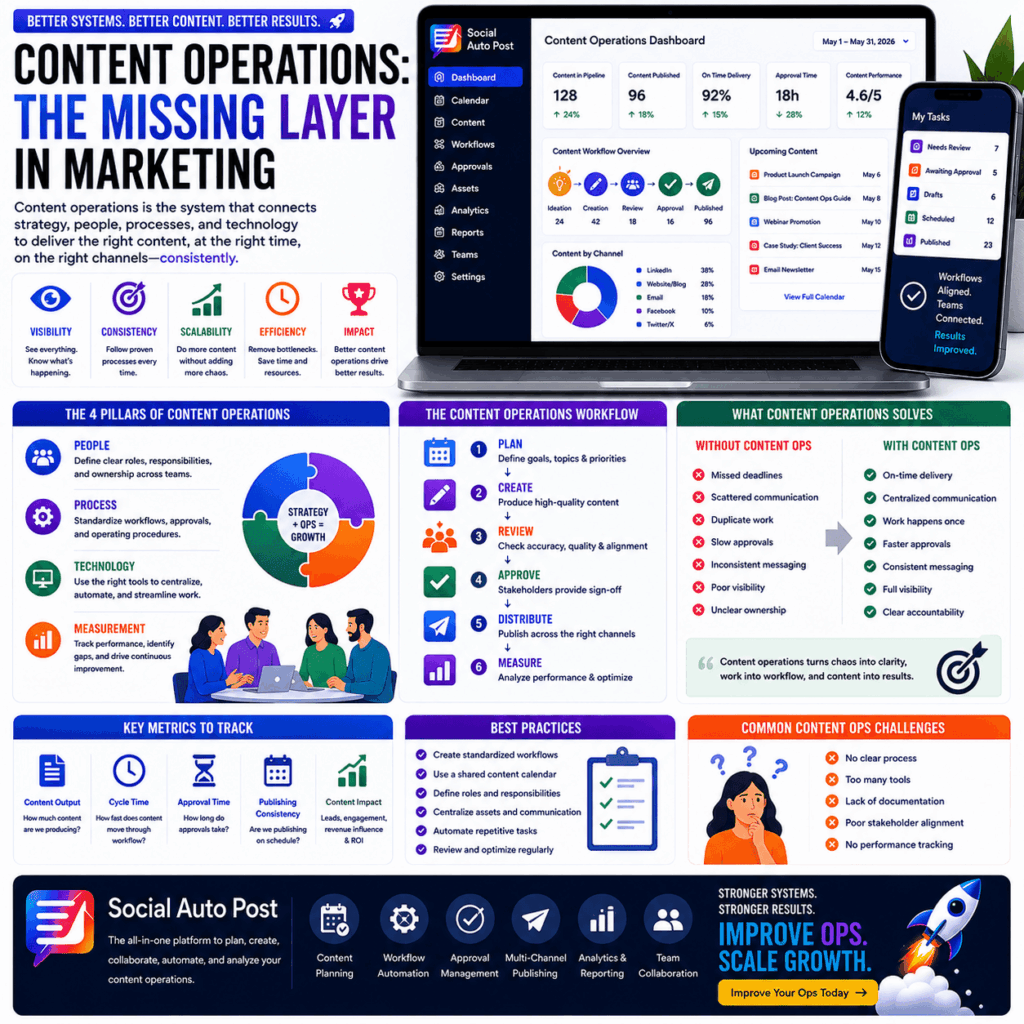
Content Operations: The Missing Layer Behind Scalable Marketing
Introduction: Why Great Content Still Fails
Content operations has become one of the most important disciplines in modern marketing. While many organizations invest heavily in writers, designers, marketers, and technology, they often overlook the systems required to keep everything working together efficiently.
As a result, campaigns launch late, approvals become bottlenecks, content gets lost, and teams unknowingly duplicate work.
The problem is rarely a lack of creativity.
More often, the challenge lies in how work moves through the organization.
This is where a structured operational framework becomes essential. By connecting strategy, people, processes, and technology, businesses can ensure that content moves smoothly from idea to measurable business impact.
Without that foundation, even exceptional content can struggle to deliver consistent results.
Why Content Operations Matters More Than Ever
Marketing has evolved significantly over the past decade.
Today, a single campaign may involve:
- Blog articles
- Social media content
- Email marketing
- Landing pages
- Video assets
- Paid advertising
- Performance reporting
Consequently, complexity increases with every additional channel.
Without a defined system, teams often experience delays, confusion, and inefficiencies.
A strong operational framework provides:
- Visibility
- Consistency
- Scalability
- Accountability
- Efficiency
Therefore, operational excellence has become a major competitive advantage for growing marketing teams.
Content Strategy vs Content Operations
Many organizations mistakenly treat strategy and operations as the same discipline.
However, they serve different purposes.
Content Strategy Focuses On
- Audience needs
- Messaging
- Positioning
- Topics
- Business goals
Content Operations Focuses On
- Workflow management
- Production processes
- Reviews and approvals
- Collaboration
- Distribution
- Performance tracking
Simply put, strategy determines what should be created, while operations determine how it gets delivered efficiently.
Both are necessary for long-term success.
The Four Pillars of an Effective Content Operations Framework
Successful teams typically build their marketing systems around four core pillars.
1. People
Content creation requires collaboration across multiple stakeholders.
These often include:
- Writers
- Editors
- Designers
- Social media managers
- Product marketers
- Leadership teams
Clearly defining ownership and responsibilities reduces confusion and improves accountability.
2. Process
Repeatable processes create consistency.
Examples include:
- Content planning
- Editorial workflows
- Approval procedures
- Publishing standards
- Reporting cycles
As a result, bottlenecks become easier to identify and eliminate.
3. Technology
Technology supports execution.
Modern platforms help teams manage:
- Editorial calendars
- Asset libraries
- Workflow approvals
- Publishing schedules
- Analytics dashboards
Most importantly, technology should simplify work rather than create additional complexity.
4. Measurement
Every workflow should be measurable.
Track:
- Production speed
- Approval timelines
- Publishing consistency
- Campaign effectiveness
- ROI
What gets measured can be improved.
Signs Your Team Needs Better Content Operations
Many organizations struggle with operational challenges without realizing the root cause.
Common warning signs include:
- Missed deadlines
- Last-minute approvals
- Scattered content assets
- Duplicate work
- Inconsistent publishing
- Limited visibility
- Slow campaign execution
Although these symptoms appear different, they usually point to the same issue: weak workflow management.
How Better Operations Improve Efficiency
One of the biggest benefits of a structured system is efficiency.
Without clear processes:
- Every project feels different.
- Coordination requires constant effort.
- Teams spend too much time managing work.
By contrast, standardized workflows create predictability.
Consequently, teams spend less time organizing tasks and more time creating value.
This allows marketing departments to increase output without dramatically increasing resources.
Scaling Content Without Increasing Complexity
Many businesses attempt to scale by hiring additional staff.
However, larger teams often introduce:
- More communication requirements
- More meetings
- More handoffs
- More operational complexity
Instead, a well-designed content production system creates scalability through process improvement.
As a result, organizations can handle higher content volumes while maintaining quality and efficiency.
A Typical Content Workflow
Most successful marketing organizations follow a structured workflow.
Step 1: Planning
Define goals, topics, and priorities.
Step 2: Creation
Develop content assets.
Step 3: Review
Evaluate quality, accuracy, and messaging.
Step 4: Approval
Obtain stakeholder sign-off.
Step 5: Distribution
Publish content across relevant channels.
Step 6: Measurement
Analyze performance and identify opportunities for improvement.
Because every asset follows the same process, execution becomes significantly more predictable.
Improving Collaboration Through Content Operations
Marketing teams frequently operate in silos.
For example, content creators may work separately from:
- Designers
- Social media managers
- Email marketers
- Product marketing teams
This often creates communication gaps.
A structured workflow framework helps align everyone around:
- Priorities
- Deadlines
- Responsibilities
- Project status
Therefore, collaboration improves while friction decreases.
The Growing Role of Automation
Automation is becoming a critical component of modern marketing operations.
Today, organizations automate tasks such as:
- Approval requests
- Status notifications
- Publishing schedules
- Reporting updates
- Workflow reminders
As a result, teams reduce administrative overhead and maintain greater consistency.
Importantly, automation is not about replacing people.
Instead, it removes repetitive work so professionals can focus on strategy and creativity.
Content Marketing vs Content Operations
Content marketing focuses on attracting, educating, and converting audiences.
Meanwhile, content operations focuses on building the systems that support those efforts.
A simple way to think about it:
Content marketing is the engine.
Operations is the infrastructure that keeps the engine running efficiently.
Without strong infrastructure, growth becomes increasingly difficult to sustain.
Metrics Every Team Should Monitor
Strong operational teams track performance across multiple areas.
Production Metrics
- Content output
- Asset completion rates
Workflow Metrics
- Approval time
- Review cycles
- Bottleneck frequency
Distribution Metrics
- Publishing consistency
- Channel engagement
Business Metrics
- Leads generated
- Pipeline influence
- Revenue contribution
- Marketing ROI
These metrics provide visibility into both operational performance and business outcomes.
What High-Performing Marketing Teams Do Differently
Leading organizations consistently:
- Build repeatable workflows
- Centralize communication
- Define ownership clearly
- Automate repetitive tasks
- Measure performance
- Optimize continuously
Rather than relying on individual effort alone, they invest in systems that support long-term growth.
The Future of Marketing Is Operational
As content volumes continue to increase, workflow efficiency will become even more important.
The companies that succeed will not necessarily have:
- Larger budgets
- Bigger teams
- More content
Instead, they will have:
- Better processes
- Better coordination
- Better systems
Operational excellence is quickly becoming a key differentiator in modern marketing.
Final Thoughts
Creating great content is important.
However, execution is equally critical.
Without strong processes, collaboration, and visibility, even the best ideas can struggle to deliver results.
Content operations provides the structure that transforms marketing from a collection of disconnected activities into a scalable growth engine.
When strategy, people, technology, workflows, and measurement work together, marketing becomes more efficient, predictable, and impactful.
That is why operational excellence is becoming one of the most valuable assets for modern marketing teams.
Improve Your Operations
Stop allowing workflow bottlenecks and disconnected processes to limit growth.