
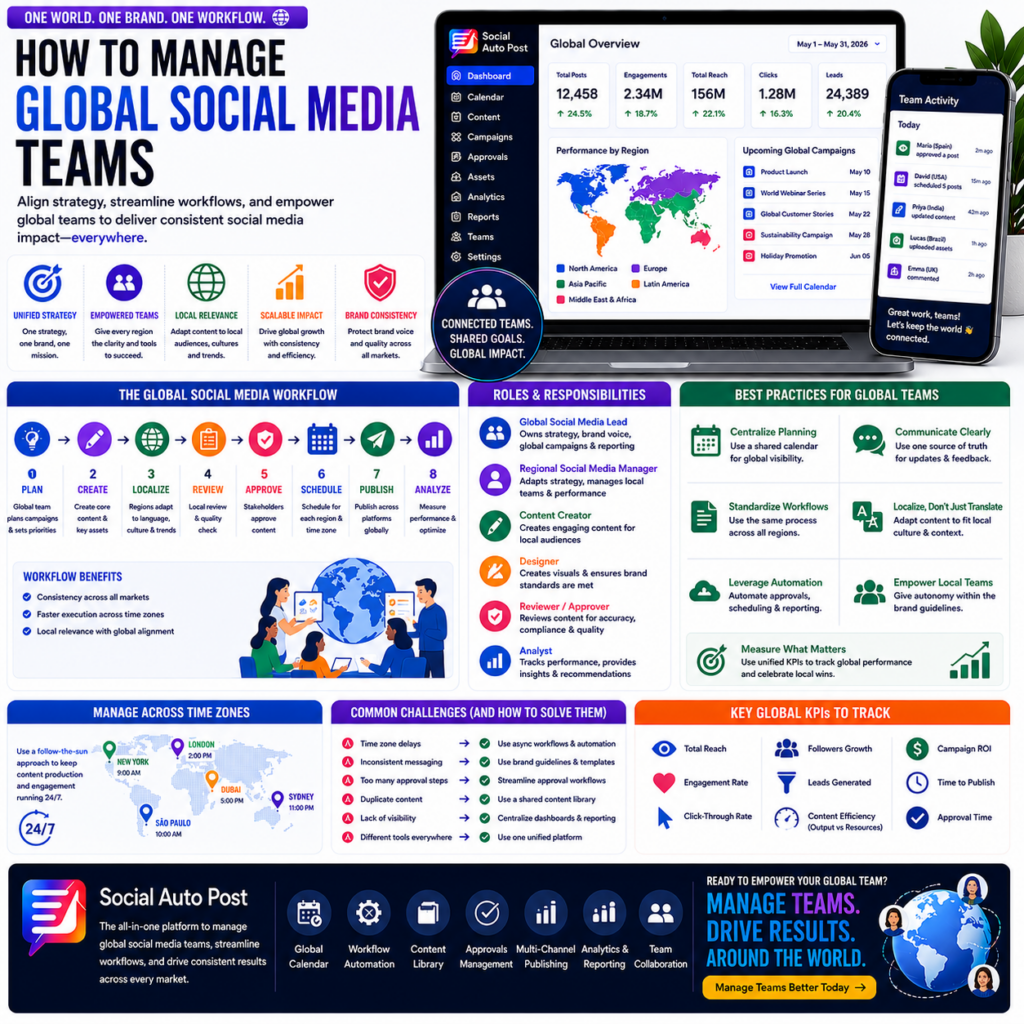
Global Social Media Teams: Manage Better
Introduction: Managing Global Social Media Teams Across Markets
Managing global social media teams has become an important part of modern marketing. As companies expand, their social media activities often grow across different countries, languages, and customer groups.
This growth creates many opportunities. However, it also brings new challenges. Teams must manage different time zones, approval processes, local trends, and communication styles while keeping the brand message consistent.
Today, many businesses have social media teams working across:
- North America
- Europe
- Asia-Pacific
- Latin America
- Middle East and Africa
Because these teams work in different regions, they need simple systems that keep everyone connected.
A clear process helps teams create content faster, share ideas easily, and maintain a consistent brand identity. Therefore, successful companies focus on teamwork, planning, and easy-to-follow workflows.
Why Global Social Media Teams Need Better Systems
Local social media teams usually focus on one market and one audience. On the other hand, global social media teams manage multiple regions, languages, and customer expectations.
They often work with:
- Multiple markets
- Different languages
- Regional campaigns
- Various customer groups
For example, a post that performs well in one country may not create the same results in another market.
Therefore, companies need a balanced strategy. The main brand message should remain consistent, while local teams should adapt content to match their audience.
Common Challenges for Global Social Media Teams
Managing Different Time Zones
Different working hours can slow down projects and communication.
For example, a team member in North America may send a request when another team in Asia has already finished work for the day.
As a result, approvals may take longer than expected.
To solve this issue, companies should create clear handoff processes between regions. This allows work to continue smoothly throughout the day.
Keeping a Consistent Brand Voice
Another common challenge is maintaining the same brand style across different markets.
Without clear guidelines, teams may create content with different tones and messages.
Therefore, companies should provide:
- Brand guidelines
- Writing examples
- Design rules
- Content templates
These resources help every team create content that feels connected and professional.
Avoiding Duplicate Content
Sometimes, regional teams create similar posts without knowing about each other’s plans.
Consequently, time and resources are wasted.
A shared content calendar helps prevent this issue. It allows everyone to view upcoming campaigns, planned posts, and important dates.
Internal Link: Add link to your content calendar management page.
Improving Communication Between Teams
Information can become separated when teams work in different locations.
However, shared communication tools make collaboration easier.
Teams can use these platforms to:
- Share updates
- Review content
- Give feedback
- Track progress
As a result, employees stay connected even when they are thousands of miles apart.
Creating a Better Global Social Media Team Strategy
Step 1: Build a Clear Content Plan
Every successful social media team starts with a clear plan.
The plan should include:
- Brand goals
- Main messages
- Content topics
- Campaign goals
- Target audiences
Additionally, a strong plan helps every market follow the same direction.
For more marketing guidance, visit HubSpot Marketing Blog.
Step 2: Create Content Categories
Content categories help teams stay organized and plan more effectively.
Common examples include:
Educational Content
This includes helpful guides, industry tips, and useful information that helps customers.
Product Content
These posts include updates, announcements, and feature highlights.
Customer Content
Reviews, customer stories, and experiences help build trust.
Brand Content
Company news, culture, and values help audiences understand the brand.
Industry Content
Trends, opinions, and expert advice help position the company as a leader.
As a result, content categories make planning easier across different regions.
Step 3: Use a Shared Content Calendar
A shared calendar helps global social media teams stay aligned.
It should include:
- Product launches
- Events
- Campaign dates
- Seasonal posts
- Regional activities
Moreover, a shared calendar reduces confusion and prevents teams from creating duplicate content.
Internal Link: Add link to social media content calendar page.
Step 4: Define Team Roles Clearly
Clear roles help everyone understand their responsibilities.
The main marketing team can manage:
- Brand direction
- Global campaigns
- Main content assets
- Performance reports
Meanwhile, regional teams can manage:
- Local trends
- Community responses
- Language updates
- Market changes
This approach creates teamwork while allowing local teams to bring creativity and market knowledge.
Step 5: Improve Content Localization
Content should feel natural for each audience.
Localization includes:
- Language changes
- Cultural updates
- Local examples
- Market preferences
However, direct translation is often not enough.
Instead, teams should adapt content so customers can easily understand and connect with the message.
Step 6: Create a Simple Approval Process
Large teams need clear approval steps to avoid delays.
A simple process can include:
Content Creation
↓
Regional Review
↓
Final Approval
↓
Publishing
This approach keeps quality high while helping teams publish content faster.
Internal Link: Add link to social media approval workflow page.
Step 7: Use Collaboration Tools
Strong teamwork requires reliable communication tools.
Companies should avoid:
❌ Long email chains
❌ Separate documents
❌ Missing feedback
Instead, teams should use shared platforms where they can:
- Review content
- Share updates
- Track tasks
- Discuss changes
Furthermore, one shared workspace gives everyone better visibility.
Internal Link: Add link to marketing collaboration tools page.
Step 8: Create the Same Workflow Everywhere
A simple workflow makes daily tasks easier.
A common process includes:
- Planning
- Writing
- Review
- Approval
- Scheduling
- Publishing
- Reporting
Because teams follow the same steps, projects move faster and mistakes are reduced.
Step 9: Automate Repeated Tasks
Automation helps teams save time and reduce manual work.
Teams can automate:
- Approval alerts
- Publishing schedules
- Reports
- Reminders
As a result, marketers can spend more time creating valuable content and improving campaigns.
Internal Link: Add link to social media automation tools page.
Step 10: Build a Shared Content Library
A content library gives teams quick access to approved materials.
Store:
- Images
- Templates
- Brand files
- Campaign assets
- Product information
Therefore, teams can reuse successful materials instead of creating everything from the beginning.
Step 11: Track Results Across Markets
All regions should measure success using similar goals.
Important metrics include:
- Awareness
- Reach
- Impressions
- Engagement
- Comments
- Shares
- Clicks
- Growth
- Leads
- Signups
- Customer actions
- Business results
- Revenue impact
- Return on investment
Consistent reporting makes it easier to understand what works across different markets.
For analytics resources, visit Google Analytics Academy.
Step 12: Use a Follow-the-Sun Workflow
Global teams can continue working throughout the day by using regional handoffs.
For example:
North America creates content.
↓
Europe reviews content.
↓
Asia-Pacific publishes content.
Because of this approach, campaigns can move forward without long delays.
Mistakes Global Social Media Teams Should Avoid
Many companies struggle because they:
❌ Do not create a clear strategy
❌ Use different processes across regions
❌ Ignore local audiences
❌ Store information in separate places
❌ Measure results differently
However, these challenges can be solved with better planning, communication, and teamwork.
What Successful Teams Do Differently
Strong global marketing teams:
✅ Share one clear strategy
✅ Adapt content locally
✅ Use simple workflows
✅ Automate repeated tasks
✅ Track performance regularly
✅ Communicate consistently
Ultimately, connected teams create stronger marketing results.
The Future of Global Social Media Management
Remote work and international marketing will continue to grow.
Therefore, companies will need better systems for:
- Planning
- Collaboration
- Automation
- Reporting
In addition, businesses with strong social media processes will react faster and compete more effectively.
For platform resources, visit Meta Business Resources.
Final Thoughts
Managing global social media teams requires planning, teamwork, and flexibility.
Companies do not need to control every local decision. Instead, they need clear systems that help every region succeed.
When teams share goals and work together, businesses can achieve:
- Faster campaigns
- Better teamwork
- Stronger branding
- Long-term growth
A connected social media team can become a powerful advantage for any global company.
Manage Teams
Stop dealing with scattered workflows, slow approvals, and disconnected teams.