
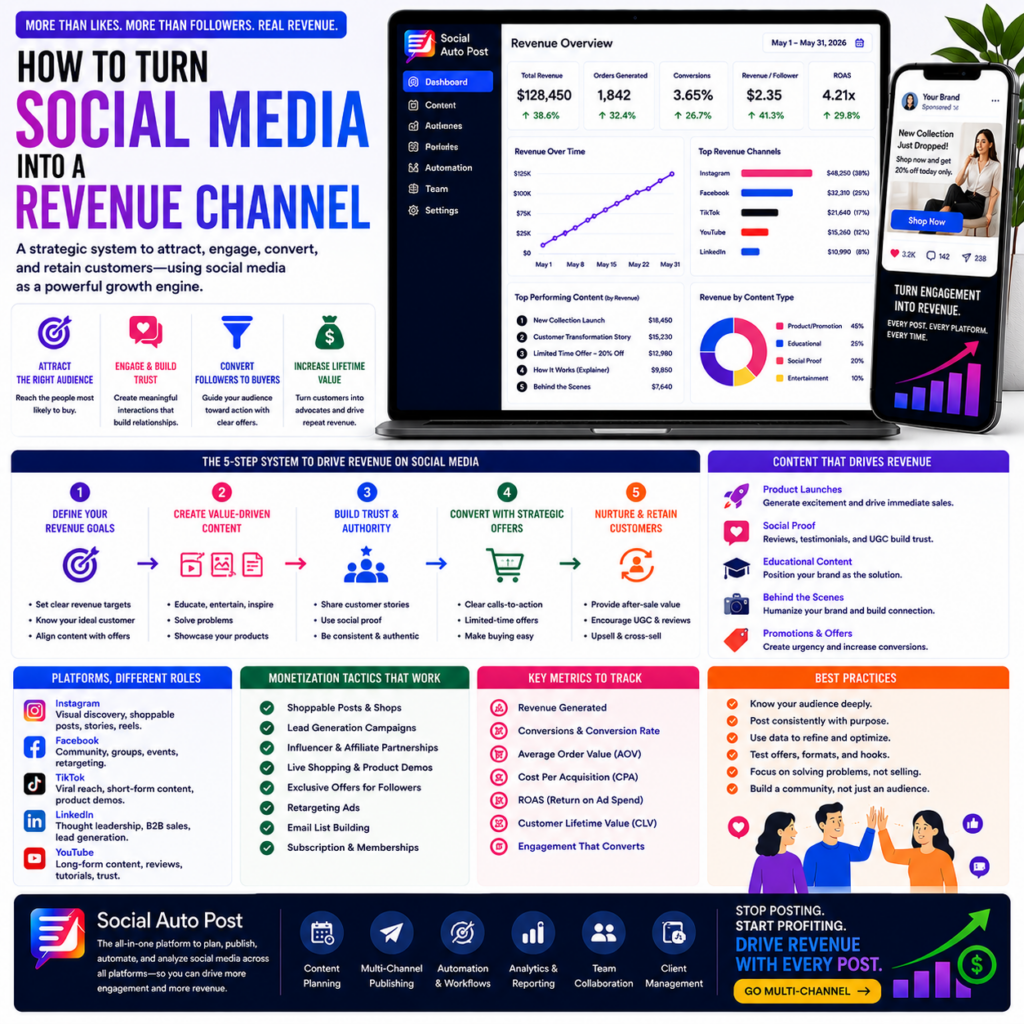
Social Media Revenue Strategy: How to Turn Social Media Into a Revenue Channel
A strong social media revenue strategy helps businesses generate more than likes and followers—it turns social platforms into measurable revenue channels. Today, successful companies use social media to attract qualified leads, nurture prospects, increase sales, and build lasting customer relationships. By focusing on business outcomes instead of vanity metrics, you can transform your marketing efforts into a predictable source of growth.
Many businesses still view social media as a branding tool. While engagement metrics such as likes, shares, comments, and reach are valuable, they do not always translate into revenue. Therefore, the most successful brands ask a different question: How much revenue did our social media generate?
That simple shift in mindset changes how content is created, measured, and optimized.
Why Your Social Media Revenue Strategy Matters
Publishing content without a clear business objective often leads to activity without results.
Common mistakes include:
- Posting without a goal
- Creating content that doesn’t solve customer problems
- Forgetting a call-to-action (CTA)
- Tracking only vanity metrics
- Ignoring lead nurturing
Instead, every post should support a measurable business objective.
Set Goals for Your Social Media Revenue Strategy
Before creating content, define your primary business goals.
For example:
- Generate qualified leads
- Increase product sales
- Book more demos
- Grow your email list
- Improve customer retention
- Reduce customer acquisition costs
Once your goals are clear, every piece of content becomes more focused and effective.
Understand the Customer Journey
Customers rarely buy after seeing a single social media post.
Instead, they typically move through several stages:
Awareness
They discover your business.
Consideration
They research possible solutions.
Decision
They compare providers and evaluate trust.
Purchase
They become paying customers.
Retention
Satisfied customers return and recommend your business.
As a result, your content should support every stage of this journey.
Build Trust Before Selling
Trust is one of the biggest drivers of online sales.
High-performing content includes:
- Educational articles
- Industry insights
- Customer success stories
- Behind-the-scenes content
- Product demonstrations
Because people buy from brands they trust, educational content often outperforms constant sales promotions.
Create a Balanced Content Strategy
Avoid making every post promotional.
Instead, follow a simple content mix:
- 50% Educational content
- 20% Thought leadership
- 15% Customer success stories
- 15% Promotional content
This balanced approach builds relationships while naturally guiding prospects toward a purchase.
Build Clear Conversion Paths
Every post should encourage readers to take the next step.
Examples include:
- Read a blog article
- Download a guide
- Register for a webinar
- Request a product demo
- Start a free trial
- Visit your online store
- Contact your sales team
Clear calls-to-action improve conversion rates because they reduce uncertainty.
Expand Your Social Media Revenue Strategy Across Multiple Channels
Today’s buyers interact with businesses through several channels before making a purchase.
For example, a customer may:
- Discover your brand on LinkedIn
- Read a blog through Google Search
- Subscribe to your newsletter
- See a Facebook post
- Return through email
- Complete a purchase
Each interaction builds trust and increases the likelihood of conversion.
Repurpose Content to Increase ROI
One successful piece of content can support several marketing channels.
For example, a blog article can become:
- LinkedIn post
- Facebook update
- Instagram carousel
- X (Twitter) thread
- Email newsletter
- YouTube Short
- Downloadable guide
Consequently, repurposing content increases your return on investment while reducing production time.
Automate Your Social Media Revenue Strategy
Manual marketing becomes difficult as businesses grow.
Automation allows you to:
- Schedule content
- Publish across multiple platforms
- Nurture leads automatically
- Recycle evergreen posts
- Trigger follow-up emails
- Generate marketing reports
Therefore, automation creates consistency without adding extra work.
Measure Revenue Instead of Vanity Metrics
Likes and followers are useful indicators, but they do not always measure business success.
Instead, monitor metrics such as:
Traffic
- Website visitors from social media
Leads
- Qualified prospects generated
Conversions
- Visitors who become customers
Customer Acquisition Cost (CAC)
- Marketing cost per customer
Customer Lifetime Value (CLV)
- Revenue generated by each customer
Return on Investment (ROI)
- Revenue generated from marketing activities
These metrics provide a much clearer picture of campaign performance.
Align Marketing and Sales
Marketing and sales should work together toward the same revenue goals.
Marketing generates qualified leads.
Sales teams provide valuable feedback on:
- Lead quality
- Customer objections
- Buying behavior
- Frequently asked questions
As a result, future campaigns become even more effective.
Improve Your Social Media Revenue Strategy With Data
Every campaign produces valuable insights.
Regularly review:
- Highest-performing posts
- Best-converting campaigns
- Top-performing platforms
- Customer acquisition sources
- Revenue generated by campaign
Then optimize your strategy based on real business data rather than assumptions.
Build a Repeatable Revenue Engine
The most successful businesses do not rely on occasional viral content.
Instead, they create repeatable systems.
A scalable workflow looks like this:
- Identify customer problems.
- Create valuable content.
- Publish across multiple channels.
- Drive traffic to your website.
- Capture leads.
- Nurture prospects.
- Convert customers.
- Measure performance.
- Improve the process.
- Repeat consistently.
Over time, this system creates predictable business growth.
Common Mistakes to Avoid
Avoid these common mistakes:
- Chasing followers instead of customers
- Publishing without conversion goals
- Ignoring lead nurturing
- Measuring only engagement
- Posting inconsistently
- Selling without building trust
- Failing to automate repetitive tasks
By avoiding these pitfalls, your marketing efforts become much more effective.
The Future of Social Media Revenue Strategy
Social media is becoming increasingly connected with:
- Email marketing
- Search engine optimization (SEO)
- CRM platforms
- Marketing automation
- Sales pipelines
Rather than operating independently, these systems work together to create a complete revenue engine.
Businesses that integrate their marketing channels will have a significant competitive advantage.
Final Thoughts
Social media should no longer be viewed as simply a branding channel.
With the right social media revenue strategy, businesses can generate qualified leads, increase sales, strengthen customer relationships, and create sustainable long-term growth.
Companies that focus on business outcomes instead of vanity metrics will be better positioned for success in today’s competitive digital landscape.
Drive Revenue With Social Auto Post
Ready to transform your social media into a revenue-generating engine?
Start growing your business with smarter social media automation today.