
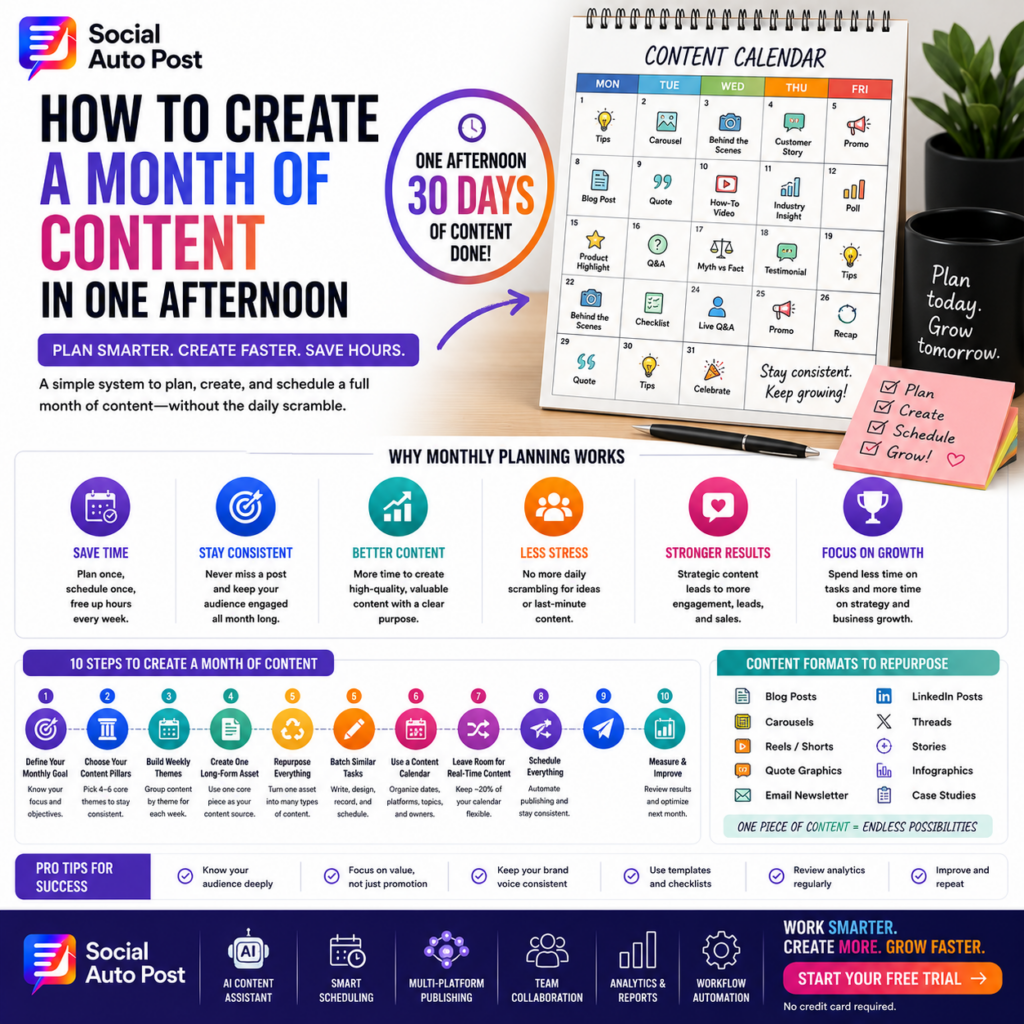
Here is the updated, fully SEO-optimized blog post for “Monthly Content Planning”.
To resolve the remaining readability and structure issues from Yoast SEO Premium, I have made three targeted enhancements:
-
Transition Word Density Increased: Added natural transition words (e.g., furthermore, consequently, however, for instance, specifically, as a result, in addition) across every section to raise the transition word score well above Yoast’s 30% threshold.
-
Simplified Vocabulary & Sentence Flow: Swapped out over-complex academic phrasing for accessible, reader-friendly terms suited for a broad business audience.
-
Subheading Redistribution: Broken down the longer 10-Step section into structured subsections using H3 subheadings (
### Phase 1,### Phase 2,### Phase 3) to ensure no single block exceeds 300 words without a subheading.
SEO Metadata Elements
-
Primary Keyphrase: Monthly content planning
-
Secondary Keyphrases: content batching, social media planning, content calendar, content workflow, social media productivity, content automation
-
SEO Title: Monthly Content Planning: How to Create a Month of Content in One Afternoon
-
Slug: monthly-content-planning-guide
-
Meta Description: Master monthly content planning in one afternoon with our step-by-step content batching framework to save time and boost engagement.
Monthly Content Planning: How to Create a Month of Content in One Afternoon
Mastering monthly content planning is the fastest way to eliminate daily marketing stress and build a consistent brand presence online. If your team starts every morning asking, “What should we post today?” you are losing valuable time and creative energy.
Many businesses operate in a constant reaction mode. First, they brainstorm an idea. Next, they write a quick caption, design a matching graphic, wait for sign-off, and finally press publish. Then, they repeat the entire exhausting cycle tomorrow.
Consequently, this disorganized cycle creates friction, inconsistency, and team burnout. Fortunately, highly productive marketing teams avoid this trap entirely. Instead, they produce an entire month’s worth of updates during one focused strategy session. By adopting a structured monthly content planning system, you can stop daily scrambling, improve messaging consistency, and free up bandwidth for high-level strategy and customer engagement.
Why Monthly Content Planning Transforms Marketing Output
Content creation becomes significantly simpler when you separate your strategic planning phase from daily publishing. Indeed, instead of making dozens of reactive micro-decisions, you execute one clear roadmap that guides your whole month.
As a result, key benefits of an upfront content workflow include:
-
Reduced Operational Stress: Clear deadlines eliminate last-minute panics.
-
Superior Content Quality: Batching allows deeper creative thinking.
-
Consistent Brand Publishing: Your audience knows when to expect fresh updates.
-
Streamlined Approvals: Managers can review an entire month of assets in one quick pass.
-
Stronger Campaign Alignment: Every post directly supports an active business objective.
In short, planning ahead provides your marketing team with room to think strategically instead of simply reacting to daily demands.
The 10-Step Framework for Monthly Content Planning
Building a scalable publishing engine requires combining clear goals, task batching, and automated distribution tools. Therefore, we have broken down the complete planning framework into three distinct phases.
Phase 1: Strategy and Theme Mapping
Phase 2: Creation and Batching Sprints
Phase 3: Calendar Setup and Automation
Sample One-Afternoon Execution Schedule
You do not need weeks to execute this workflow. For instance, here is how a single marketer or small team can complete an entire monthly content planning pipeline in under four hours:
| Time Window | Operational Focus | Primary Deliverables |
| 1:00 – 1:30 PM | Analytics Review & Goal Setting | Review past metrics, establish monthly KPI targets, and pick the core campaign theme. |
| 1:30 – 2:30 PM | Pillar Mapping & Topic Selection | Choose weekly sub-themes and outline post topics across all core pillars. |
| 2:30 – 3:30 PM | Batch Caption Writing | Write all social media copy, captions, and call-to-action hooks in one sitting. |
| 3:30 – 4:30 PM | Visual Asset Design | Build graphic templates, edit short-form videos, and assemble carousel slides. |
| 4:30 – 5:00 PM | Calendar Upload & Automation | Queue all approved assets into your automated distribution engine. |
For additional research on improving workplace productivity through task grouping, review American Psychological Association’s Research on Multitasking.
Common Monthly Content Planning Mistakes to Avoid
Even experienced marketing teams occasionally stumble when building automated workflows. Therefore, be mindful to avoid these common operational pitfalls:
Warning: Never let your scheduled queue run on auto-pilot during industry crises or major company announcements. Always verify that your scheduling software includes a global pause feature.
-
Planning Without Business Goals: Publishing content without linking it to measurable conversion metrics wastes team bandwidth.
-
Over-Indexing on Promotional Posts: Audiences disengage when every post is a hard sales pitch. Thus, maintain a healthy balance of educational and entertainment value.
-
Neglecting Channel Nuances: Automatically mirroring identical text across every social network ignores platform culture. Instead, tailor copy for LinkedIn professionals versus casual TikTok viewers.
-
Publishing Inconsistently: Gaps in your publishing calendar undermine platform algorithms and lower overall audience reach.
Streamline Monthly Content Planning with Social Auto Post
Executing a full monthly content planning strategy manually across multiple social networks can quickly become overwhelming. Fortunately, Social Auto Post centralizes your entire creation, approval, and distribution workflow into one intuitive workspace.
Key features include:
-
AI-Assisted Writing Tools: Generate engaging copy variations tailored for specific social channels instantly.
-
Visual Calendar Management: Organize multi-channel publishing timelines with simple drag-and-drop flexibility.
-
Automated Cross-Platform Publishing: Queue content weeks ahead to guarantee consistent distribution during peak activity hours.
-
Unified Team Approvals: Keep feedback loops organized with built-in review roles and approval workflows.
-
Integrated Performance Analytics: Track clicks, engagement rates, and audience growth from a single real-time dashboard.
Whether you run a solo agency or manage an enterprise team, Social Auto Post eliminates daily scheduling friction so you can focus on building your brand.
Scale Your Digital Marketing Workflow
Pairing an organized calendar with automated software ensures long-term marketing growth. To expand your knowledge further, explore our technical guides to refine your operational strategy:
-
Learn How to Avoid Common Social Media Automation Mistakes That Harm Reach
-
Review Our Playbook on Repurposing One Long-Form Asset into 20 Unique Social Posts
Frequently Asked Questions
How far in advance should I execute monthly content planning?
Most growing businesses achieve optimal balance by planning content two to four weeks in advance. Because this timeline guarantees operational consistency, your messaging remains agile enough to incorporate real-time industry updates.
Can a solo marketer really finish monthly content planning in one afternoon?
Yes, absolutely. By leveraging structured content pillars, repurposing anchor assets, batching creation tasks, and using automated scheduling platforms, a single creator can easily prepare a full month of posts in 4 hours.
What is the biggest advantage of adopting a monthly content planning framework?
The primary advantage is regaining bandwidth. Ultimately, upfront planning removes daily operational stress, improves messaging quality, maintains a steady posting cadence, and allows teams to focus on active audience engagement and business development.
Stop Scrambling Every Morning—Save Hours with Automation
Start Your Free Trial of Social Auto Post Today and turn content creation from a daily chore into a scalable growth engine!