
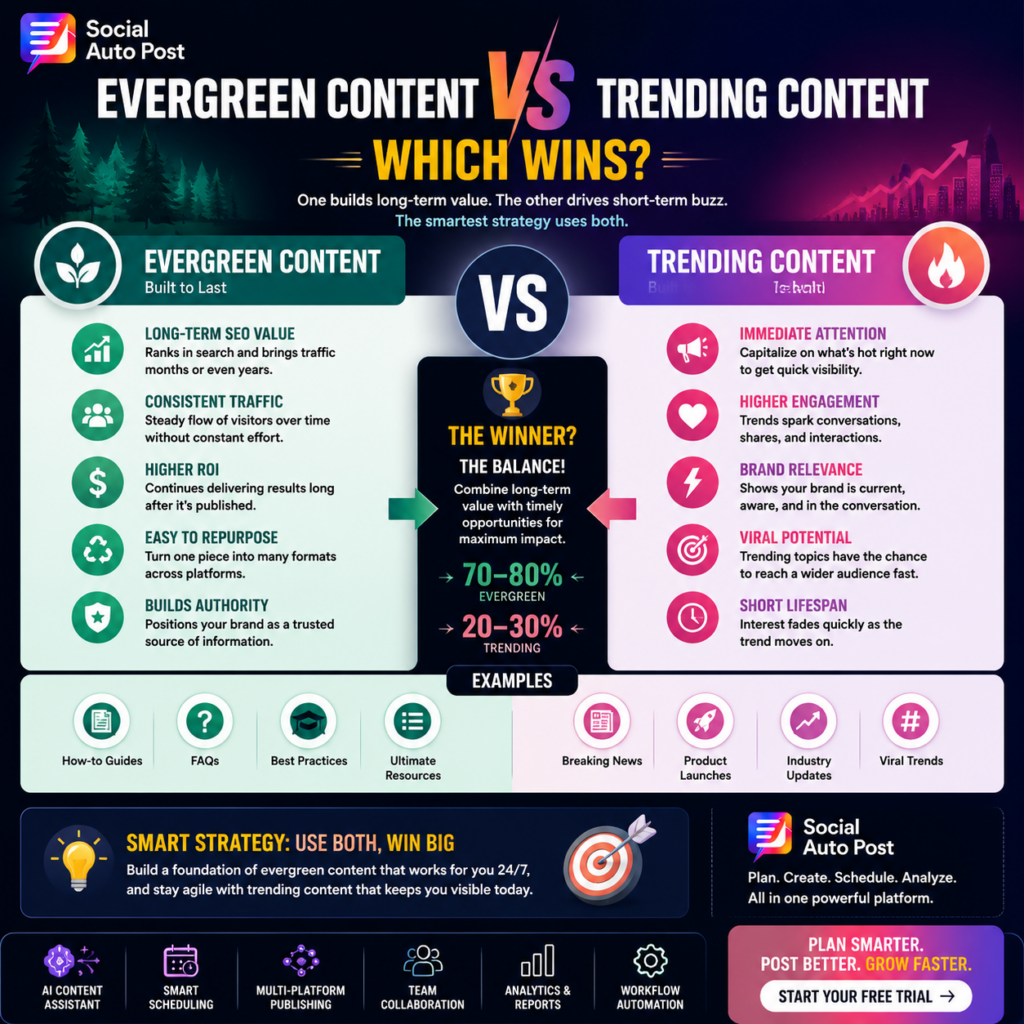
Evergreen Content Marketing vs Trending Content: Which Wins?
Every growth-focused team eventually faces the same fundamental strategic dilemma: should you invest heavily in an evergreen content marketing framework or chase the latest viral trends?
Trending content can generate thousands of immediate views overnight. However, a dedicated evergreen content marketing strategy builds digital assets that continue bringing organic visitors months—or even years—after publication.
The reality is that both approaches play a crucial role in a successful publishing engine. Consequently, the key to sustainable growth lies in knowing when to deploy each asset type and how to balance them effectively within your editorial pipeline.
Understanding Evergreen Content Marketing vs. Trending Content
To build an efficient digital media machine, you must first understand how these two formats differ in purpose, lifespan, and overall ROI.
What Is Evergreen Content?
Evergreen pieces stay useful, accurate, and relevant long after their initial publication date. Just like evergreen trees keep their leaves throughout every season, these foundational articles continue attracting readers year-round.
Common examples include:
-
In-depth beginner guides and tutorials
-
Frequently asked questions (FAQs)
-
Industry best practices and frameworks
-
Curated resource libraries and tools
A high-quality guide written today as part of your evergreen content marketing roadmap can rank on search engines for years to come.
What Is Trending Content?
Conversely, trending content focuses on time-sensitive topics that are currently generating massive public discussion.
Examples include:
-
Breaking industry news and policy updates
-
Product announcements and software releases
-
Viral social media challenges and memes
-
Seasonal events and holiday campaigns
While trending topics generate rapid traffic spikes, their visibility decays quickly once public interest shifts.
The Strategic Advantages of Evergreen Content Marketing
Executing a consistent evergreen content marketing strategy offers compounding returns that form the backbone of modern search engine optimization (SEO).
Compounding Organic Search Value
Search engines like Google reward helpful content that consistently satisfies user search intent over long periods. Furthermore, as quality evergreen articles age, they naturally accumulate:
-
High-authority backlinks
-
Predictable organic search traffic
-
Increased domain authority
-
Top keyword rankings
Superior Return on Investment (ROI)
Creating comprehensive, expert-led content requires a significant investment of time and resources. However, because evergreen pieces continue generating organic leads long after publication, they offer one of the highest marketing returns available.
In addition, timeless resources are vastly easier to repurpose across multiple channels. For example, a single long-form guide can easily be converted into LinkedIn slide decks, email newsletters, infographic summaries, and video scripts.
The Strategic Advantages of Trend-Driven Content
While timeless content creates stability, trend-driven publishing provides immediate velocity and keeps your brand relevant in real-time conversations.
Immediate Visibility and Social Engagement
Capitalizing on trending topics allows your brand to ride active search volumes. Because audiences are already discussing these topics, current updates perform exceptionally well across social channels like LinkedIn, X (Twitter), and Instagram.
Demonstrating Industry Authority
Regularly covering major industry developments proves that your organization remains at the cutting edge of your field. To learn more about measuring social engagement metrics effectively, read Social Media Examiner’s Guide to Social Analytics.
Evergreen Content Marketing vs. Trending Content Matrix
| Feature | Evergreen Content Marketing | Trending Content |
| Traffic Profile | Sustainable, compounding long-term growth | Rapid immediate spike followed by quick decay |
| Primary SEO Benefit | High backlink accumulation and domain authority | Short-term surge in search visibility |
| Lifetime ROI | Extremely high due to lasting utility | Moderate; relies on speed and timing |
| Best Channels | Organic Search (SEO), Resource Libraries | Social Media, Email Broadcasts, News Feeds |
| Lifespan | Years (with periodic updates) | Days to weeks |
How to Combine Both Strategies into One Ecosystem
Successful digital brands do not choose one format over the other. Instead, they integrate both into a balanced distribution engine.
       ┌─────────────────────────────────────────────────────────┐
       │             SUSTAINABLE CONTENT ECOSYSTEM               │
       └────────────────────────────┬────────────────────────────┘
                                    │
            ┌───────────────────────┴───────────────────────┐
            ▼                                               ▼
┌────────────────────────┐                     ┌────────────────────────┐
│   EVERGREEN FOUNDATION │                     │    TRENDING TIMELY     │
│       (70% - 80%)      │                     │       (20% - 30%)      │
│                        │                     │                        │
│  • How-To Guides       │                     │  • Breaking News       │
│  • Industry Pillars    │<────────────────────┤  • Platform Updates    │
│  • Resource Hubs       │   Internal Links    │  • Viral Commentary    │
└────────────────────────┘                     └────────────────────────┘
A recommended content allocation ratio is:
-
70–80% Evergreen Content: Builds durable search rankings and compounding traffic.
-
20–30% Trending Content: Captures real-time conversations and boosts immediate engagement.
Practical Synergy Example
Imagine you publish a foundational guide titled “The Complete Guide to Social Media Automation.” Months later, a major platform introduces a brand-new scheduling feature.
You can quickly publish a trend-focused article analyzing the new update. Then, by linking that news post directly back to your comprehensive guide, you pass fresh link equity to your core evergreen content marketing asset while capturing immediate news traffic.
Maintaining and Refreshing Your Evergreen Library
Evergreen does not mean “set and forget.” To maintain your organic rankings, you must keep your content library fresh.
For actionable advice on organizing your editorial queue, check out our guide on monthly content planning.
Common Content Strategy Pitfalls
Operational Warning: Avoid chasing every viral trend. Publishing commentary on topics outside your core niche dilutes your brand authority and confuses search engine crawlers.
-
Publishing Only Trends: Your web traffic drops to zero the moment you stop publishing.
-
Ignoring Trends Completely: Your brand appears out-of-touch with current industry developments.
-
Failing to Update Evergreen Assets: Search engines systematically demote outdated guides in favor of newer resources.
Simplify Your Content Workflow with Social Auto Post
Managing both real-time trends and structured evergreen content marketing queues requires efficient distribution infrastructure. Social Auto Post helps marketing teams organize, schedule, and analyze multi-channel campaigns from a single dashboard.
Key capabilities include:
-
AI-Assisted Drafting: Rapidly format news commentary or long-form promotional posts.
-
Visual Content Calendars: Maintain a healthy balance between scheduled evergreen assets and timely trend updates.
-
Automated Multi-Platform Publishing: Queue content weeks in advance to maintain consistent posting schedules.
-
Recycling Engine: Automatically re-queue top-performing evergreen assets to maximize reach without extra manual effort.
Scale Your Editorial Operations
Pairing a balanced content mix with automated publishing software turns content creation into a predictable growth engine. Learn more by exploring our operational playbooks:
-
Learn How to Avoid Common Social Media Automation Mistakes That Harm Reach
-
Review Our Playbook on Repurposing One Long-Form Asset into 20 Unique Social Posts
Frequently Asked Questions
What is evergreen content marketing?
Evergreen content marketing is an editorial strategy focused on creating timeless, highly valuable content that remains relevant for long periods, continually driving organic search traffic and qualified leads.
Is trending content beneficial for long-term SEO?
While trending content rarely ranks for long periods, it can generate quick authority-building backlinks, brand mentions, and social signals that indirectly boost your domain’s overall search standing.
What ratio of evergreen versus trending content should I publish?
Most successful brands maintain a ratio of 70–80% evergreen content to 20–30% trending content, balancing reliable search growth with real-time audience engagement.
Build a Smarter Content Strategy Today
Start Your Free Trial of Social Auto Post Today and build a content engine that drives results today and tomorrow!