
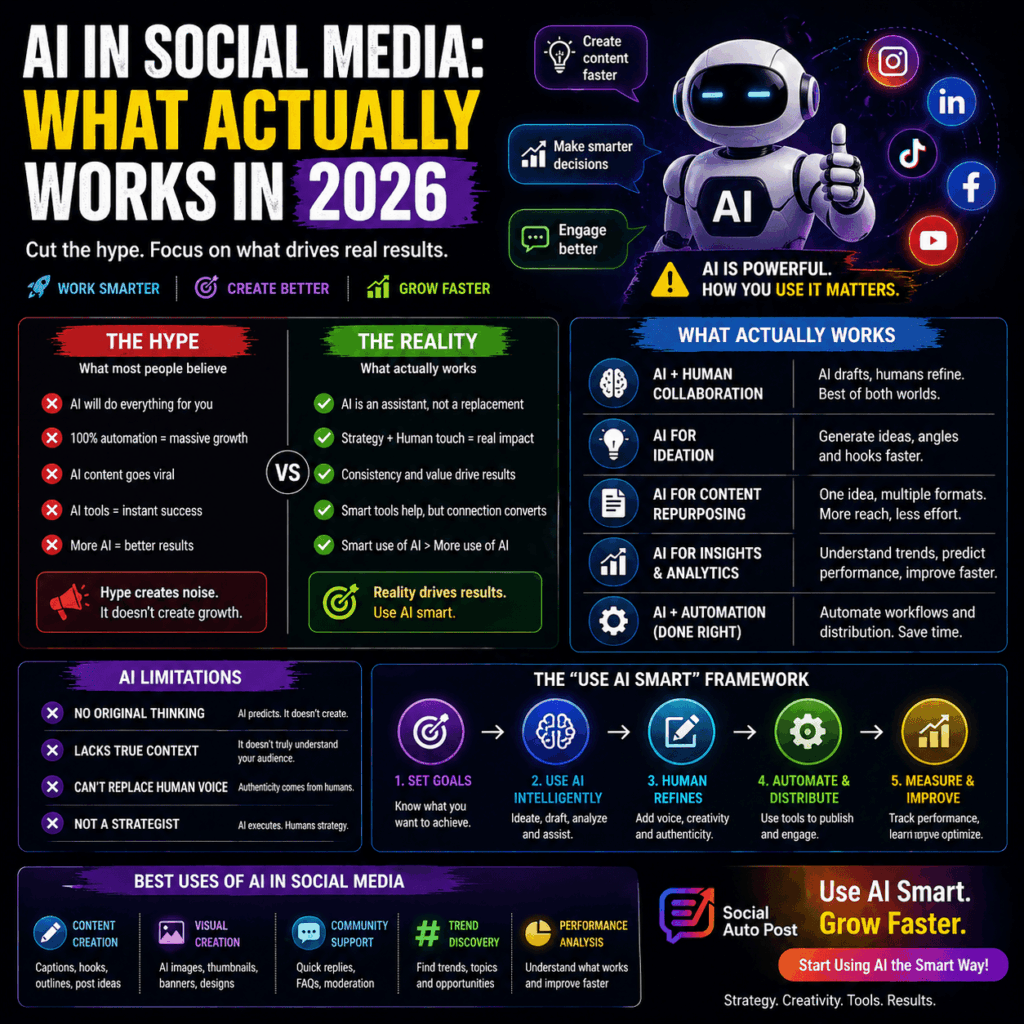
Introduction: The Gap Between AI Hype and Reality in 2026
AI is now deeply embedded in social media workflows. From content creation to automation, it promises faster growth and easier execution.
However, despite widespread adoption, results are inconsistent. Many brands are discovering that AI alone does not guarantee performance — strategy still matters more than tools.
🚨 The Core Problem: AI Without Direction
A common mistake is using AI as a shortcut rather than a system.
For example, many teams:
- Generate posts instantly without refinement
- Automate publishing end-to-end
- Skip strategy and rely on tools alone
As a result, content often becomes repetitive, disengaged, and indistinguishable from competitors.
Importantly, AI doesn’t replace strategy — it amplifies whatever already exists.
⚙️ What AI Actually Does Well
To use AI effectively, it’s essential to understand its strengths.
Firstly, AI excels at speed, helping teams generate drafts and ideas quickly.
Secondly, it identifies patterns in data, which supports trend analysis.
In addition, it is highly effective for repetitive workflows such as scheduling or formatting.
Finally, it works best as a creative assistant, not a replacement for human thinking.
❌ Where AI Fails in Social Media
Despite its power, AI has clear limitations.
It does not:
- Create truly original ideas
- Build deep brand personality
- Understand audience nuance fully
- Develop long-term strategy
Because of this, relying on it alone often leads to generic and low-impact content.
⚠️ Common AI Mistakes (And Why They Hurt Performance)
1. Fully Automated Content Publishing
When content is posted without human editing, it often lacks emotional depth and differentiation.
2. Over-Automation of Engagement
Automating replies and messaging can make brands feel disconnected and robotic.
3. Ignoring Brand Voice Training
Without proper input, AI outputs become inconsistent and diluted.
4. No Data-Driven Feedback Loop
Without performance analysis, content production becomes repetitive and directionless.
✅ What Actually Works in 2026
1. AI + Human Collaboration (Core Model)
The most effective workflow is:
AI drafts → Human refines → System distributes
This ensures both speed and authenticity.
2. AI for Ideation and Creative Expansion
AI is highly effective for:
- Brainstorming content ideas
- Exploring new angles
- Breaking creative blocks
This improves creative output significantly.
3. AI for Content Repurposing
One strong idea can be transformed into multiple formats:
- Posts
- Threads
- Captions
- Short scripts
This increases efficiency without losing quality.
4. AI for Performance Insights
Instead of guessing, teams can use AI to:
- Analyze top-performing content
- Identify engagement patterns
- Suggest improvements
This leads to continuous optimization.
5. Smart Automation (Not Full Automation)
Automation should support execution, not replace thinking.
Best use cases include:
- Scheduling posts
- Managing distribution
- Streamlining workflows
📊 The Winning Framework for AI in Social Media
A high-performing system follows this model:
AI (Speed) + Human (Creativity) + System (Execution) = Scalable Growth
🚀 What Changes When AI Is Used Correctly
When implemented properly, teams experience:
- Faster content production
- Stronger brand consistency
- Higher engagement rates
- Improved workflow efficiency
More importantly, content feels human again — not automated.