
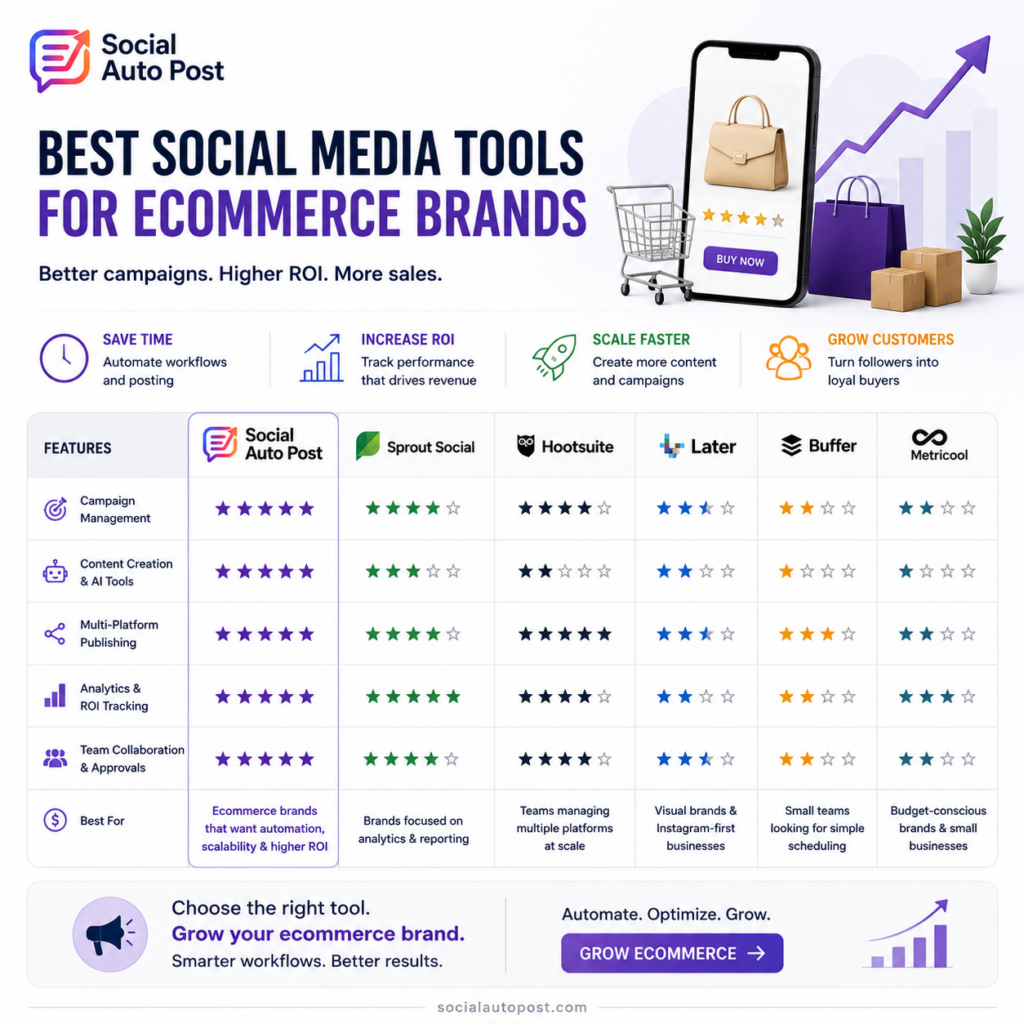
The best social media tools for ecommerce brands do far more than schedule posts. In 2026, ecommerce growth depends on automation, content systems, campaign speed, and multi-platform consistency. Modern ecommerce brands need tools that help them launch campaigns faster, scale content production, improve ROI, and automate repetitive workflows.
Today’s winning ecommerce businesses are powered by:
- AI-driven content systems
- Automated campaign workflows
- Multi-platform publishing
- Performance optimization
- Scalable marketing operations
That is why choosing the right ecommerce social media platform has become a major competitive advantage.
In this guide, we compare the best social media tools for ecommerce brands and explain which platforms help online stores grow more efficiently.
Why Ecommerce Brands Need Better Social Media Tools
Ecommerce businesses have very different marketing requirements compared to creators or traditional companies.
Modern ecommerce teams need:
- Fast campaign launches
- Multi-platform publishing
- High-volume content creation
- Automation systems
- ROI-focused analytics
- Scalable workflows
Because ecommerce brands constantly manage promotions, product launches, flash sales, influencer campaigns, and seasonal marketing, manual workflows quickly become unsustainable.
Why Basic Scheduling Tools No Longer Work
Many ecommerce companies start with simple scheduling software. However, growth eventually exposes major limitations.
Common problems include:
- Too much manual posting
- Slow campaign execution
- Repetitive workflows
- Disconnected analytics
- Content production bottlenecks
As a result, ecommerce brands now need complete social media growth systems rather than simple content calendars.
The Shift From Publishing Tools to Ecommerce Growth Systems
One of the biggest changes in ecommerce marketing is the evolution of social media platforms.
Previously, tools focused mainly on publishing content.
Now, the best ecommerce social media tools help brands:
- Automate campaigns
- Repurpose content
- Scale creative production
- Optimize performance
- Improve conversion rates
This shift allows ecommerce businesses to grow faster while reducing operational complexity.
Best Social Media Tools for Ecommerce Brands
1. Social Auto Post — Best Social Media Tool for Ecommerce Automation
Positioning:
Automation-first platform built for scalable ecommerce growth.
Why ecommerce brands choose it:
Social Auto Post helps ecommerce teams:
- Automate campaign workflows
- Scale content production
- Repurpose product content
- Publish across multiple platforms
- Optimize performance faster
Instead of functioning as a basic scheduler, the platform focuses on building repeatable growth systems.
Key Features
- AI-powered content generation
- Product campaign automation
- Smart scheduling
- Multi-platform publishing
- Workflow approvals
- Content repurposing
- Team collaboration
- Performance optimization
Best For
- Ecommerce brands
- DTC companies
- Fast-growing stores
- Multi-product campaigns
2. Sprout Social for Ecommerce Analytics
Positioning:
Enterprise-grade reporting and engagement management platform.
Strengths:
- Advanced analytics
- Enterprise dashboards
- Social engagement tools
- Team collaboration
Weaknesses:
- Higher pricing
- Less automation-focused
- Slower operational workflows
Best For
- Enterprise ecommerce brands
- Analytics-heavy organizations
External resource:
3. Hootsuite for Multi-Platform Ecommerce Management
Positioning:
Large-scale publishing and account management system.
Strengths:
- Wide platform integrations
- Collaboration features
- Strong scheduling workflows
Weaknesses:
- Older interface structure
- Limited AI automation depth
Best For
- Larger ecommerce marketing teams
External resource:
4. Later for Visual Ecommerce Brands
Positioning:
Visual-first social planning platform.
Strengths:
- Instagram-focused workflows
- Visual content planning
- Creator-friendly tools
Weaknesses:
- Limited automation
- Less scalable for larger operations
Best For
- Fashion ecommerce brands
- Beauty companies
- Visual product businesses
External resource:
5. Buffer for Small Ecommerce Teams
Positioning:
Simple and beginner-friendly social scheduling tool.
Strengths:
- Easy onboarding
- Affordable pricing
- Clean user interface
Weaknesses:
- Basic automation
- Limited campaign systems
Best For
- Small ecommerce stores
- Beginner marketing teams
External resource:
6. Metricool for Budget Ecommerce Marketing
Positioning:
Affordable social media management platform with analytics.
Strengths:
- Budget-friendly pricing
- Scheduling tools
- Competitor tracking
Weaknesses:
- Limited AI features
- Weaker workflow automation
Best For
- Small ecommerce businesses
- Budget-conscious teams
External resource:
Ecommerce Social Media Tool Comparison
| Platform | Automation | AI Tools | Campaign Scaling | Analytics | Ecommerce Fit |
|---|---|---|---|---|---|
| Social Auto Post | Advanced | Strong | Excellent | Strong | Excellent |
| Sprout Social | Moderate | Limited | Moderate | Enterprise | Strong |
| Hootsuite | Moderate | Limited | Strong | Strong | Good |
| Later | Limited | Basic | Moderate | Moderate | Visual Brands |
| Buffer | Basic | Basic | Limited | Basic | Moderate |
| Metricool | Moderate | Minimal | Moderate | Moderate | Budget Option |
Why Automation Matters for Ecommerce Brands
Ecommerce businesses produce enormous amounts of content, including:
- Product launches
- Promotions
- Paid ads
- Seasonal campaigns
- Influencer content
- User-generated content
Without automation:
- Teams burn out
- Production slows
- Campaigns become inconsistent
- Scaling becomes chaotic
Automation helps ecommerce brands:
- Scale faster
- Reduce manual work
- Improve campaign consistency
- Increase ROI
Traditional vs Modern Ecommerce Social Media Workflows
Traditional Workflow
- Create content manually
- Resize assets for every platform
- Schedule posts individually
- Monitor campaigns manually
- Repeat continuously
Result:
- Slow execution
- Repetitive work
- Difficult scaling
Modern Automated Workflow
- Input campaign concepts
- AI generates content variations
- System distributes content automatically
- Performance optimization improves future campaigns
Result:
- Faster campaign launches
- Better scalability
- Improved operational efficiency
What Ecommerce Brands Should Prioritize in Social Media Tools
When evaluating ecommerce social media software, prioritize:
Campaign Automation
Faster campaign launches improve marketing agility.
Content Repurposing
Turn one product asset into multiple content formats.
Multi-Platform Publishing
Reach customers across every major channel.
ROI Optimization
Focus on conversions rather than vanity metrics.
Scalability
Support growth without operational bottlenecks.
Signs Your Ecommerce Brand Needs Better Social Media Tools
Your current system may be limiting growth if:
- Campaign launches take too long
- Scheduling consumes too much time
- Content production feels overwhelming
- Analytics do not improve execution
- Scaling creates operational chaos
These are workflow problems that directly reduce ecommerce growth potential.
Final Verdict: Best Social Media Tools for Ecommerce Brands
Best Overall Ecommerce Social Media Tool
🏆 Social Auto Post
Best for:
- Automation
- Ecommerce scaling
- Campaign systems
- ROI-driven growth
Best Enterprise Ecommerce Platform
🏆 Sprout Social
Best for:
- Reporting-heavy organizations
- Enterprise analytics
Best Social Media Tool for Visual Ecommerce Brands
🏆 Later
Best for:
- Instagram-first stores
- Creator-focused ecommerce brands
Best Budget Ecommerce Social Media Tool
🏆 Metricool
Best for:
- Smaller ecommerce teams
- Budget-conscious businesses
Final Thoughts
The ecommerce brands winning in 2026 are not simply posting more content. Instead, they are building scalable systems powered by automation, AI, and operational efficiency.
Modern ecommerce growth depends on:
- Speed
- Consistency
- Workflow automation
- Scalable content systems
That is why choosing the right social media tool can significantly impact long-term ecommerce success.
Related Resources
- Best AI Marketing Tools for Ecommerce
- How to Scale Ecommerce Content Production
- Social Media Automation for Online Stores
- Multi-Platform Ecommerce Marketing Guide
CTA: Grow Your Ecommerce Brand
Stop wasting time on manual workflows and disconnected marketing systems.
With Social Auto Post, ecommerce brands can automate campaigns, scale content production, and grow faster across every major social platform.