
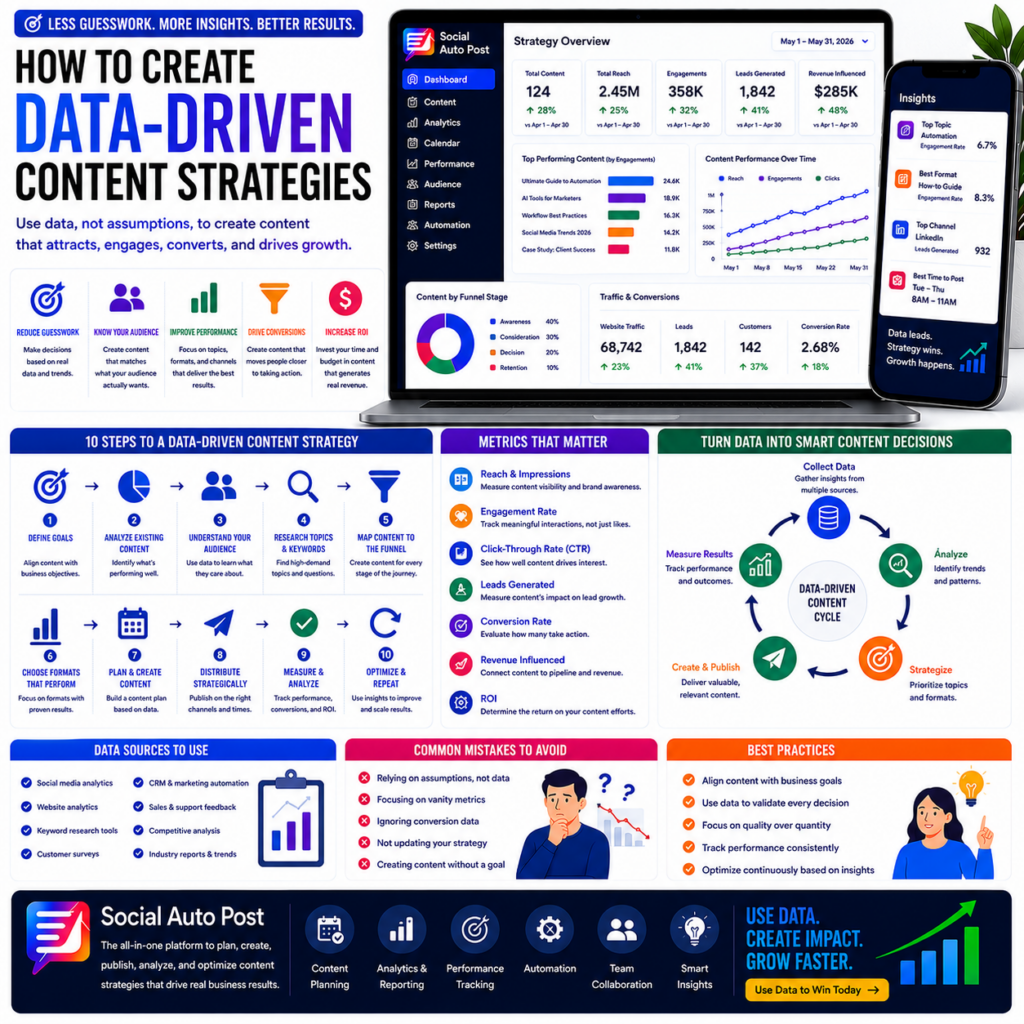
Data Driven Marketing Strategies for Content Growth
Introduction: Smarter Content With Data Driven Marketing
Many teams still rely on assumptions when creating content. However, modern marketing now depends on analytics and real user behavior.
A data driven marketing approach helps teams understand what actually works instead of guessing. As a result, content becomes more effective and easier to measure.
Why Data Driven Marketing Matters
Traditional marketing often depends on opinions or trends. However, this can lead to inconsistent results.
In contrast, a data-led approach helps teams:
- Understand audience behavior
- Improve content performance
- Increase conversions
- Support business growth
👉 External reference: https://www.hubspot.com/marketing-statistics
Therefore, decisions become more reliable and less risky.
Start With Clear Business Goals
Before looking at data, define your goals.
For example:
- Increase leads
- Improve sales
- Grow traffic
- Build brand awareness
Because of this, your strategy stays focused and measurable.
Use Performance Data to Guide Content
Next, review what content performs best.
Look at:
- Traffic pages
- Engagement rates
- Conversion results
👉 Internal link: /blog/content-performance-analysis
However, do not focus only on views. Instead, focus on results that impact business outcomes.
Understand Your Audience Behavior
Your audience provides valuable signals.
For example:
- Comments
- Questions
- Customer feedback
- Support requests
In addition, repeating patterns often reveal strong content opportunities.
Use Search Data to Validate Ideas
Search data helps confirm demand before you create content.
Look for:
- Keyword trends
- High-intent queries
- Industry searches
👉 External tool: https://trends.google.com
Therefore, you reduce wasted effort and improve content accuracy.
Measure Conversion Performance
Engagement alone is not enough.
Instead, track:
- Leads
- Signups
- Purchases
- Demo requests
Because of this, you can connect content directly to revenue.
Build Content Pillars From Data
Once patterns appear, organize them into themes such as:
- Educational content
- Product content
- Industry insights
- Case studies
As a result, your strategy becomes structured and scalable.
Create a Continuous Optimization Loop
A strong marketing system improves over time.
The process looks like:
Research → Create → Publish → Measure → Improve
Meanwhile, each cycle improves accuracy and performance.
Optimize Distribution Channels
Data also shows where content performs best.
For example:
- Social media platforms
- Email campaigns
- Organic search
👉 Internal link: /blog/digital-content-distribution-guide
Additionally, posting time and format also impact results.
Reporting That Connects to Business Results
Good reporting focuses on impact.
Track:
- Traffic
- Leads
- Revenue
- ROI
👉 Internal link: /blog/marketing-performance-reporting
Therefore, leadership can clearly understand performance.
Common Mistakes in Data Driven Marketing
Avoid these errors:
- Tracking too many metrics
- Ignoring conversions
- Copying competitors blindly
- Acting on single data points
However, fixing these improves long-term performance.
What High-Performing Teams Do
Strong teams:
- Use clear goals
- Analyze real data
- Track conversions
- Improve continuously
Because of this, their content performs more consistently.
Future of Data Driven Marketing
Marketing is becoming more automated and predictive.
In the future, teams will use:
- AI insights
- Real-time analytics
- Predictive modeling
Therefore, decisions will become faster and more accurate.
Final Thoughts
Data driven marketing helps teams replace guesswork with evidence.
Instead of guessing what works, teams use real insights to guide decisions.
Ultimately, this leads to stronger content, better engagement, and higher conversions.