
Introduction: Why Multi Platform Marketing Often Fails
Multi platform marketing should create one unified campaign across social, email, and blog.
However, most campaigns feel disconnected.
For example, social posts go live but don’t match the blog. At the same time, emails are sent with different messaging. As a result, the campaign feels fragmented.
So the problem isn’t bad ideas—it’s poor coordination.
Without proper multi platform marketing, even strong content loses impact.
What Multi Platform Marketing Really Means
Running a campaign across multiple channels isn’t about posting everywhere.
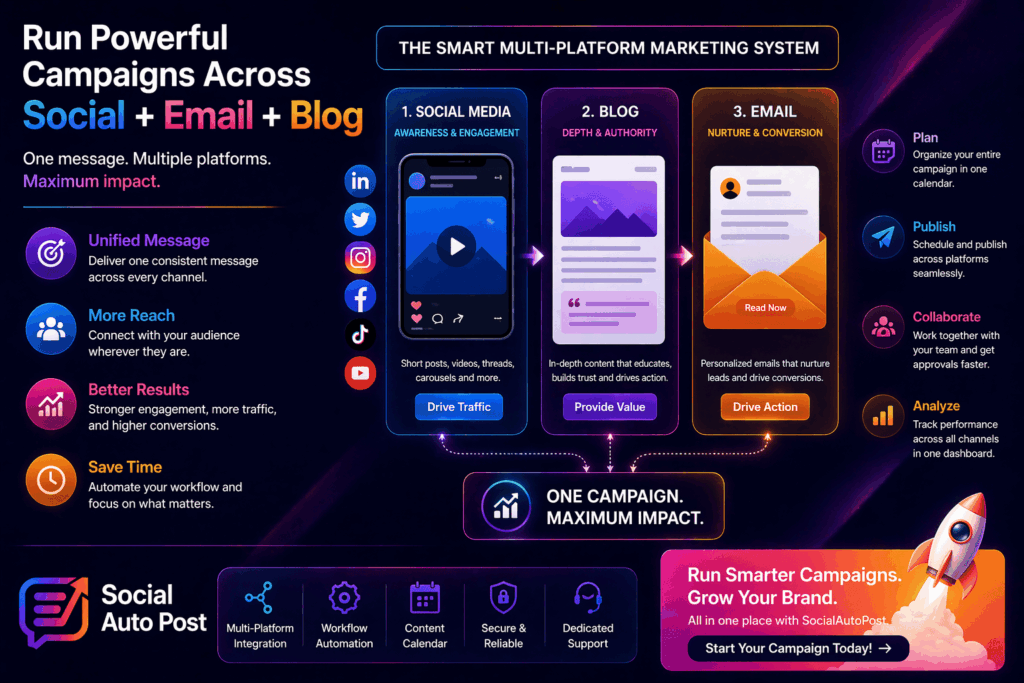
Instead, multi platform marketing means delivering one consistent message across different touchpoints.
Each channel plays a clear role:
- Blog → depth and authority
- Email → direct communication
- Social → reach and engagement
When these work together, the campaign becomes much more effective.
Why Multi Platform Marketing Matters
When your channels are aligned:
🚀 Reach increases because audiences differ across platforms
🚀 Engagement improves since users see repeated messages
🚀 Conversions grow through multiple touchpoints
However, without integration:
🚫 Messaging becomes inconsistent
🚫 Opportunities are missed
🚫 Campaign performance drops
The Multi Platform Marketing Framework
Here’s a simple system to run better campaigns.
Step 1: Start With One Core Idea
Every campaign needs one clear message.
For example:
- Product launch
- Feature update
- Educational topic
- Industry insight
Rule: One campaign = one idea.
Step 2: Define Your Goal
Before creating content, decide what you want to achieve.
For instance:
- Drive blog traffic
- Generate leads
- Increase engagement
- Promote a feature
Because of this, your goal shapes the entire campaign.
Step 3: Build the Core Asset (Blog)
The blog acts as the foundation of your multi platform marketing strategy.
It should include:
- Main idea
- Detailed explanation
- Supporting insights
- Clear CTA
Think of it as your campaign hub.
Step 4: Distribute Content Across Channels
Now break the content into channel-specific formats.
Social Media (Top of Funnel)
- Short posts
- Threads
- Carousels
- Videos
Goal: Drive traffic to the blog.
Email (Middle of Funnel)
- Campaign summary
- Key insights
- CTA
Goal: Move users toward action.
Blog (Core Asset)
- Full content
- Deep insights
- Conversion focus
Step 5: Align Messaging Across Channels
Consistency is critical in multi platform marketing.
Your campaign should:
- Use the same core message
- Keep a consistent tone
- Reinforce the same CTA
For example:
Social → Quick hook
Email → Summary + value
Blog → Full breakdown
Step 6: Build a Unified Content Calendar
Plan everything together instead of separately.
For example:
- Day 1 → Blog published
- Day 2 → Social posts begin
- Day 3 → Email sent
- Day 4–7 → Continued promotion
As a result, your campaign feels coordinated.
Step 7: Automate Distribution
Manual work slows campaigns down. Therefore, automation is essential.
You should:
- Schedule social posts
- Automate email delivery
- Coordinate publishing
This improves consistency and saves time.
Step 8: Track Campaign Performance
Measure performance across all channels:
- Blog traffic
- Email open and click rates
- Social engagement
Important:
Evaluate the campaign as a whole—not each channel separately.
Step 9: Optimize and Repeat
After the campaign:
- Identify top-performing content
- Repurpose winning formats
- Improve future campaigns
Because of this, your system gets better over time.
The Multi Platform Marketing System
Here’s the full flow:
Idea → Blog → Social → Email → Tracking → Optimization
This turns campaigns into repeatable systems.
Common Multi Platform Marketing Mistakes
Avoid these common issues:
❌ Treating channels separately
❌ No central content hub
❌ Poor timing
❌ Manual execution
❌ No performance tracking
What High-Performing Campaigns Look Like
When done right:
✅ Messaging stays consistent
✅ Channels support each other
✅ Timing is aligned
✅ Execution is automated
✅ Results are measurable
Recommended Resources
To improve your strategy, explore:
- https://blog.hubspot.com/marketing/multi-channel-marketing
- https://mailchimp.com/marketing-glossary/multichannel-marketing/
Where SocialAutoPost Fits In
Managing multi platform marketing manually is difficult.
You can explore:
- /features
- /pricing
- /blog
SocialAutoPost helps you:
- Plan campaigns in one place
- Automate distribution
- Align messaging
- Track performance
What Changes When You Integrate Campaigns
Once everything is connected:
🚀 Campaigns feel cohesive
🚀 Engagement increases
🚀 Conversions improve
🚀 Execution becomes easier
The Mindset Shift
Stop thinking in channels.
Start thinking in campaigns.
Because channels are tools—but systems drive growth.
Final Thoughts: Integration Wins
Anyone can post content.
However, very few run true multi platform marketing campaigns.
That’s what separates random activity from strategic growth.
🚀 CTA: Run Better Campaigns
If your marketing feels disconnected, it’s time to fix your system.
Run campaigns with SocialAutoPost—and turn scattered efforts into a powerful multi-platform engine.