
Social Media Content Pillars: The Complete Guide to Scaling Content
Establishing social media content pillars is the single best way to eliminate marketing disorganization and build a scalable publishing schedule. One of the primary reasons businesses struggle with digital marketing isn’t a lack of creative ideas—it is a lack of structural strategy. Without a clear architecture, growth teams frequently ask:
“What should we post today?”
“Have we already posted about this topic?”
“Why isn’t our audience engagement improving?”
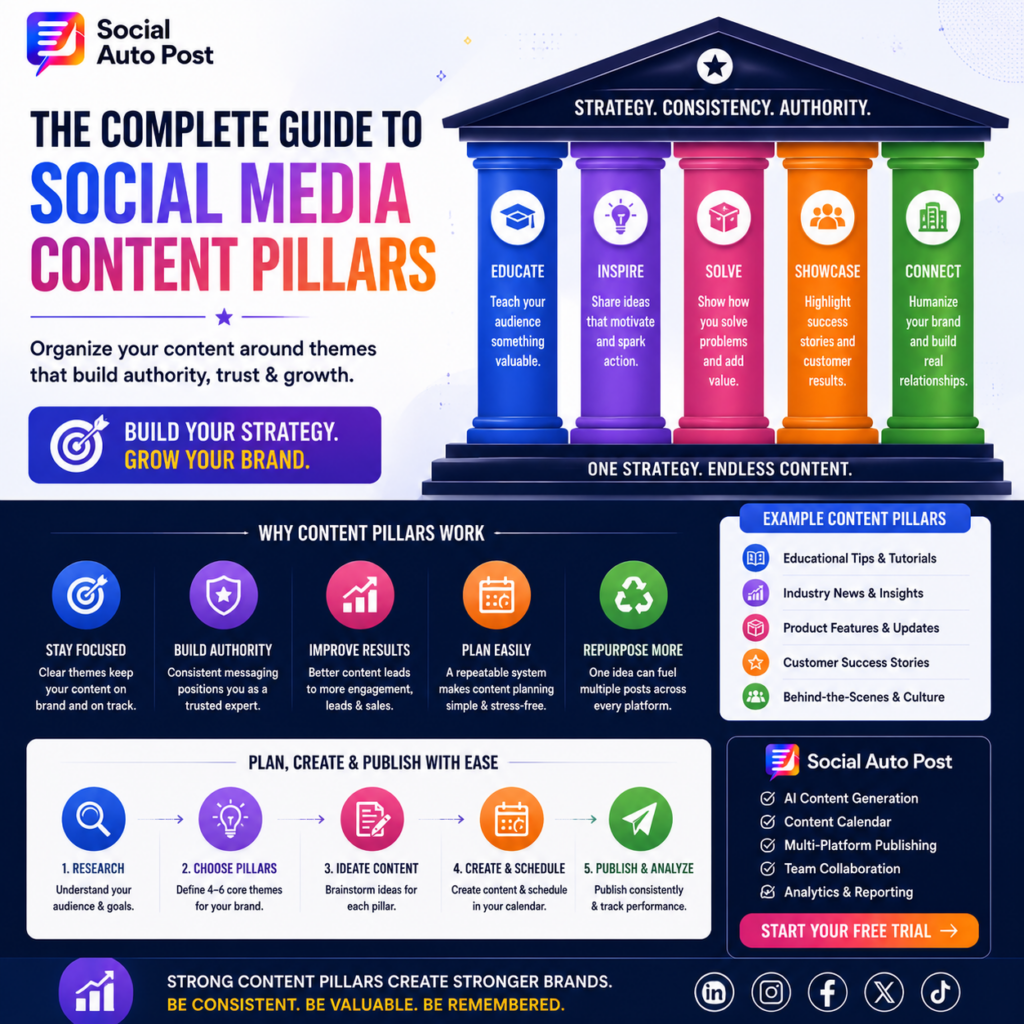
The answer lies in building a strategic foundation. Social media content pillars provide the structural framework for a consistent, recognizable, and scalable brand strategy. Instead of publishing random updates, every single post supports a core theme that aligns directly with your audience needs and business objectives.
What Are Social Media Content Pillars?
Content pillars (frequently called content buckets or core themes) are the foundational topics your organization consistently creates content around. Think of them as dedicated categories that organize your messaging ecosystem.
Instead of publishing unrelated posts, every piece of copy belongs to one of several strategic themes. For instance, a growth-focused B2B software company might utilize:
-
AI & Workflow Automation
-
Digital Growth Strategy
-
Operational Productivity
-
Analytics & Performance Telemetry
-
Customer Case Studies
Organizing your publishing around these themes establishes a distinct and memorable brand identity.
Why Strategic Pillars Matter for Brand Building
Without structured themes, your publishing strategy remains completely reactive. Conversely, adopting social media content pillars makes your execution intentional and predictable.
Key operational benefits include:
-
Streamlined Content Planning: Eliminates daily guesswork and writer’s block.
-
Stronger Brand Positioning: Establishes niche expertise across targeted topics.
-
Enhanced Audience Recognition: Followers know precisely what value to expect.
-
Simpler Team Collaboration: Content writers, designers, and managers align on shared themes.
People follow brands that consistently deliver value. Content pillars build authority by repeatedly demonstrating deep knowledge within your specific industry. To explore industry standards on editorial frameworks, review Content Marketing Institute’s Editorial Guidelines.
How Many Themes Should You Establish?
Most businesses achieve optimal balance by maintaining 4 to 6 core themes. Maintaining fewer than 4 categories often leads to repetitive posts. Conversely, maintaining more than 6 categories dilutes your core message.
| Pillar Category | Core Messaging Objective | Common Content Formats |
| Educational | Teach useful concepts and framework breakdowns | How-to guides, tutorials, FAQs, infographics |
| Industry Insights | Analyze news, market shifts, and trends | Platform updates, expert commentary, reports |
| Product & Features | Demonstrate solutions to customer pain points | Feature walkthroughs, integrations, use cases |
| Social Proof | Build trust through verified customer results | Case studies, client testimonials, reviews |
| Behind-the-Scenes | Humanize your organization and company culture | Team spotlights, event recaps, development updates |
How to Match Core Themes to Business Objectives
Every theme you publish must support a tangible business goal. Connecting your operational categories directly to conversion objectives ensures that your social channels operate as revenue drivers rather than vanity metrics.
For additional guidance on setting monthly KPI benchmarks, review our guide on monthly content planning.
Repurposing Assets Across Strategic Buckets
Building a multi-channel presence does not mean writing every post from scratch. Instead, repurpose core anchor assets across your operational framework.
For instance, a single long-form educational article can easily be converted into:
-
A multi-slide LinkedIn carousel
-
A short-form video script
-
A summary newsletter snippet
-
An X (Twitter) discussion thread
Repurposing maximizes content return on investment while maintaining messaging consistency. To learn how to convert a single article into dozens of social posts, read our playbook on leveraging AI social media captions.
Common Mistakes to Avoid in Content Strategy
Operational Warning: Avoid over-indexing on promotional content. Audiences rapidly disengage when every post is a direct sales pitch. Maintain a healthy ratio of educational value.
-
Covering Too Many Topics: Trying to satisfy every niche dilutes your market authority.
-
Ignoring Analytics Data: Review performance metrics monthly to double down on high-performing categories.
-
Publishing Inconsistently: Gaps in your publishing schedule harm platform reach and audience trust.
-
Failing to Update Categories: Review your core themes annually to ensure they align with evolving product offerings.
Streamline Strategy Execution with Social Auto Post
Managing structured social media content pillars across multiple channels requires an organized distribution setup. Social Auto Post centralizes your content planning, creation, and scheduling workflows into a single dashboard.
Key capabilities include:
-
AI-Powered Drafting: Instantly generate post hooks aligned with your core themes.
-
Visual Calendar Categorization: Color-code posts by strategic pillar to ensure balanced weekly publishing.
-
Multi-Channel Scheduling: Queue content weeks in advance across LinkedIn, Facebook, Instagram, and X.
-
Performance Telemetry: Track engagement metrics per theme to optimize your long-term roadmap.
Scale Your Digital Publishing Engine
Pairing strategic themes with automated scheduling tools transforms social media management into a predictable revenue driver:
-
Learn How to Execute Monthly Content Planning in One Afternoon
-
Discover How to Balance Evergreen Content Marketing vs Trending Updates
Frequently Asked Questions
What are social media content pillars?
They are the 4 to 6 foundational topics that a brand consistently creates posts around to build authority, maintain publishing consistency, and support broader business goals.
How many core themes should a business maintain?
Most brands perform best with four to six core themes. This range provides enough variety to keep feeds interesting without diluting core brand messaging.
Can AI assist in managing content pillars?
Yes, absolutely. AI writing tools can brainstorm post concepts, generate platform-specific caption variations, and repurpose long-form anchor assets into social updates aligned with your core themes.
Build a Smarter Publishing Strategy
Start Your Free Trial of Social Auto Post Today and build a scalable content strategy!