
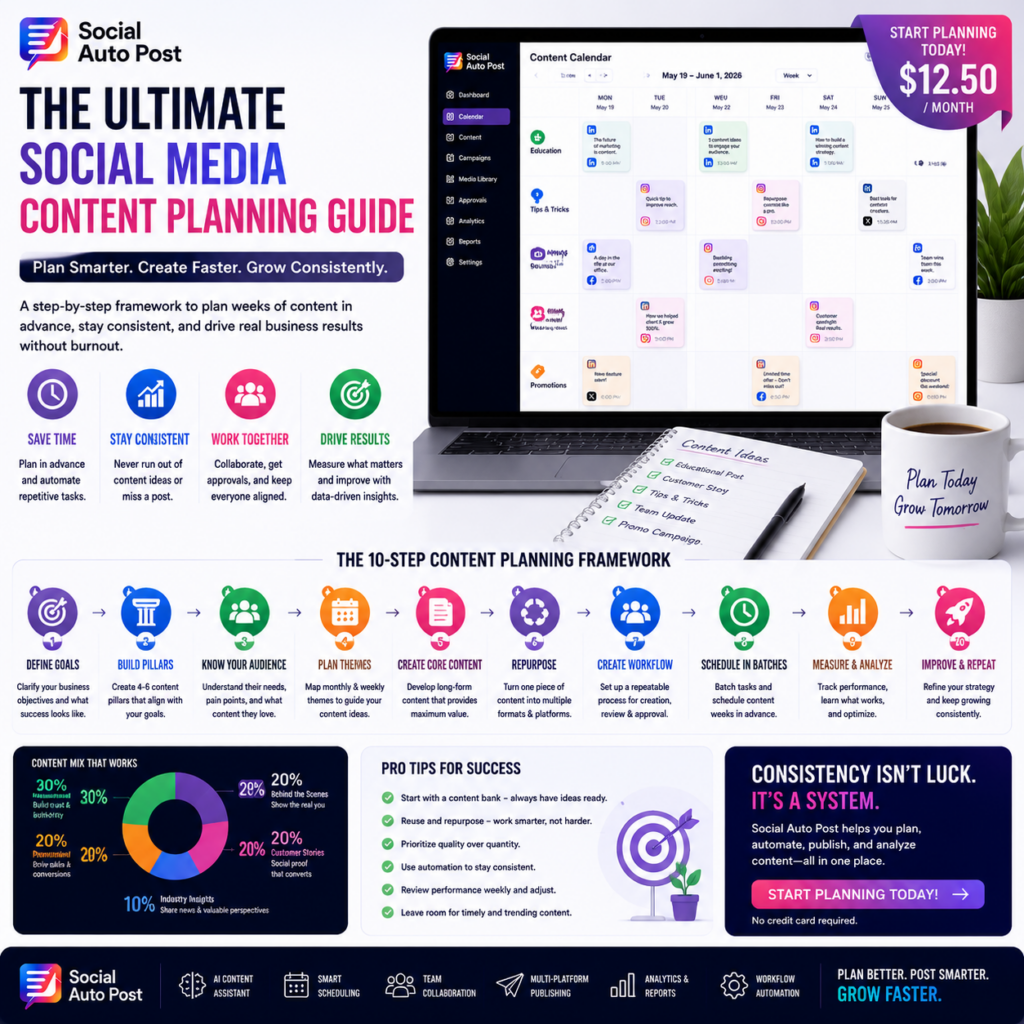
Social Media Content Planning: The Ultimate Strategy Guide
If your marketing day regularly begins with the frantic question, “What should we post today?” you are already falling behind your competition. Unfortunately, this reactive mindset stands as one of the biggest productivity killers in modern digital marketing. Teams frequently spend valuable hours brainstorming ideas, rushing approvals, creating last-minute graphics, and scrambling to meet publishing deadlines.
Consequently, this daily scramble produces inconsistent posting, lower-quality assets, missed marketing opportunities, severe team burnout, and poor long-term engagement performance.
High-performing brands do not create digital posts one day at a time. Instead, they build scalable systems for social media content planning that allow them to organize assets weeks or even months in advance. Ultimately, this structural framework creates long-term consistency, improves aesthetic quality, and gives your team the strategic freedom to focus on real business growth rather than constantly reacting to empty deadlines.
Why Strategic Social Media Content Planning Matters
Organizing your channels isn’t simply about staying neat. On the contrary, execution of structured social media content planning serves as a repeatable growth engine for your brand. When your marketing distribution assets are fully mapped out ahead of time, your business can unlock several key advantages:
-
Consistent Publishing Schedules: Maintains algorithmic favors across major platforms.
-
Elevated Production Quality: Provides designers and copywriters adequate time to refine creative assets.
-
Reduced Operational Stress: Eliminates the chaotic daily rush of last-minute approvals.
-
Unified Multi-Channel Campaigns: Synchronizes cross-functional digital launches seamlessly.
-
Measurable Marketing Performance: Enables clear data tracking against core business milestones.
The Step-by-Step Social Media Content Planning Process
Step 1: Define Core Business Goals
Before drafting a single piece of copy, you must explicitly outline what organizational success looks like. For instance, are you trying to generate high-intent leads, increase direct e-commerce sales, build general brand awareness, or drive targeted website traffic? Every post must actively support your overarching business objectives rather than existing in a vacuum.
Step 2: Establish Comprehensive Content Pillars
Building defined thematic pillars makes the entire ideation process dramatically easier. Generally speaking, most corporate brands perform exceptionally well by focusing on four to six recurring themes.
-
Educational Content: Teach your target audience a highly valuable skill.
-
Industry Insights: Discuss emerging trends, marketplace news, and expert opinions.
-
Customer Stories: Highlight authentic testimonials, case studies, and user success stories.
-
Product Spotlights: Display key features, distinct customer benefits, and real-world use cases.
-
Company Culture: Share humanizing behind-the-scenes moments and internal team updates.
Step 3: Map Assets to the Customer Journey
To drive actual conversions, your plan must guide users through a structured marketing funnel.
[Awareness: Introduce Brand] ──> [Consideration: Build Trust] ──> [Decision: Showcase Product Value]
Step 4: Organize Around Monthly Themes
Instead of selecting completely random topics each week, focus your operations around cohesive monthly motifs. For example, a software brand might dedicate January to Planning & Goal Setting, February to Customer Success Metrics, and March to Emerging Industry Trends. This structural approach makes initial batch asset creation vastly more efficient.
Step 5: Prioritize Core Content Assets First
Rather than jumping straight into drafting dozens of individual, isolated social posts, begin your creation phase with one major long-form asset. This primary source content could be a deep-dive blog article, a comprehensive industry guide, a podcast episode, or a technical webinar.
Step 6: Repurpose Across Digital Platforms
Once your core asset is finalized, you can easily slice it into multiple bite-sized pieces for different networks. To illustrate this approach, consider how a single comprehensive blog article can be seamlessly transformed into a variety of promotional formats:
| Original Asset | Multi-Platform Derivative Formats |
| 1 Long-Form Blog Post |
• 1 Detailed LinkedIn Strategy Post
• 1 Educational X (Twitter) Thread
• 1 Visual Instagram Carousel Graphic
• 1 Segmented Email Newsletter Blast
• 1 Short-Form Video Script |
Designing a Scalable Weekly Workflow
Establishing a highly structured, repeatable workflow completely removes daily decision fatigue from your creative team.
Advanced Management Tactics
Batch Creation and Balancing Agility
Batching is undoubtedly one of the greatest efficiency leaps a modern marketing team can make. Instead of constantly switching contexts between writing, designing, and publishing throughout the day, group similar tasks into dedicated blocks of time.
However, maintaining an organized plan does not mean sacrificing your corporate agility. For optimal results, structure your calendar using an 80/20 programmatic split: allocate 80% of your calendar to planned core pillars, while leaving 20% completely open for reactive topics like breaking industry news, viral conversations, or unexpected company updates.
Measuring What Actually Works
Ultimately, your execution will only improve over time if you lean heavily into hard performance data. Therefore, make it a strict habit to review deep metrics beyond vanity surface points like likes or emoji reactions. Keep a close eye on true business drivers:
-
Total Organic Reach: Is your top-of-funnel audience expanding?
-
Click-Through Rates (CTR): Are users actively navigating to your website properties?
-
Lead Conversion Volume: How many sign-ups are directly generated by your active campaigns?
-
Influenced Revenue: Can your sales pipelines be tied back to specific campaign initiatives?
Overcoming Common Execution Mistakes
Operational Warning: The biggest failure points in modern marketing stem from structural issues rather than a simple lack of creative inspiration.
| What to Avoid (Common Pitfalls) | What High-Performing Teams Do Instead |
| ❌ Planning content one day at a time | Plan calendars weeks or months in advance |
| ❌ Posting without clear business goals | 🎯 Tie every single post to a measurable KPI |
| ❌ Creating every digital asset from scratch | 🔄 Systematically repurpose all long-form media |
| ❌ Reviewing vanity likes and follower counts | 📊 Measure real conversions and influenced revenue |
Driving Efficiency Through Social Media Automation
Modern marketing platforms eliminate the vast majority of tedious manual work involved in daily publishing. By utilizing dedicated orchestration tools, businesses can seamlessly handle cross-platform scheduling, automated asset recycling, and complex cross-team approval workflows from a centralized interface.