
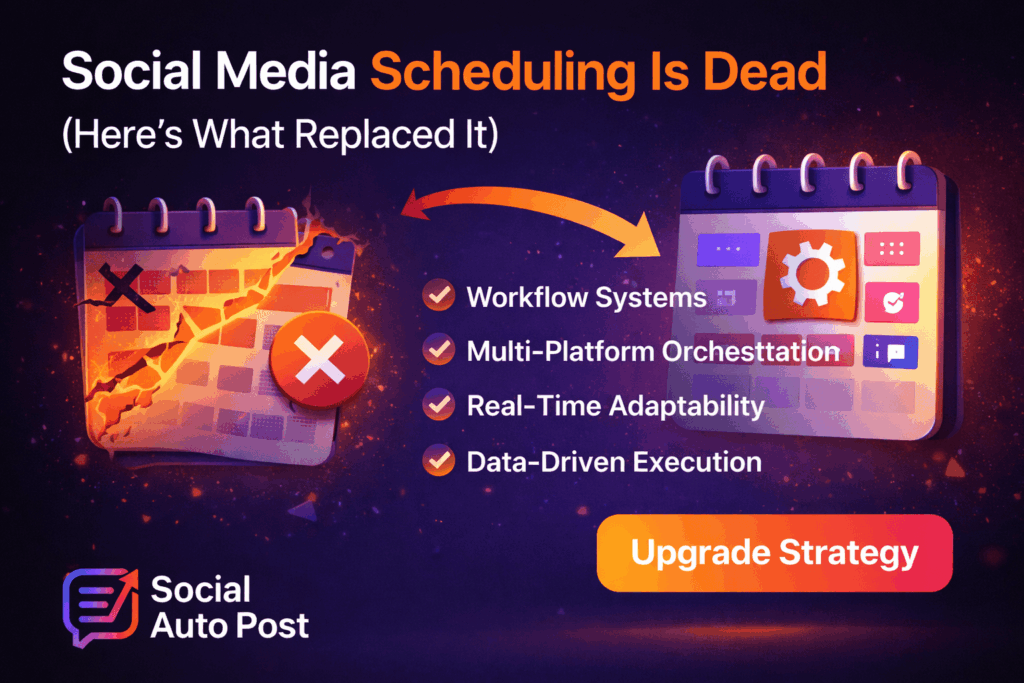
Introduction: Why Social Media Scheduling Is No Longer Enough
For years, social media scheduling was seen as the best way to manage content. Teams would plan posts, queue them, and publish automatically. At the time, this approach worked well.
However, things have changed. Today, social media scheduling alone is not enough to compete. Algorithms are smarter, content moves faster, and audiences expect more relevance.
As a result, brands that rely only on scheduling often fall behind. Instead, modern teams are shifting toward smarter systems and workflows. For more industry insights, visit HubSpot.
The Problem with Social Media Scheduling Today
Static Scheduling in a Dynamic Environment
Social media scheduling assumes content stays relevant. However, platforms move quickly.
For example:
- Trends change daily
- Conversations evolve constantly
- Audience behavior shifts over time
Because of this, pre-scheduled posts can become outdated or poorly timed.
No Feedback Loop in Social Media Scheduling
Traditional scheduling follows a simple flow:
Create → Schedule → Publish → Done
However, this model lacks feedback. Teams often miss:
- Performance insights
- Real-time adjustments
- Continuous improvement
Without feedback, content quality does not improve over time.
Fragmented Social Media Workflow
Scheduling tools rarely handle the full process. Instead, teams use multiple tools:
- Docs for planning
- Messaging apps for approvals
- Separate analytics platforms
Consequently, workflows become disconnected. Tools like Hootsuite try to solve this, but gaps still exist.
Scaling Breaks Social Media Scheduling
At a small scale, scheduling works fine. However, as content increases, problems grow.
Teams often face:
- Platform overload
- Duplicate content
- Coordination issues
Therefore, scheduling does not solve complexity—it exposes it.
The Shift Beyond Social Media Scheduling
The industry is moving toward a bigger model: social media workflows and operations.
Instead of focusing only on posting, teams now manage the full content lifecycle.
What Replaced Social Media Scheduling?
Workflow-Based Social Media Systems
Modern teams use structured workflows instead of simple queues.
Content moves through:
- Planning
- Creation
- Review
- Approval
- Publishing
- Optimization
This approach improves consistency and efficiency.
Multi-Platform Content Distribution
Instead of posting manually, teams now:
- Publish across multiple platforms at once
- Adjust content formats automatically
- Maintain consistent messaging
For example, platforms like Sprout Social support cross-channel strategies.
Real-Time Content Adaptation
Unlike static scheduling, modern systems allow quick changes.
Teams can:
- React to trends faster
- Update campaigns instantly
- Adjust messaging based on context
As a result, content stays relevant.
Data-Driven Social Media Workflows
Performance data now drives decisions.
Teams analyze:
- What content performs best
- Which platforms convert
- When audiences engage
For deeper analytics strategies, see
https://blog.hootsuite.com/social-media-analytics/
The New Model: Social Media as a System
Think of your strategy as a system, not a task.
A modern social media workflow includes:
Centralized Control
Everything lives in one place:
- Content calendar
- Campaign planning
- Publishing
- Analytics
Team Collaboration
Clear roles improve efficiency:
- Creators
- Editors
- Managers
As a result, delays and confusion decrease.
Automation at Scale
Automation handles repetitive tasks such as:
- Posting
- Formatting
- Distribution
Therefore, teams can focus on strategy.
Continuous Optimization
Performance data feeds back into future campaigns. This creates a loop of constant improvement.
Why Moving Beyond Social Media Scheduling Matters
If you rely only on scheduling, several risks appear:
🚫 Slower execution
🚫 Missed opportunities
🚫 Lower performance
🚫 Scaling challenges
In contrast, workflow-based systems improve speed, consistency, and results.
What High-Performing Teams Do Differently
Top teams follow a different approach.
They:
- Build workflows instead of queues
- Manage campaigns instead of individual posts
- Optimize continuously
- Focus on systems, not tasks
Because of this, they scale faster and perform better.
Where SocialAutoPost Fits In
SocialAutoPost is designed for this shift. Instead of simple scheduling, it offers a complete workflow system.
Key Benefits
- Unified workflow from planning to analytics
- Multi-platform publishing
- Built-in collaboration
- Scalable campaign execution
- Performance-driven insights
The Mindset Shift
To stay competitive, teams must change how they think.
Instead of asking:
“When should we post?”
Ask:
“How does this fit into our workflow?”
This shift improves clarity, speed, and results.
Final Thoughts
Social media scheduling is not useless—it’s just outdated. While it solved earlier problems, today’s environment requires more flexibility and structure.
Therefore, the future belongs to teams that build scalable workflows, not just posting schedules.
CTA: Upgrade Your Workflow
If you’re still relying only on scheduling tools, it’s time to evolve.
Upgrade your strategy with SocialAutoPost and build a system that scales.