
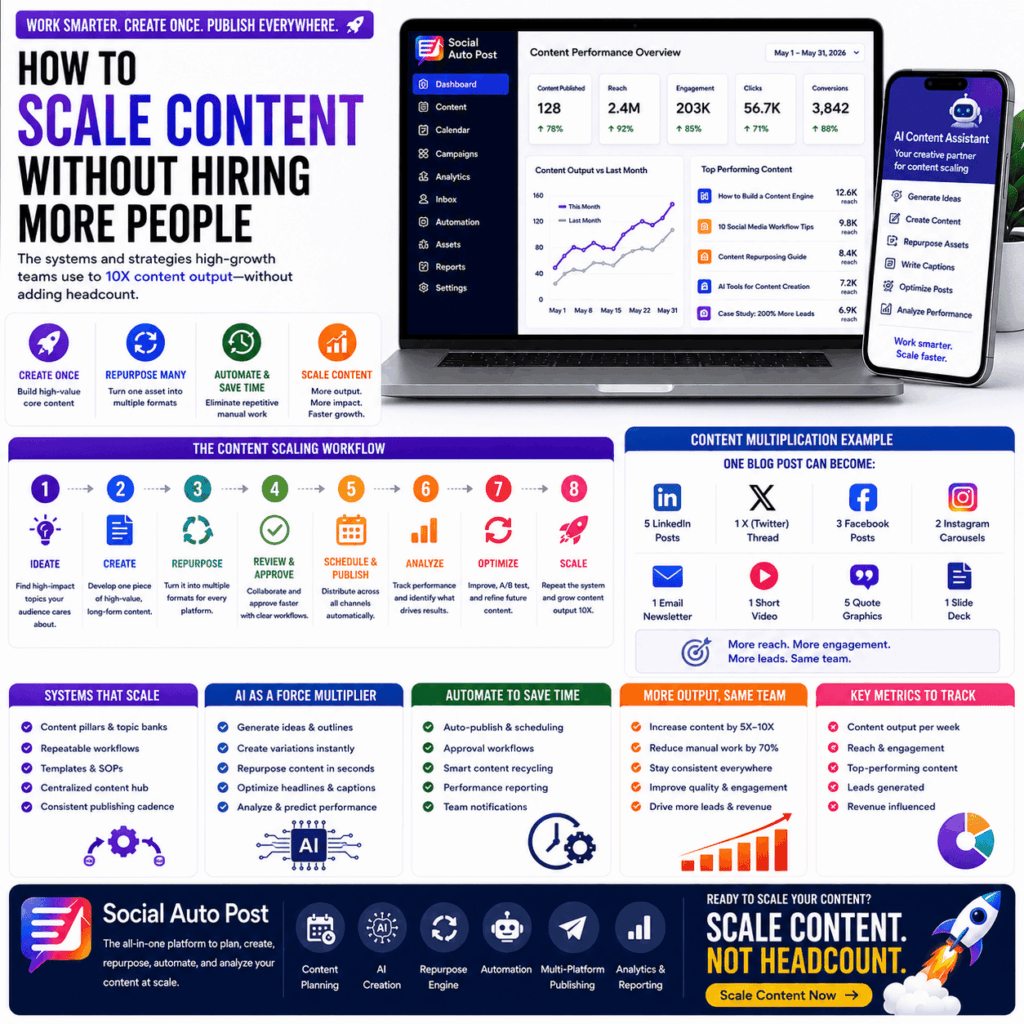
Content scaling has become a major challenge for marketing teams in 2026. As companies publish more blogs, social posts, videos, and campaigns, many assume that hiring more people is the only way forward.
However, this is not always true. In fact, many high-performing teams now scale content without increasing headcount.
Instead of relying only on hiring, they improve systems, workflows, and automation. As a result, they produce more content with fewer resources.
Therefore, content scaling is no longer about team size. It is about working smarter.
Why Hiring More People Is Not Enough for Content Scaling
At first, hiring may seem like the easiest solution. For example, companies often add writers, designers, and social media managers when content demand grows.
However, this approach creates new challenges over time.
For instance:
- More meetings are needed
- Approval cycles become slower
- Communication becomes harder
- Costs increase significantly
As a result, output does not always grow in proportion to team size. In many cases, workflows—not talent—become the real limitation.
A Better Approach to Content Scaling
Instead of focusing only on people, modern teams focus on systems.
Rather than thinking:
People → Content
They shift to:
Systems → Content
In this model, teams:
- Create content once
- Repurpose it many times
- Automate repetitive tasks
- Distribute it across channels
Because of this shift, output grows without constant hiring.
Build a Content Engine for Better Content Scaling
Rather than creating content one piece at a time, successful teams build a content engine.
This is important because it removes the need to restart every week.
A content engine usually includes:
- Clear content themes
- Repeatable workflows
- Repurposing systems
- Distribution plans
- Performance tracking
As a result, teams spend less time planning and more time producing useful content.
Start With Strong Core Content
To scale effectively, it helps to begin with high-value content.
For example:
- Blog posts
- Webinars
- Case studies
- Research reports
- Podcasts
- Product guides
After creating one strong piece, it can be reused in many ways.
In other words, one asset can generate dozens of smaller content pieces.
Therefore, the focus should not be on quantity alone. Instead, it should be on maximizing value from each piece.
Use Content Repurposing to Scale Faster
One of the easiest ways to improve content scaling is through repurposing.
For example, a single blog post can become:
- Several LinkedIn posts
- Multiple tweets or threads
- Email newsletters
- Carousel posts
- Short videos
- Quote graphics
Because of this, teams can publish more content without creating everything from scratch.
In addition, repurposing helps extend the life of existing content.
How AI Improves Content Scaling
Today, AI plays a major role in content operations.
For instance, teams use AI to:
- Generate outlines
- Rewrite content
- Create variations
- Suggest headlines
- Draft social posts
- Analyze performance
Importantly, AI does not replace strategy. Instead, it supports execution.
As a result, small teams can produce output that previously required much larger teams.
Use Templates to Speed Up Content Creation
In addition, templates make content creation faster and more consistent.
For example, teams can standardize:
Blog posts
This ensures structure is always clear.
Social media posts
This reduces time spent writing from scratch.
Emails
This improves consistency across campaigns.
Case studies
This makes storytelling easier to repeat.
Reports
This simplifies regular updates.
Because of templates, teams reduce decision fatigue and improve speed.
Build a Simple Weekly Workflow
Consistency is important for scaling content.
For example, a weekly structure might look like this:
Monday – Planning and research
Tuesday – Writing main content
Wednesday – Repurposing content
Thursday – Reviews and edits
Friday – Scheduling and analysis
As a result, teams know exactly what to do each day.
Centralize Your Content Workflow
Many teams lose time because work is spread across tools.
For example:
- Email threads
- Chat apps
- Documents
- Spreadsheets
- Project boards
To improve efficiency, it is better to centralize everything.
Therefore, keep all content plans, approvals, and assets in one system. This makes collaboration much easier.
Automate Repetitive Work
Furthermore, many tasks do not need manual effort.
For instance, you can automate:
- Scheduling posts
- Publishing content
- Sending reminders
- Updating workflows
- Reporting performance
Because of automation, teams save time and reduce errors.
Focus on Content Multiplication
Instead of asking what to create next, high-performing teams ask something different.
They ask:
“How many pieces can we create from this one idea?”
This mindset is powerful.
For example, one strong idea can often outperform multiple weak ones.
As a result, teams get more value from less effort.
Reduce Approval Delays
However, approval bottlenecks often slow everything down.
Common issues include:
- Too many reviewers
- Unclear responsibilities
- Slow feedback
- Repeated changes
To solve this, simplify the process.
For example:
Low-risk content:
Creator → Approval → Publish
High-risk content:
Creator → Manager → Approval → Publish
Because of this structure, content moves faster.
Measure Both Output and Efficiency
Although many teams track performance, fewer track efficiency.
Therefore, it helps to measure:
- Content published per week
- Time per asset
- Approval speed
- Repurposing rate
- Workflow consistency
These metrics often reveal hidden problems.
Build a Distribution System
Creating content is only the first step.
After that, distribution becomes equally important.
For example:
Blog → LinkedIn → Email → Social posts → Video → Archive
Because of distribution, each piece of content reaches more people.
As a result, content value increases significantly.
Common Mistakes in Content Scaling
Many teams struggle because they:
❌ Hire before fixing systems
❌ Skip repurposing
❌ Use too many tools
❌ Rely on manual work
❌ Lack structure
❌ Focus only on output
Instead, successful teams focus on simple systems that repeat.
What High-Performing Teams Do Differently
In contrast, strong teams:
✔ Build systems
✔ Use AI wisely
✔ Repurpose content
✔ Automate tasks
✔ Centralize workflows
✔ Track efficiency
✔ Focus on consistency
Because of this, they scale without large teams.
Example Workflow for Content Scaling
A simple process looks like this:
- Choose topic
- Create long-form content
- Use AI for variations
- Repurpose into formats
- Review content
- Publish and distribute
- Track results
- Reuse what works
Then repeat weekly.
Over time, this builds a strong content system.
Final Thoughts
Content scaling is no longer about hiring more people.
Instead, it is about building better systems.
With AI, automation, repurposing, and simple workflows, teams can grow content output without increasing headcount.
Ultimately, the most successful companies are not the biggest.
They are the most efficient.