
Introduction
The social media tools future is rapidly evolving, and traditional scheduling is no longer enough for modern marketing teams. In fact, this shift is already reshaping how businesses operate across digital channels.
As the social media tools future develops, companies will rely more on automation, AI, and content systems instead of simple scheduling tools. Because of this change, organizations must rethink how they manage content across multiple platforms.
While scheduling still exists, it is no longer the core function of modern social media platforms.
Why the Social Media Tools Future Is Changing Fast
For many years, social media tools were built mainly around one function: scheduling posts.
This worked well when content creation was simple and platforms were limited. However, things have changed significantly.
Today’s environment is much more complex. Teams now manage:
- Multiple social platforms
- High-volume content production
- Cross-channel campaigns
- Distributed marketing teams
As a result, scheduling alone can no longer support modern workflows.
The Problem With Traditional Social Media Tools
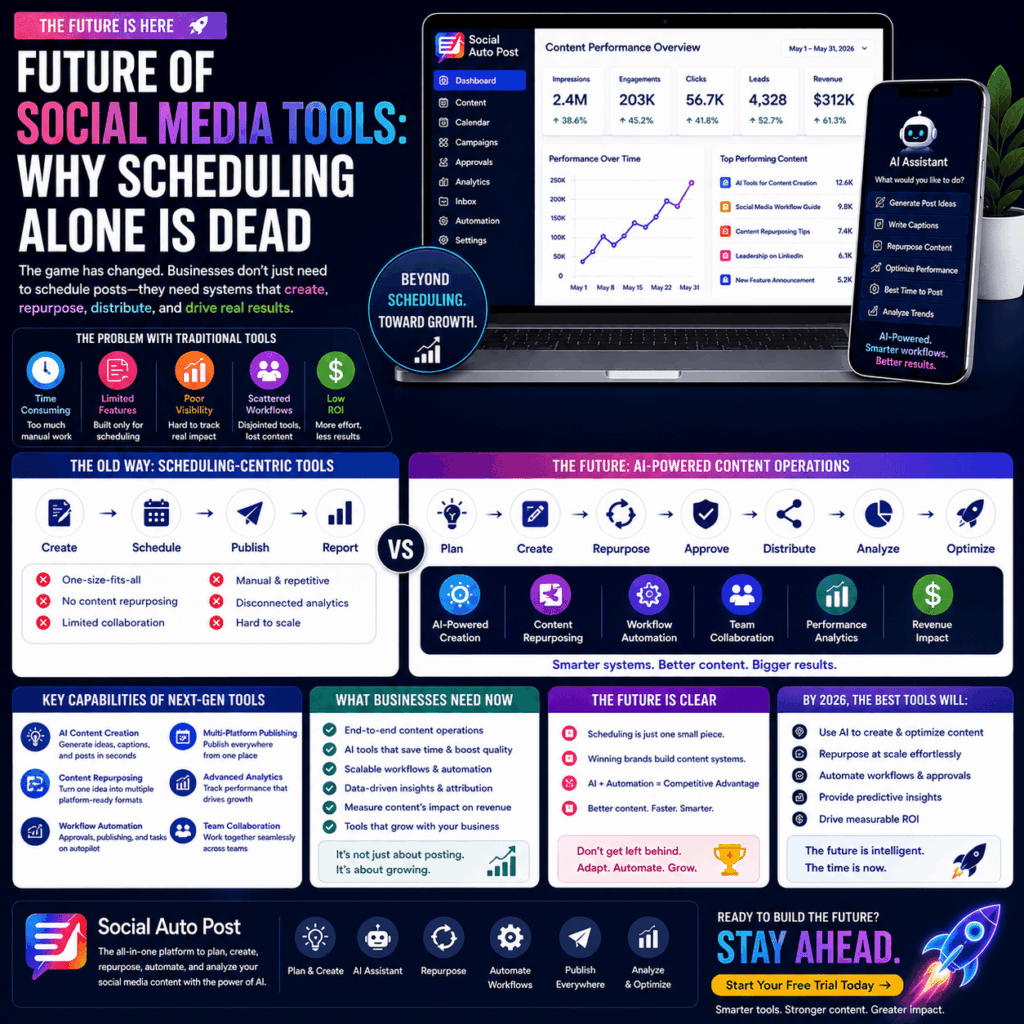
Most legacy tools follow a very simple workflow:
Create → Schedule → Publish → Analyze
Although this model worked in the past, it no longer fits current demands.
Today, content must be distributed across many channels, including:
- X (Twitter)
- TikTok
- YouTube Shorts
- Blogs
- Email campaigns
Because of this expansion, the social media tools future requires far more than basic publishing features.
Why Scheduling Is No Longer Enough
Scheduling has now become a standard feature across almost every platform.
In addition, most social networks already include native scheduling tools.
Therefore, scheduling is no longer a competitive advantage.
Instead, businesses now prioritize:
- Automation
- Collaboration tools
- AI assistance
- Workflow systems
- Performance tracking
Consequently, modern tools must offer much more than a content calendar.
The Social Media Tools Future Is About Systems
One major shift is the move from standalone tools to complete content systems.
These systems manage the full content lifecycle, including:
- Planning
- Creation
- Approval workflows
- Repurposing
- Distribution
- Analytics
- Optimization
More importantly, this system-based approach allows teams to scale without increasing manual workload.
AI in the Social Media Tools Future
Artificial intelligence is accelerating this transformation significantly.
AI Content Creation
For example, AI can help generate:
- Captions
- Headlines
- Content ideas
- Campaign structures
AI Repurposing
In addition, one piece of content can easily become multiple assets:
- Social posts
- Email content
- Video scripts
- Threads
- Blogs
AI Optimization
Furthermore, AI improves performance by identifying:
- Best posting times
- Engagement trends
- High-performing topics
As a result, teams can operate more efficiently with fewer resources.
Modern Workflow in the Social Media Tools Future
Traditionally, workflows looked like this:
Create → Schedule → Publish → Report
However, modern workflows are much more advanced:
Plan → Create → Repurpose → Approve → Distribute → Analyze → Optimize → Scale
Importantly, scheduling is now just one small step in a much larger system.
What Businesses Need in the Social Media Tools Future
Modern teams are increasingly prioritizing:
Workflow automation
To reduce repetitive manual tasks.
Multi-platform publishing
To distribute content efficiently across channels.
Content repurposing
To maximize the value of every asset.
Team collaboration
To improve communication and approvals.
Data-driven insights
To support better decision-making and ROI.
Therefore, traditional scheduling-only tools are becoming less relevant.
Content Repurposing in the Social Media Tools Future
One major trend is content multiplication.
For example, one blog post can become:
- 5 LinkedIn posts
- 3 Facebook posts
- 1 email sequence
- 1 X thread
- 1 video script
- 1 carousel
In this way, businesses generate more output without increasing workload.
Internal Links (SEO Boost)
To explore more, check:
- <a href=”/ai-content-automation/”>AI Content Automation</a>
- <a href=”/content-repurposing-guide/”>Content Repurposing Guide</a>
- <a href=”/social-media-workflow-system/”>Social Media Workflow System</a>
- <a href=”/multi-platform-publishing/”>Multi-Platform Publishing</a>
External Resources
For further reading:
Images (SEO Required)
Image 1
Alt text: social media tools future workflow automation diagram
Image 2
Alt text: AI driven social media tools future systems
Image 3
Alt text: social media tools future content repurposing strategy
Signs You’ve Outgrown Basic Social Media Tools
It may be time to upgrade your system if:
❌ Content creation takes too long
❌ Repurposing is still manual
❌ Reporting is disconnected
❌ Collaboration happens in chat tools
❌ Scaling requires hiring more staff
These issues are workflow limitations rather than tool limitations.
Final Thoughts
The social media tools future is not about posting faster. Instead, it is about building smarter systems that connect content, automation, and analytics.
While scheduling will still exist, it is no longer the center of social media management.
Ultimately, successful businesses will focus on:
- Automation
- AI-driven workflows
- Content systems
- Repurposing strategies
- Data-driven growth
In conclusion, the future belongs to systems—not schedulers.