
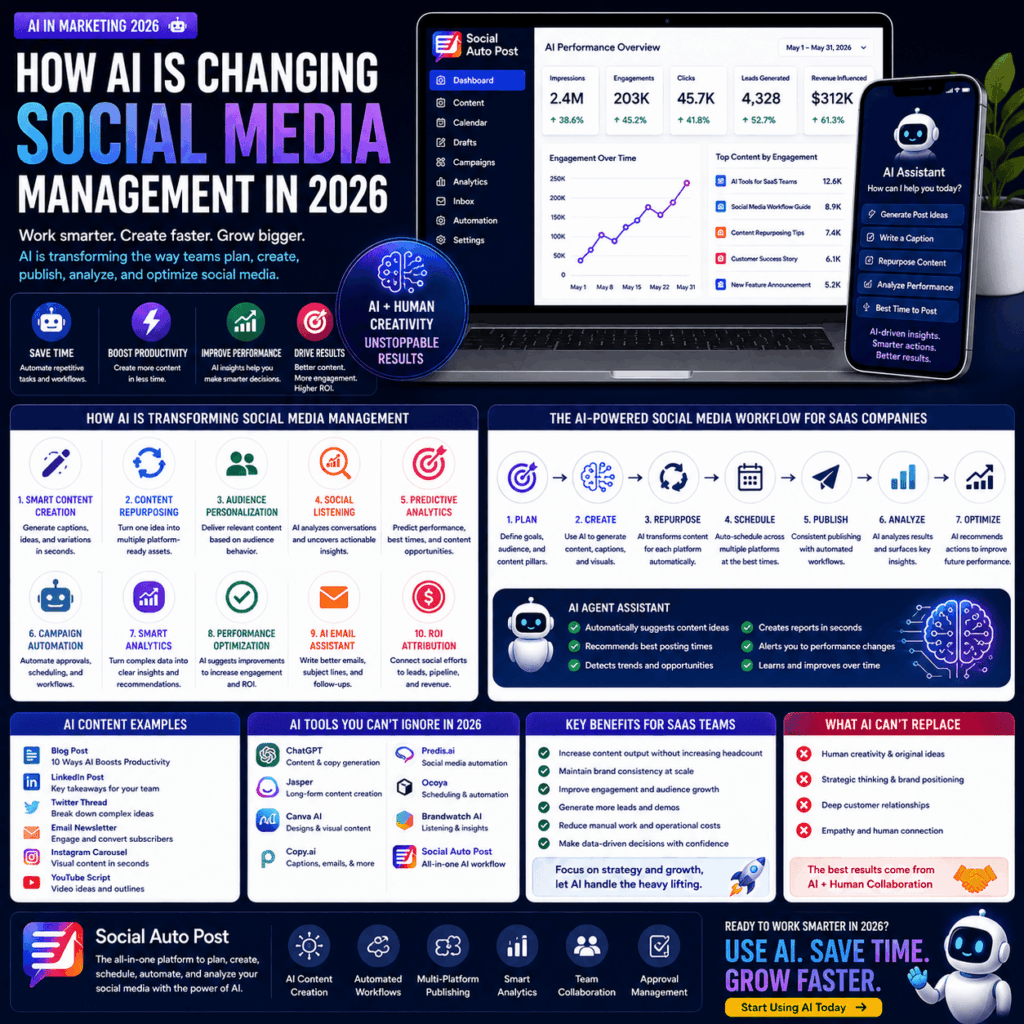
AI social media tools are reshaping how businesses manage content, automation, and engagement in 2026. Instead of spending hours on manual posting, scheduling, and reporting, marketing teams now rely on intelligent systems that streamline workflows and improve decision-making.
Rather than replacing marketers, these tools enhance productivity and remove repetitive work so teams can focus on strategy and creativity.
How AI Social Media Tools Are Changing Marketing Workflows
Marketing workflows are shifting from manual execution to intelligent automation.
Previously, teams asked what to post next. Now they focus on how systems can execute faster and more efficiently.
As a result, organizations are redesigning entire content pipelines around automation and AI-assisted decision-making.
AI Social Media Tools for Faster Content Creation
One of the biggest advantages of automation is speed.
These systems help generate captions, ad copy, blog ideas, and campaign variations in seconds. Additionally, they reduce the time spent on repetitive writing tasks.
However, human oversight still matters because brand tone, messaging, and creativity remain strategic responsibilities.
For more on workflow improvement, see:
👉 Internal Link: Marketing Automation Best Practices
Automating Content Repurposing With AI Tools
Content repurposing used to be time-consuming.
Now, a single blog post can be transformed into multiple assets across platforms such as LinkedIn, Instagram, email campaigns, and short-form posts.
This shift significantly increases content ROI and allows teams to scale output without increasing workload.
👉 Internal Link: Content Repurposing Strategies
Personalization Through AI Social Media Tools
Personalization has become a major performance driver.
Modern systems analyze audience behavior, interests, and engagement patterns to deliver tailored content.
Consequently, users see more relevant messaging, which improves engagement rates and conversion potential.
Smarter Social Listening and Audience Insights
In addition to content creation, AI improves social listening.
Brands can now track sentiment, monitor competitors, and identify trends in real time.
Instead of manually reviewing data, teams receive summarized insights that highlight what actually matters.
Predictive Analytics for Better Decisions
Predictive systems now estimate performance before content is published.
They can suggest:
- Best posting times
- Expected engagement
- Content performance trends
Therefore, marketers can make informed decisions before launching campaigns.
According to industry research from
HubSpot Marketing Insights
data-driven marketing consistently outperforms guesswork-based strategies.
Streamlining Campaign Management
Campaign execution often involves multiple teams and tools.
Automation reduces friction by handling approvals, scheduling, and reporting.
Moreover, it ensures campaigns run consistently without delays or manual bottlenecks.
AI in Social Media Analytics
Traditional reporting often overwhelms teams with too many metrics.
Now, analytics tools simplify decision-making by answering key business questions directly.
For example:
- What content generated leads?
- Which campaign performed best?
- What should be improved next?
For reference, see:
Google Marketing Platform
The Rise of Content Operations
Modern marketing teams are shifting from “posting content” to managing content systems.
This operational mindset improves consistency, scalability, and long-term efficiency.
AI supports this transformation by reducing manual coordination and improving workflow visibility.
What AI Still Cannot Replace
Despite its capabilities, AI has clear limitations.
It cannot fully replace:
- Strategic thinking
- Emotional intelligence
- Brand storytelling
- Human relationships
Therefore, the best results come from combining human creativity with machine efficiency.
How to Adopt AI Social Media Tools Effectively
Businesses should avoid two extremes:
First, ignoring AI completely leads to inefficiency.
Second, over-automation reduces authenticity.
Instead, companies should begin with high-impact areas such as scheduling, reporting, and content repurposing.
👉 Internal Link: AI Workflow Automation Guide
The Future of Marketing Automation
In the future, teams will spend less time on execution and more time on strategy.
Automation will handle repetitive tasks, while humans focus on creativity, customer insight, and growth.
As a result, marketing becomes more strategic and less operational.
Common Mistakes to Avoid
Many companies struggle with adoption because they:
- Overuse automation without guidelines
- Publish unedited AI content
- Ignore performance quality
- Fail to integrate workflows properly
Therefore, balance is essential for long-term success.
Why AI Social Media Tools Matter
These systems offer three key benefits:
Speed – Faster content production
Scale – Higher output without extra resources
Efficiency – Reduced manual workload
In combination, these advantages significantly improve marketing performance.
Final Thoughts
AI social media tools are not replacing marketers.
Instead, they are redefining how marketing teams operate.
Businesses that adopt automation strategically will scale faster, work more efficiently, and make better decisions.
Ultimately, success depends not on producing more content—but on building smarter systems.
Use AI Social Media Tools to Grow Faster
With modern automation platforms like Social Auto Post, teams can streamline workflows, repurpose content, and improve campaign performance with less effort.
👉 Use automation to scale smarter, not harder.