
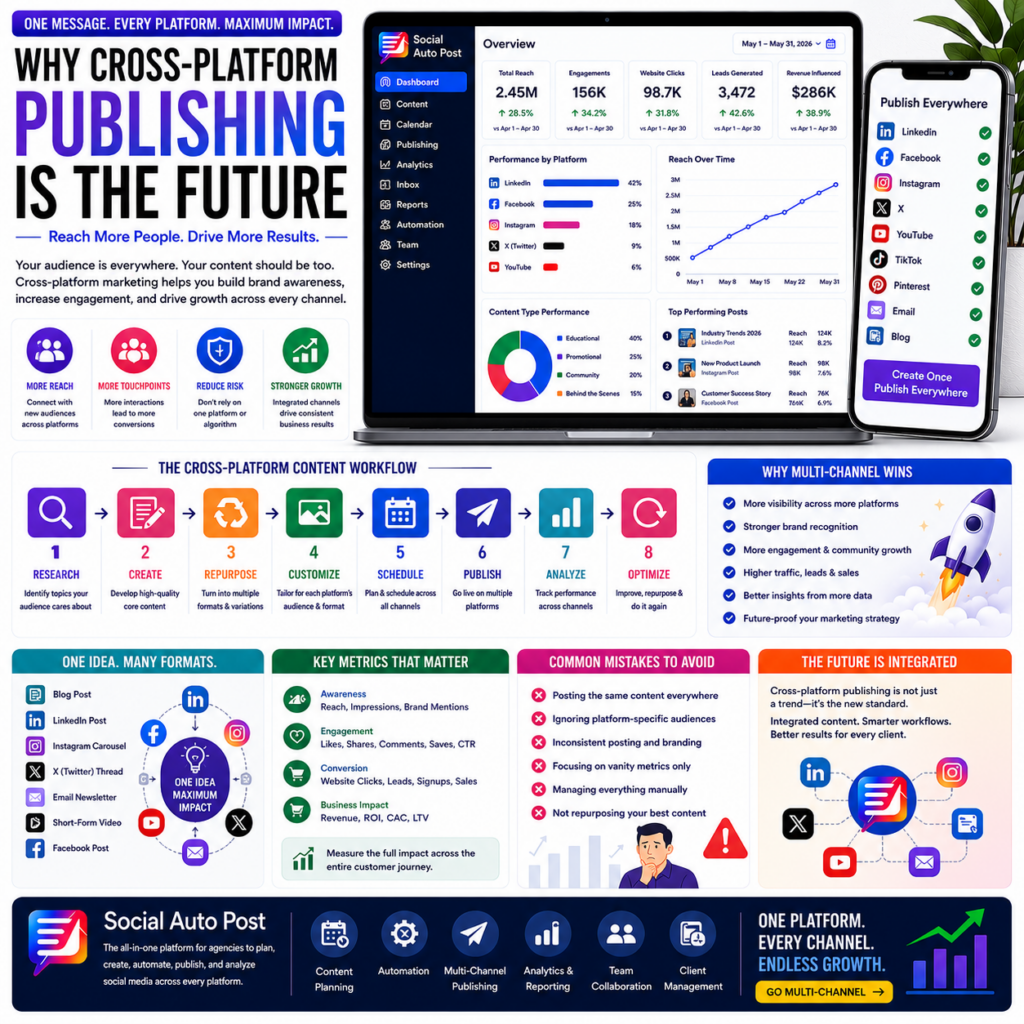
Cross Platform Marketing: Why Cross-Platform Publishing Is the Future
Cross platform marketing is no longer an optional strategy for businesses that want sustainable growth. Today’s customers interact with brands across multiple digital channels, from social media and search engines to blogs and email. As a result, businesses that publish consistently across platforms can increase visibility, build trust, and generate more leads than those relying on a single channel.
A decade ago, companies could grow by focusing on one social network. However, today’s digital landscape has changed dramatically. Algorithms evolve, audience behavior shifts, and new platforms continue to emerge. Therefore, depending on only one platform creates unnecessary risk.
Instead of concentrating all your efforts on one channel, successful brands are building integrated content strategies that connect every customer touchpoint.
Why Cross Platform Marketing Is More Important Than Ever
Customers no longer follow a simple buying journey.
For example, someone might:
- Discover your business on LinkedIn
- Search Google for more information
- Read a blog article
- Join your email newsletter
- See a Facebook advertisement
- Book a demo after receiving a follow-up email
Each interaction builds trust. Consequently, businesses that maintain a consistent presence across channels create more opportunities to convert visitors into customers.
What Is Cross Platform Marketing?
Cross platform marketing is the practice of creating content once and distributing it strategically across multiple digital channels while adapting it for each audience.
These channels may include:
- X (Twitter)
- Threads
- YouTube
- Email newsletters
- Company blog
- Short-form video platforms
Rather than publishing identical content everywhere, businesses tailor one core message for each platform’s audience and format.
The Risks of Single-Platform Marketing
Relying on one platform places your business at the mercy of changing algorithms.
For example, a decline in organic reach can quickly reduce:
- Website traffic
- Brand visibility
- Engagement
- Lead generation
- Sales opportunities
By comparison, cross platform marketing spreads risk across several channels and creates a more stable growth strategy.
Benefits of Cross Platform Marketing
Publishing across multiple channels offers several advantages.
Reach More Customers
Every platform attracts a different audience. Therefore, publishing across several channels significantly increases your potential reach.
Build Stronger Brand Recognition
Consistent messaging helps customers recognize your business wherever they encounter your content.
Increase Customer Touchpoints
Marketing studies show that buyers usually interact with a brand several times before making a purchase. As a result, every additional channel strengthens the customer journey.
Improve Marketing ROI
One well-researched piece of content can generate value across numerous platforms, making content creation far more efficient.
Create Once, Publish Everywhere
High-performing marketing teams rarely create separate campaigns for every platform.
Instead, they develop one comprehensive piece of content and repurpose it into multiple formats.
For example:
A single blog article can become:
- A LinkedIn post
- A Facebook update
- An X thread
- An email newsletter
- An Instagram carousel
- A YouTube Short
- A short-form video script
Consequently, one idea produces content for multiple channels while reducing production time.
Cross Platform Marketing Across Different Channels
Every platform serves a unique purpose.
Ideal for B2B insights, thought leadership, and professional networking.
Excellent for community engagement, discussions, and educational posts.
Best suited for visual storytelling, product showcases, and brand awareness.
X (Twitter)
Useful for industry news, quick updates, and conversations.
Email Marketing
Perfect for nurturing leads, promoting offers, and strengthening customer relationships.
Company Blog
Provides long-term SEO value while establishing authority in your industry.
Together, these channels create a complete marketing ecosystem.
Build an Effective Cross Platform Marketing Workflow
A repeatable workflow makes publishing more efficient.
For example:
- Research a topic.
- Write a detailed blog article.
- Create platform-specific social posts.
- Design supporting visuals.
- Schedule content.
- Publish consistently.
- Monitor performance.
- Repurpose top-performing content.
Because every step supports the next, content becomes a scalable marketing asset rather than a one-time project.
Why Content Repurposing Increases ROI
Repurposing is one of the most effective content marketing strategies.
Instead of constantly producing new material, businesses can maximize existing content.
Examples include:
- Blog → Newsletter
- Blog → LinkedIn Carousel
- Webinar → Video Clips
- Podcast → Quote Graphics
- Case Study → Social Media Thread
- Whitepaper → Infographic
Accordingly, every content asset continues generating value long after publication.
Automate Your Cross Platform Marketing
Managing several channels manually takes time and often leads to inconsistent publishing.
Automation helps businesses:
- Schedule posts
- Coordinate publishing
- Manage approvals
- Recycle evergreen content
- Generate reports
- Maintain consistent branding
As a result, marketing teams can scale their efforts without increasing workload.
Measure Cross Platform Marketing Success
Instead of evaluating platforms separately, measure their contribution to overall business goals.
Important metrics include:
Awareness
- Reach
- Impressions
- Brand mentions
Engagement
- Likes
- Comments
- Shares
- Saves
- Click-through rate
Conversions
- Website visits
- Lead generation
- Demo requests
- Sales
Business Performance
- Revenue
- Customer acquisition
- Return on investment (ROI)
Ultimately, the combined impact of every channel provides a clearer picture of marketing success.
Common Cross Platform Marketing Mistakes
Avoid these common mistakes:
- Publishing identical content everywhere
- Ignoring platform-specific audiences
- Posting inconsistently
- Tracking only vanity metrics
- Creating new content instead of repurposing
- Managing every channel manually
Instead, focus on creating a connected content system that evolves over time.
The Future of Cross Platform Marketing
Digital marketing will continue becoming more connected.
Businesses that succeed will:
- Build integrated marketing systems
- Repurpose content efficiently
- Automate repetitive tasks
- Deliver consistent customer experiences
- Improve campaigns using performance data
Therefore, cross platform marketing is becoming the standard for businesses that want sustainable growth.
Final Thoughts
The future of marketing is not about publishing everywhere without a strategy. Instead, it is about reaching the right audience with consistent, valuable content across the channels they already use.
By embracing cross platform marketing, businesses can improve visibility, strengthen customer relationships, increase efficiency, and generate better long-term results.
Companies that invest in connected publishing today will be better prepared for tomorrow’s digital landscape.
Go Multi-Channel with Social Auto Post
Stop depending on one platform for your marketing success.
Start building a smarter cross platform marketing strategy today.