
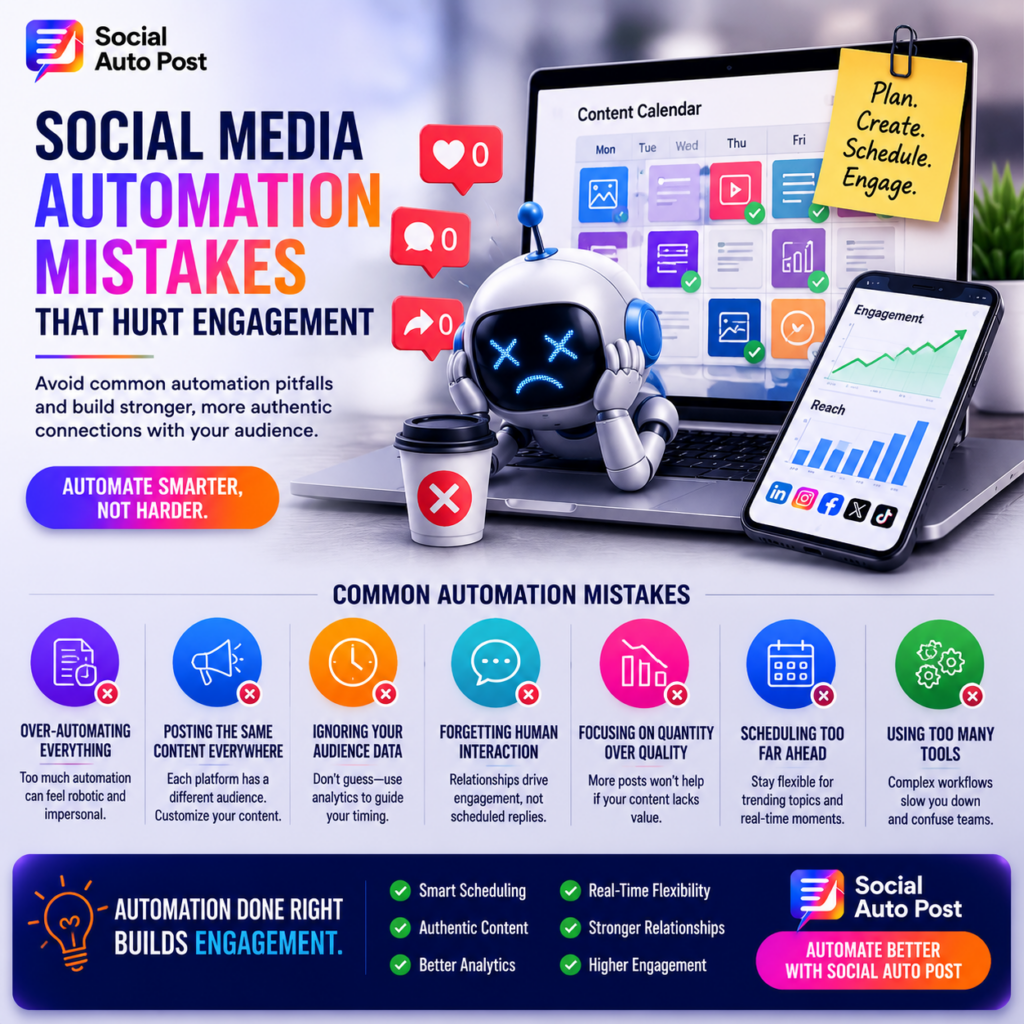
Social Media Automation Mistakes That Hurt Engagement
Avoiding critical social media automation mistakes is essential for maintaining organic reach and brand credibility in modern digital marketing. Today, growth teams routinely rely on automated systems to queue multi-platform updates, manage distribution workflows, track conversion metrics, and save countless manual hours every week.
When configured thoughtfully, automation establishes operational consistency and frees up internal bandwidth. However, making critical social media automation mistakes—such as over-automating touchpoints—often results in robotic messaging, steep drops in organic reach, poor response timing, and eroded brand trust.
The true goal of marketing automation is not to make your brand sound like a bot. Rather, it is to build a scalable distribution architecture so your team can dedicate more energy to genuine human connection and high-level strategy.
Top 10 Social Media Automation Mistakes That Harm Reach
1. Executing Without a Defined Brand Strategy
Automating before establishing clear brand guidelines simply generates ineffective content at a larger scale. Before setting up automated queues, explicitly map out your target demographics, messaging pillars, brand voice parameters, and conversion goals.
2. Cross-Posting Identical Copy Across Channels
Connecting every profile to broadcast identical messaging across networks ignores distinct channel norms. A deep breakdown formatted for LinkedIn will feel completely out of place when automatically mirrored onto Instagram without platform-specific adjustments.
3. Sacrificing Authentic Brand Voice
Relying entirely on unedited AI templates or static canned copy yields robotic captions that alienate followers. Your automation stack should support your unique voice—never replace it.
4. Fully Automating Audience Engagement
While scheduling content is highly efficient, delegating two-way conversations entirely to automated bots is one of the most damaging social media automation mistakes. Customers expect authentic human replies, nuanced customer support, and tailored recognition during active discussions.
5. Ignoring Downstream Performance Analytics
Scheduling hundreds of updates without analyzing performance metrics creates major operational blind spots. Regularly review click-through rates, conversion metrics, and engagement trends to refine your distribution queue.
High-Impact Automation vs. Harmful Practices
To maintain high organic reach and eliminate social media automation mistakes, it is critical to distinguish between constructive workflow automation and practices that suppress engagement.
| Operational Area | High-Impact Automation Strategy | Engagement-Damaging Practice |
| Content Distribution | Queueing platform-tailored updates ahead of time based on verified peak windows. | Cross-posting identical text and link dumps simultaneously across every network. |
| Community Relations | Setting alerts for brand mentions so human managers can respond promptly. | Deploying generic auto-responder bots for public post comments. |
| Content Generation | Using AI engines to brainstorm ideas, outline drafts, and format post variations. | Publishing raw, unedited synthetic text without human review or voice checks. |
| Calendar Governance | Maintaining an agile queue with built-in buffers for real-time news and updates. | Lock-step scheduling months out with zero operational oversight or pausing capabilities. |
Fixing Social Media Automation Mistakes in Your Workflow
Building an efficient publishing engine requires a clear, repeatable process that combines algorithmic efficiency with human oversight to avoid social media automation mistakes.
Additional Operational Pitfalls to Avoid
Strategy Note: Maintain an 80/20 balance in your content pipeline—80% scheduled, foundational strategy paired with 20% real-time, spontaneous industry updates.
-
Forgetting Timely Industry Context: A rigid, fully automated content pipeline can quickly look out of touch when major industry news or global events occur. Ensure your scheduling suite includes quick-pause controls for emergency events.
-
Scheduling Content Too Far in Advance: Setting up campaigns months ahead without interim reviews often leads to outdated promotions or broken URL links. Audit your upcoming queues every two weeks.
-
Ignoring Varying Regional Behaviors: Pushing out global campaign updates at a single static time neglects audience time-zone spreads. Segment your publishing schedules by region to maximize visibility.
-
Managing an Overly Fragmented Tool Stack: Juggling separate disconnected web apps for scheduling, graphics, approvals, and analytics creates unnecessary manual work. Consolidate your publishing stack into a unified management platform.
For practical steps on structuring your queue efficiently without losing authenticity, explore our guide on building a social media content calendar.
Automate Smarter with Social Auto Post
Managing multi-channel distribution without making critical social media automation mistakes requires the right infrastructure. Social Auto Post helps marketing teams automate repetitive administrative work while keeping human creativity at the forefront.
Featuring multi-platform scheduling, AI writing assistance, unified approval management, and real-time performance analytics, Social Auto Post eliminates manual scheduling friction. Consequently, your team can scale campaign reach, maintain brand authenticity, and consistently turn casual followers into loyal customers.
Optimize Your Digital Marketing Operations
Building a scalable social media strategy requires pairing reliable automation with strong messaging. Explore our technical manuals to sharpen your execution.
-
Learn How to Find Your Audience’s Peak Activity Windows Using Performance Analytics
-
Review Our Playbook on Repurposing One Long-Form Asset into 20 Unique Social Posts
Frequently Asked Questions
Do common social media automation mistakes hurt organic post engagement?
Yes. Drop-offs in reach typically occur when brands make key social media automation mistakes, such as over-automating two-way conversations, posting generic unedited copy, or failing to adjust post formats for specific social networks.
Which social media management tasks should businesses automate?
Businesses should automate repetitive operational tasks—such as post scheduling, multi-platform publishing, queue management, and analytics reporting. Strategy, visual design reviews, and community conversations should always remain human-driven.