
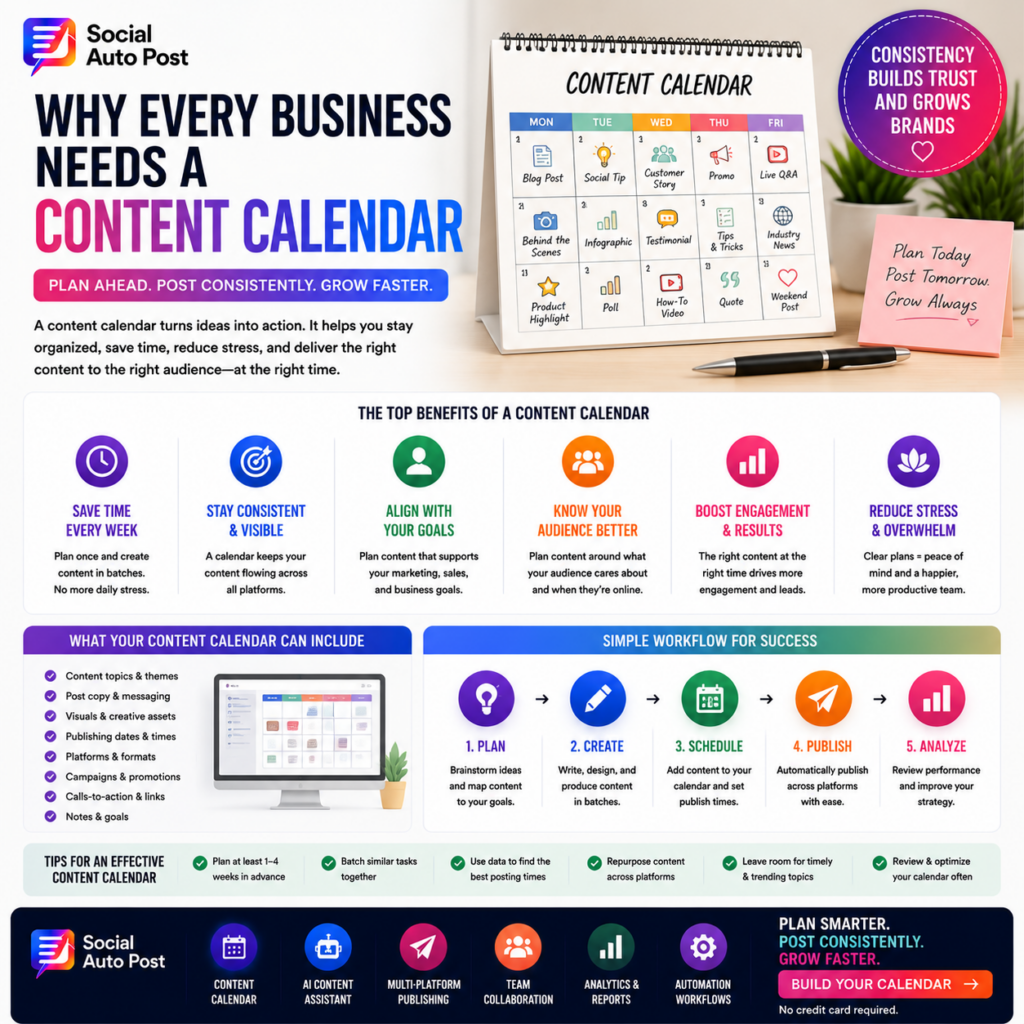
Social Media Content Calendar: The Ultimate Business Productivity Guide
One of the greatest operational obstacles modern marketing teams face is not a total scarcity of creative ideas. Rather, it is a complete absence of structural organization.
Far too many teams operate in a constant, highly reactive state: scrambling every Monday morning to figure out what needs to go live, rushing on Tuesday to design last-minute promo assets, arguing on Wednesday over missing graphics, and suddenly remembering an essential product update late Thursday afternoon.
This ad-hoc approach creates immense internal stress and generates completely inconsistent results. High-performing brand teams work quite differently. They rely on a centralized social media content calendar to organize multi-channel campaigns, maintain regular publishing schedules, and ensure every single asset actively supports broader commercial objectives.
What Is a Social Media Content Calendar?
In modern brand operations, a social media content calendar is an enterprise planning system designed to organize upcoming digital assets across multiple distribution platforms and defined timeframes.
Rather than managing complex campaigns through fragmented memory, unorganized spreadsheet files, or endless chat threads, a dedicated calendar gives teams complete structural visibility over:
-
Target Channels: Where the specific asset will be published (e.g., LinkedIn, Instagram, X, or email newsletters).
-
Resource Ownership: Which copywriter, designer, or video editor is responsible for the deliverable.
-
Approval Workflows: Current asset statuses, moving from initial ideation to draft, review, and final scheduled release.
-
Strategic Alignment: Which specific business goal or promotional campaign the asset supports.
Core Advantages of a Structured Content Strategy
1. Drive Unwavering Audience Consistency
Consistency builds brand authority. When your audience knows when to expect value, trust grows naturally. Utilizing a social media content calendar eliminates daily guesswork and ensures your publishing queue remains full even during busy operational weeks.
2. Eliminate Last-Minute Firefighting
Rushing assets through execution creates constant operational friction. By planning your publishing schedule weeks in advance, creative teams can execute calmly, complete thorough quality reviews, and avoid frantic deadlines.
3. Elevate Production Quality
Last-minute content creation almost always leads to rushed messaging, generic stock visuals, and formatting errors. Giving your team dedicated research and editing windows dramatically improves the quality of your output.
Anomaly Matrix: Content Calendar vs. Content Workflow
To build a truly scalable distribution engine, it is crucial to distinguish between your overall calendar visibility and your operational execution steps.
| Operational Dimension | Social Media Content Calendar | Social Media Content Workflow |
| Primary Focus | Timeline & Visibility: When and where content goes live. | Execution Lifecycle: How content moves from idea to final publication. |
| Core Components | Publish dates, target platforms, asset formats, and campaign tags. | Drafting protocols, visual design sprints, review handoffs, and approvals. |
| Strategic Outcome | Clear organizational roadmap across all brand channels. | Scalable, error-free production velocity without internal bottlenecks. |
Designing Your Weekly Content Production Engine
Building an effective organizational framework requires establishing clear, repeatable production stages. Instead of writing and designing individual updates daily, high-performing teams organize their work into distinct workflow steps.
Common Implementation Mistakes to Avoid
Execution Note: A calendar provides essential structure, but it should never become rigid. Always leave open buffer space to react quickly to breaking industry news or emerging viral trends.
-
Planning Only a Few Days Ahead: Operating on a short weekly runway keeps your team trapped in reactive mode. Aim to map out core campaigns 2 to 4 weeks in advance.
-
Over-Indexing on Direct Promotions: Constantly blasting sales pitches alienates followers. Maintain a healthy balance by weaving educational insights and social proof into your schedule.
-
Failing to Assign Explicit Asset Ownership: A calendar item without an assigned team member frequently misses its target publish date. Always designate a clear owner for every deliverable.
To explore how grouping your creative sessions can dramatically save production hours, check out our guide on implementing content batching workflows.
Streamline Your Publishing Workflow with Social Auto Post
Managing multiple social media networks using static spreadsheets and manual uploads quickly becomes a massive administrative burden. This is precisely why Social Auto Post integrates your entire planning, creation, and publishing pipeline into a single platform.
Featuring drag-and-drop calendars, multi-channel scheduling, team approval tools, and real-time performance analytics, Social Auto Post eliminates last-minute publishing stress. Consequently, your team can stop asking what to post every morning and focus on executing a data-driven strategy that yields predictable, long-term brand growth.
Optimize Your Digital Marketing Operations
Building a high-impact marketing engine requires combining strategic planning with efficient automation tools. Explore our companion technical guides to refine your operational strategy further.
-
Review Our Complete Framework for Repurposing One Asset Into 20 Social Media Updates
-
Discover How to Find Your Brand’s Best Time to Post Using Performance Analytics
Frequently Asked Questions
How far in advance should a business plan its social media content calendar?
Most businesses operate best by planning content 2 to 4 weeks in advance. This timeframe gives your team ample room for asset production and internal approvals while remaining agile enough to adjust for timely industry developments.