
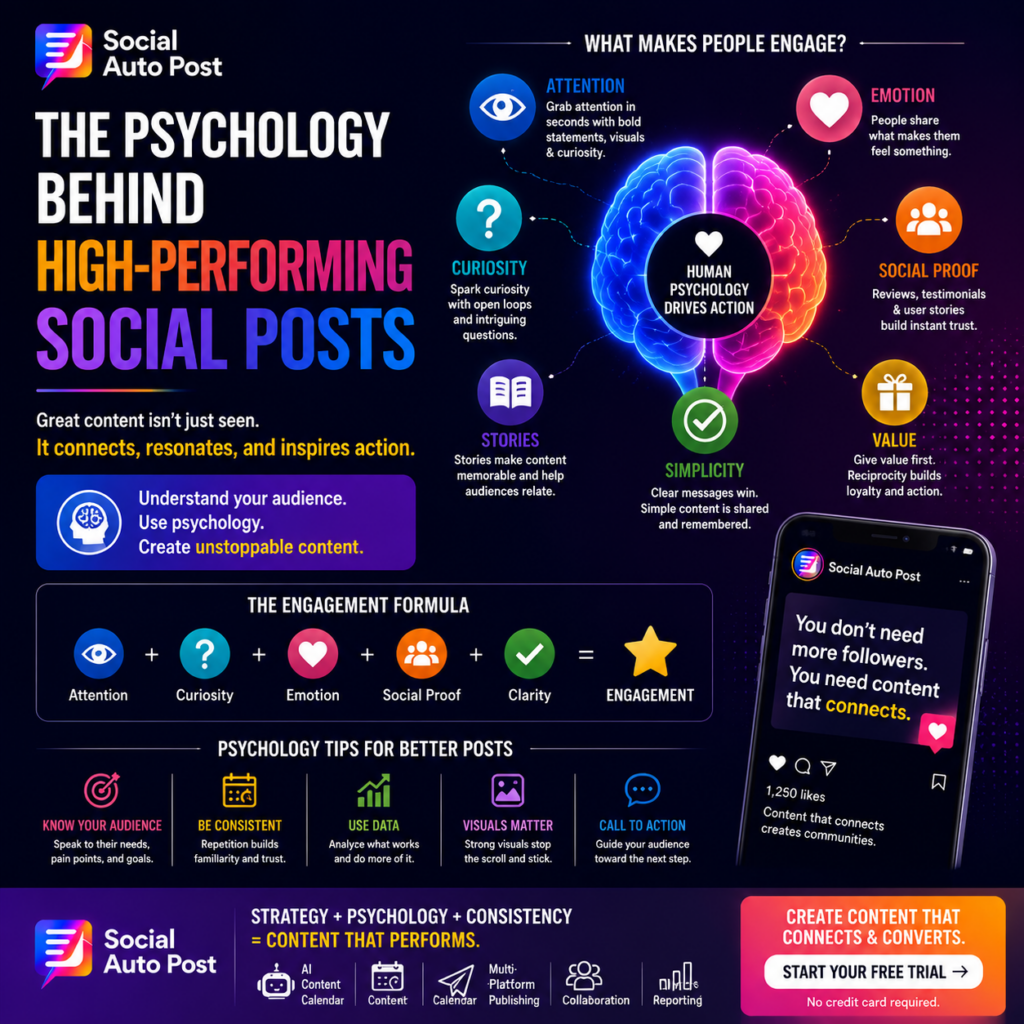
Social Media Psychology: Why High-Performing Posts Work
Understanding social media psychology is essential because thousands of marketing posts compete for attention every minute, yet only a fraction receive high engagement. Why do some social updates generate viral reach while others are completely ignored?
It is rarely a matter of luck. On the contrary, high-performing content succeeds because it aligns directly with human behavioral drivers. Users do not engage simply because a graphic looks polished. Instead, they interact when content captures attention, triggers curiosity, sparks emotion, or solves a pressing problem. Consequently, leveraging social media psychology allows marketing teams to craft resonance rather than simply filling publishing slots.
The Core Fundamentals of Social Media Psychology
1. Winning the Battle for Attention
Every day, average users scroll past hundreds of feed updates. As a result, your content has only a fraction of a second to interrupt their scroll. High-performing updates utilize surprising statistics, bold statements, or thought-provoking questions to create cognitive friction.
For example, instead of writing “Here are five quick marketing tips,” try leading with “Most businesses lose half their leads before the first follow-up.” Because the human brain naturally pauses when presented with an unexpected insight, bold statements stop the scroll immediately.
2. Exploiting Curiosity Gaps
People possess a strong biological urge to fill information gaps, which cognitive scientists refer to as the curiosity gap.
Common examples include:
-
“The single analytics mistake 90% of growth teams make…”
-
“Why your organic engagement dropped overnight (and how to fix it)…”
-
“The simple scheduling tweak most agencies overlook…”
However, the objective is never clickbait. Rather, your goal is to spark genuine interest that you immediately reward with high-value takeaways.
According to research from the American Psychological Association, information gaps create a state of cognitive arousal that compels individuals to seek closure through immediate action.
Applying Emotional Triggers in Social Media Psychology
People rarely make online sharing decisions based purely on logic; instead, emotion drives digital engagement. When content makes users feel something, they are far more likely to save, comment, or forward it to peers.
| Emotional Driver | Psychological Trigger | Ideal Content Format |
| Inspiration | Achievement & personal growth | Founder stories, transformation metrics |
| Surprise | Counter-intuitive data | Market research findings, industry reveals |
| Belonging | Shared identity & values | Community spotlights, relatable memes |
| Confidence | Operational clarity | Step-by-step frameworks, templates |
To explore how structured messaging supports emotional connection, review our guide on social media content pillars.
Tactical Frameworks for Psychological Content
For additional insights on writing platform-tailored post hooks quickly, read our breakdown of leveraging AI social media captions.
Leveraging Social Proof and the Mere Exposure Effect
In digital marketing, trust is built through repetition and validation. Therefore, incorporating two specific psychological principles will significantly improve your baseline conversion rates:
[Consistent Exposure] ──> [Familiarity & Trust] ──> [Peer Validation / Social Proof] ──> [Higher Conversion Rates]
-
Social Proof: People look to others when making decisions under uncertainty. Consequently, featuring user reviews, client results, and case studies validates your brand claims far better than self-promotional posts.
-
The Mere Exposure Effect: Psychologists have long established that repeated encounters with a brand foster preference and familiarity over time. Therefore, consistent publishing matters far more than occasional viral hits.
To see how consistency drives long-term campaign momentum, explore our breakdown of social media growth tips.
Strategic Errors in Social Media Psychology
Marketing Warning: Overcomplicating post copy creates cognitive friction. If a reader cannot digest your core point within five seconds, they will scroll past.
Avoid these common psychological missteps:
-
❌ Communicating Too Many Messages: Maintain a single focal point per update.
-
❌ Highlighting Features Over Benefits: Focus on how the reader’s life or workflow improves.
-
❌ Creating Curiosity Without Delivery: Teasing value without fulfilling it destroys audience trust.
-
❌ Neglecting Clear Formatting: Large walls of text induce fatigue; instead, use bullet points and short paragraphs.
For insights on organizing long-term publishing queues without burnout, read our guide on building an annual content strategy.
Operationalize Social Media Psychology with Social Auto Post
Applying cognitive principles consistently across multiple networks requires an organized production engine. Social Auto Post empowers marketing teams to turn psychological insights into daily automated campaigns.
Key platform features include:
-
AI Copywriting Engine: Generate high-converting hooks, curiosity-driven captions, and clear CTAs instantly.
-
Visual Strategy Calendars: Plan content pillars and maintain consistent exposure without manual stress.
-
Multi-Platform Automation: Schedule and format tailored updates across LinkedIn, Instagram, Facebook, and X.
-
Performance Telemetry: Track saves, shares, and comment velocity to refine your psychological hooks over time.
Scale Your Content Strategy Today
Combining cognitive principles with automated distribution turns content creation into a predictable growth driver:
-
Learn How to Execute Monthly Content Planning in One Afternoon
-
Discover How to Repurpose One Long-Form Asset into 20 Unique Social Posts
Frequently Asked Questions
Why is social media psychology important for digital marketers?
Social media psychology explains how people process information, make engagement decisions, and build trust online. Understanding these behavioral patterns enables marketers to create content that captures attention and drives action.
What emotion drives the highest social media engagement?
There is no single dominant emotion, but content that inspires, provides surprising insights, or creates a sense of belonging consistently generates high save and share rates.
How does consistency build brand trust over time?
Through the mere exposure effect, audiences develop a natural preference for brands they encounter repeatedly. Continuous publishing establishes authority, familiarity, and long-term brand equity.
Master the Science of Audience Engagement