
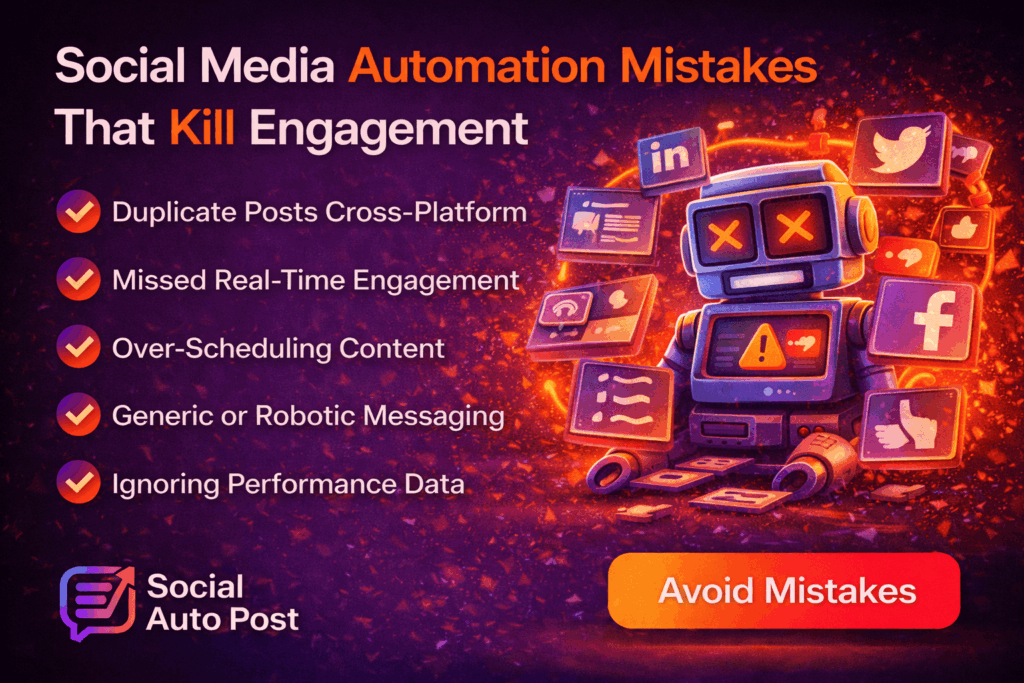
Introduction: When Social Media Automation Backfires
Social media automation is supposed to make things easier.
And when used correctly, it does.
However, many brands misuse social media automation and unknowingly damage their performance.
Instead of saving time and improving results, they experience:
- Lower engagement
- Decreasing reach
- A disconnected audience
Why does this happen?
Because bad social media automation doesn’t just fail—it scales your mistakes.
The Promise vs Reality of Social Media Automation
On one hand, the promise is clear:
- Post consistently
- Save time
- Scale content
On the other hand, the reality often looks very different:
- Generic posts
- Poor engagement
- A robotic brand voice
So, automation itself isn’t the issue.
Instead, the problem lies in how it’s implemented.
The Biggest Social Media Automation Mistakes
Let’s explore the most common social media automation mistakes that quietly reduce engagement.
1. Social Media Automation Without Platform Customization
This is the most common mistake.
Many teams publish the same content across:
- X
However, they don’t adapt the content.
Why this hurts
Each platform has different:
- Audience expectations
- Content formats
- Engagement behavior
As a result, content feels out of place—and engagement drops.
2. Ignoring Platform-Specific Formatting
In many cases, automation tools apply the same formatting everywhere.
For example:
- Long captions on short-form platforms
- Excessive hashtags
- Poor visual structure
Why this matters
Content that doesn’t feel native gets ignored quickly.
Therefore, formatting should always match the platform.
3. Over-Scheduling Content
Another common issue is scheduling content too far in advance.
While planning is useful, over-automation creates problems.
Why it hurts
- Content becomes outdated
- Trends are missed
- Messaging feels disconnected
In contrast, flexible scheduling keeps content relevant.
4. No Real-Time Engagement
Automation often replaces interaction—but it shouldn’t.
Many teams post content but fail to:
- Reply to comments
- Engage with users
- Join conversations
Why it matters
Social media is not just broadcasting—it’s interaction.
Without engagement, algorithms reduce your reach.
5. Repetitive Content Patterns
Over time, automation can lead to predictable posting.
For instance:
- Same format
- Same tone
- Same structure
Why this is a problem
Audiences lose interest.
Additionally, platforms may deprioritize repetitive content.
6. No Performance Tracking
Some teams automate everything but never review results.
Why this hurts
Without data:
- You don’t know what works
- You repeat weak content
- Growth slows down
According to HubSpot, data-driven strategies consistently outperform guesswork.
7. Removing the Human Element
Perhaps the biggest mistake is over-automation.
When brands rely too heavily on automation, they lose:
- Personality
- Emotion
- Authenticity
Why it matters
People connect with people—not systems.
The Right Social Media Automation Strategy
Now that we’ve covered the mistakes, let’s look at better approaches.
1. Customize Content for Each Platform
Instead of copying content, adapt it.
- Adjust tone
- Change structure
- Optimize format
This makes your content feel native and engaging.
2. Combine Automation with Human Interaction
Automation should handle publishing.
Meanwhile, humans should handle:
- Replies
- Conversations
- Community building
This balance is critical.
3. Stay Flexible
Even with automation, adaptability is key.
For example:
- Adjust posts based on trends
- React to current events
- Update scheduled content
As a result, your content stays relevant.
4. Track and Optimize Performance
Use analytics tools like Google Analytics to understand:
- What performs well
- What needs improvement
Then, refine your strategy accordingly.
5. Focus on Content Quality First
Automation amplifies your content.
So, if the content is weak, automation will only make it worse.
A Simple Framework for Better Automation
To simplify:
Automation = Efficiency + Adaptation + Human Touch
If one element is missing, performance drops.
What Smart Social Media Automation Looks Like
When done correctly:
- Content fits each platform
- Posting is consistent but natural
- Engagement is active
- Performance improves over time
Internal Resources You Should Explore
To improve your strategy further, explore:
- Social media content strategy guide
- Engagement optimization techniques
- Content planning workflows
- Analytics and reporting frameworks
Where SocialAutoPost Fits In
Most tools only automate posting.
However, smarter tools go further.
SocialAutoPost helps with:
- Multi-platform customization
- Workflow automation
- Flexible scheduling
- Performance tracking
- Team collaboration
What Happens When You Fix These Mistakes
Once your automation improves:
- Engagement increases
- Reach expands
- Content feels more authentic
- Workload becomes manageable
Final Thoughts: Automation Is a Tool, Not the Strategy
Ultimately, social media automation is powerful—but it’s not your strategy.
Instead, your strategy should be:
- Value-driven
- Audience-focused
- Data-informed
Automation simply helps you execute it more efficiently.
CTA: Avoid Social Media Automation Mistakes
If your current strategy is hurting engagement, it’s time to rethink it.
Avoid social media automation mistakes—and turn automation into a growth engine.