
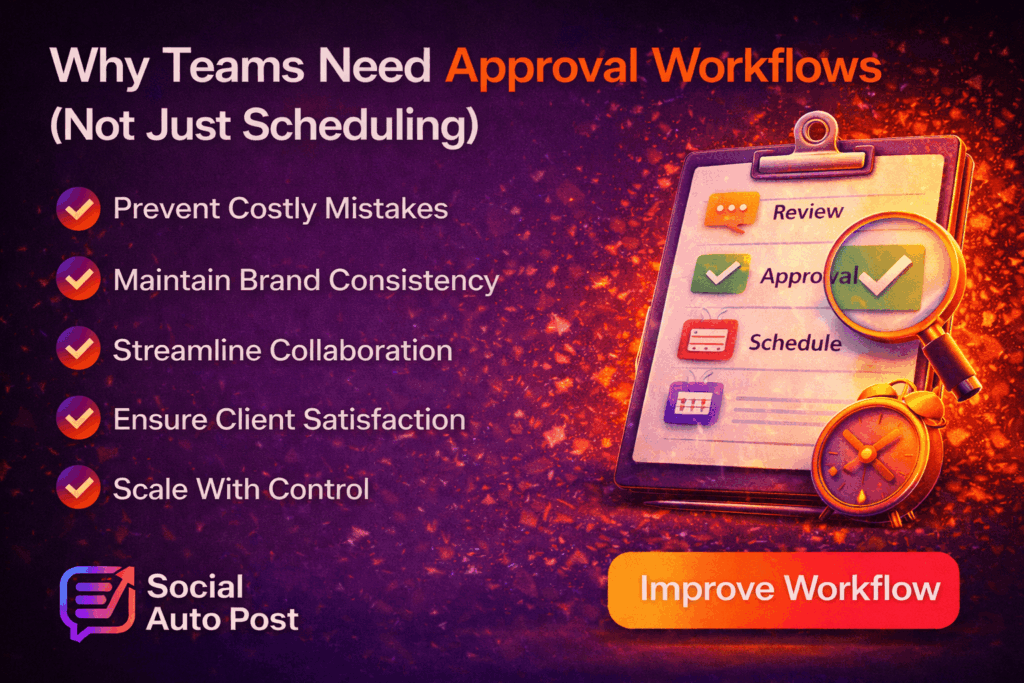
Introduction: Why Teams Need an Approval Workflow
An approval workflow is the missing layer most teams overlook in social media management.
Many assume their biggest issue is scheduling. At first, that seems true—planning content in advance does help. However, as teams grow, new problems appear.
Posts go live with errors. Messaging becomes inconsistent. Clients request last-minute edits.
That’s because scheduling handles timing, while structured review processes ensure quality.
What Scheduling Does Well
Scheduling tools are designed to:
- Publish content at specific times
- Automate posting
- Maintain consistency
They answer a simple question: “When should this go live?”
However, they don’t confirm whether the content is accurate, aligned, or approved.
The Role of an Approval Workflow
A structured workflow defines how content moves from creation to publishing.
It typically answers:
- Who creates the content
- Who reviews it
- Who signs it off
- What happens if changes are needed
Because of this, content is validated before it reaches the public.
Why Scheduling Alone Breaks at Scale
As output increases, relying only on scheduling becomes risky.
Mistakes Go Public Faster
Without review layers:
- Typos slip through
- Incorrect links get published
- Messaging errors appear publicly
Once content is live, fixing it becomes reactive instead of preventive.
Inconsistent Brand Voice
Different contributors bring different styles. Without a review step:
- Tone varies
- Messaging drifts
- Brand identity weakens
A structured process keeps communication aligned.
Friction With Clients
For agencies, lack of approvals often leads to:
- Repeated revisions
- Last-minute feedback
- Misaligned expectations
A clear system reduces confusion and builds trust.
Bottlenecks and Unclear Status
Without structure:
- Teams ask, “Is this ready?”
- Feedback is scattered
- Content gets delayed
Defined steps remove this ambiguity.
Lack of Ownership
When no process exists:
- Responsibility is unclear
- Decisions are delayed
- Mistakes are shared across the team
Clear roles fix this instantly.
What a Good Workflow Looks Like
A simple structure:
- Content creation
- Internal review
- Stakeholder approval
- Final edits
- Scheduling and publishing
Each step is defined, so nothing gets skipped.
Scheduling vs Review Systems
Without a review system:
- Faster output
- Higher risk
- Lower consistency
With one in place:
- Slightly slower process
- Stronger quality
- Reliable scaling
The goal isn’t just speed—it’s consistency at scale.
How to Build a Better Process
1. Define Clear Roles
Assign responsibility:
- Creator
- Reviewer
- Approver
This removes confusion and overlap.
2. Standardize the Flow
Every post should follow the same steps. As a result, teams gain predictability and efficiency.
3. Centralize Feedback
Keep everything in one place instead of scattered tools. This improves clarity and reduces errors.
4. Set Deadlines
Define when reviews happen and when content is locked. This keeps things moving.
5. Combine With Scheduling
The correct order is:
Review → Approval → Scheduling → Publishing
External Perspective
Structured workflows are widely recognized as essential for scaling operations. For example, the Project Management Institute highlights the importance of defined processes and accountability in team performance.
What Changes When You Add Structure
Once a proper system is in place:
- Content quality improves
- Brand consistency increases
- Team efficiency grows
- Client satisfaction rises
As a result, teams operate with less stress and more control.
Final Thoughts
Scheduling helps teams move faster. However, speed without control creates risk.
Structured workflows bring clarity, accountability, and consistency—making it possible to scale without chaos.
CTA: Improve Your Workflow
If your team relies only on scheduling, it’s time to evolve your process.
Explore better systems like SocialAutoPost to manage content, feedback, and publishing in one place.