
Introduction: Repurpose Content Instead of Creating More
Repurpose content to grow faster without increasing your workload.
Most teams believe growth requires constant content creation. As a result, they push for daily posts, endless brainstorming, and more output.
However, this approach often leads to burnout, lower quality, and inconsistent messaging.
Meanwhile, high-performing brands take a different approach—they repurpose content strategically.
What It Means to Repurpose Content
To repurpose content doesn’t mean copying and pasting the same post everywhere.
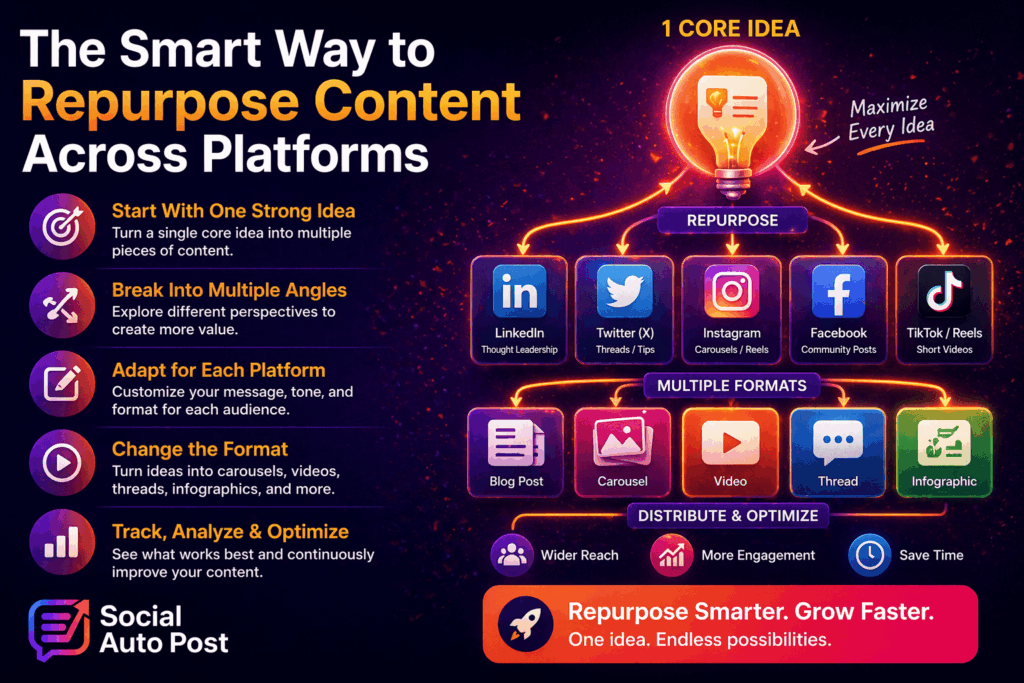
Instead, it means taking one strong idea and adapting it for different platforms and formats.
So rather than creating ten new ideas, you turn one idea into multiple pieces of content.
Why Teams Should Repurpose Content
When you repurpose content effectively, several benefits follow.
Save time
You spend less time creating and more time distributing.
Increase reach
Different platforms expose your content to different audiences.
Improve consistency
Your core message stays aligned across channels.
Maximize ROI
Every idea delivers more value.
Why Simple Duplication Fails
Many teams confuse repurposing with duplication.
However, posting identical content across platforms creates problems:
- Content feels out of place
- Formatting doesn’t match platform expectations
- Engagement drops
Therefore, real repurposing requires adaptation—not repetition.
A Smart Framework to Repurpose Content
Step 1: Start With One Strong Idea
Everything begins with a valuable core idea, such as:
- A blog insight
- A case study
- A strategy tip
- A product update
If the idea is weak, repurposing won’t fix it.
Step 2: Break the Idea Into Angles
Next, expand that idea into multiple perspectives.
For example, a topic like “workflow mistakes” can become:
- Educational: Top mistakes to avoid
- Opinion: Why workflows fail
- Tactical: How to fix issues
- Visual: A checklist or diagram
This step multiplies your content opportunities.
Step 3: Repurpose Content for Each Platform
Each platform requires a different approach.
- LinkedIn → Insight-driven, longer posts
- X (Twitter) → Short, punchy threads
- Instagram → Visual-first carousels or reels
- Facebook → Conversational and community-focused
- TikTok → Short, hook-driven videos
Because of these differences, adapting content is essential.
Step 4: Change the Format
Don’t just rewrite—transform the format.
One idea can become:
- Blog post
- Carousel
- Short video
- Infographic
- Thread
As a result, your output increases without extra effort.
Step 5: Distribute Over Time
Timing matters just as much as content.
Instead of posting everything at once:
- Spread posts over days or weeks
- Reintroduce ideas strategically
- Avoid audience fatigue
Step 6: Track and Optimize
Not all content performs equally.
Track:
- Engagement by platform
- Best-performing formats
- Audience preferences
Then refine your strategy based on real data.
Insights from organizations like the Content Marketing Institute consistently show that optimized distribution outperforms constant creation.
What Smart Repurposing Looks Like
A strong system ensures:
- Content feels native to each platform
- Messaging remains consistent
- Effort stays manageable
- Output scales efficiently
Common Mistakes to Avoid
Avoid these pitfalls when you repurpose content:
- Copy-pasting across platforms
- Ignoring platform-specific behavior
- Overusing the same idea too frequently
- Skipping performance tracking
Each of these reduces effectiveness.
What High-Performing Teams Do Differently
Successful teams don’t rely on volume alone.
Instead, they:
- Focus on fewer, stronger ideas
- Build systems around repurposing
- Adapt content intelligently
- Use automation tools
- Continuously improve performance
Tools That Help You Repurpose Content
Managing this manually can be time-consuming. That’s where tools like SocialAutoPost come in.
They help with:
- Multi-platform publishing
- Content adaptation
- Workflow automation
- Scheduling and planning
- Performance tracking
What Happens When You Repurpose Content Effectively
Once you apply this system:
- Content output increases
- Engagement improves
- Brand consistency strengthens
- Time investment decreases
In other words, you get better results with less effort.
Final Thoughts: Repurpose Content to Scale Smarter
You don’t need more ideas—you need to extract more value from the ideas you already have.
Creating endlessly is not sustainable. However, repurposing strategically allows you to scale without burnout.
The fastest-growing brands aren’t producing the most—they’re leveraging their content the best.
CTA: Repurpose Content Smarter
If your team is stuck creating content from scratch every day, it’s time to shift your approach.
Repurpose content with a smarter system and turn one idea into a complete content engine.