
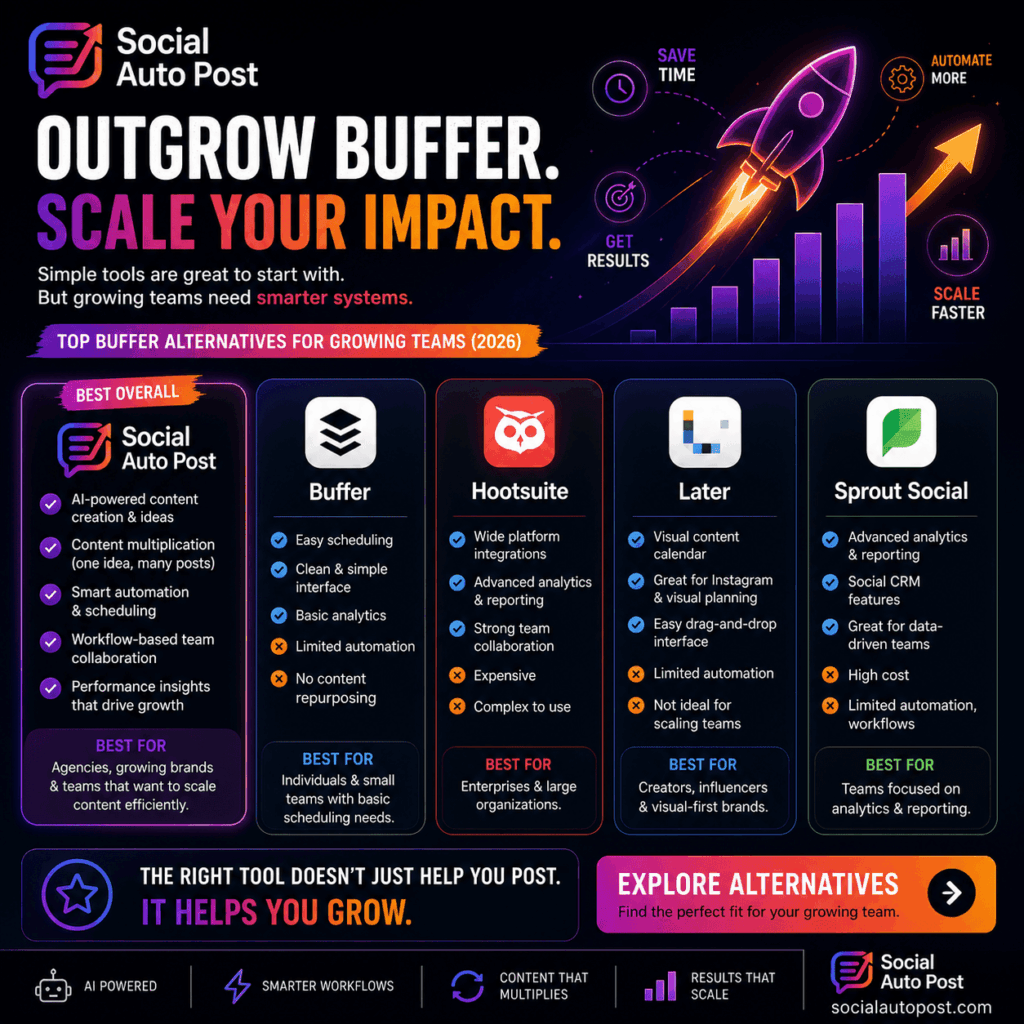
Introduction: Buffer Alternatives for Growing Teams
As teams grow, Buffer alternatives for growing teams become essential because basic scheduling tools start to slow down workflows.
Buffer is simple and effective at the beginning, but scaling teams quickly run into limitations like manual posting, limited automation, and lack of workflow systems.
This guide explores the best Buffer alternatives in 2026 built for automation, collaboration, and scalable content systems.
1. What Growing Teams Actually Need
Small teams can survive on simple scheduling tools, but growing teams need more advanced systems.
Small Teams Need:
- Basic scheduling
- Simple UI
- Light analytics
Growing Teams Need:
- Automation workflows
- Content repurposing
- Multi-platform publishing
- Team collaboration systems
- Performance optimization
👉 This is where most traditional tools fall short.
2. The Shift: From Scheduling Tools to Content Systems
Modern Buffer alternatives for growing teams are no longer just schedulers—they are content engines.
A real system should:
- Reduce manual work
- Increase content output
- Improve performance over time
- Scale with your team
If a tool only schedules posts, it’s no longer enough in 2026.
3. Best Buffer Alternatives for Growing Teams (2026)
🚀 Social Auto Post (Best for Scaling Teams)
Positioning: AI-driven content automation system
Key Features:
- AI content generation
- Content repurposing (1 idea → many posts)
- Automated publishing workflows
- Team collaboration system
- Performance optimization
📌 Why it stands out:
Unlike Buffer, it functions as a content engine, not just a scheduler.
📷 Image (alt: Buffer alternatives for growing teams – Social Auto Post dashboard showing automation workflow)
👉 Best for:
- Agencies
- Scaling brands
- Multi-platform teams
⚡ Hootsuite (Best for Enterprise Management)
Outbound reference: Hootsuite official platform
Strengths:
- Multi-platform integrations
- Advanced analytics
- Enterprise collaboration
Weakness:
- Expensive
- Complex UI
- Limited automation depth
👉 Best for large corporate teams
📷 Image (alt: Buffer alternatives for growing teams – Hootsuite analytics dashboard interface)
🎯 Later (Best for Visual Planning)
Outbound reference: Later social media platform
Strengths:
- Visual drag-and-drop calendar
- Instagram-focused planning
- Creator-friendly workflow
Weakness:
- Limited automation
- Not ideal for scaling teams
👉 Best for creators and visual brands
📷 Image (alt: Buffer alternatives for growing teams – Later visual content calendar for Instagram planning)
📊 Sprout Social (Best for Analytics)
Outbound reference: Sprout Social platform
Strengths:
- Deep analytics and reporting
- CRM-style engagement tools
- Strong insights for brands
Weakness:
- High cost
- Limited automation systems
👉 Best for data-driven teams
💰 Metricool (Best Budget Option)
Outbound reference: Metricool social media tool
Strengths:
- Affordable pricing
- Scheduling + analytics combo
- Multi-platform support
Weakness:
- Limited advanced automation
- Basic workflow design
👉 Best for small teams scaling slowly
4. Feature Comparison
| Feature | Buffer | Social Auto Post | Others |
|---|---|---|---|
| Scheduling | ✅ | ✅ Advanced | ✅ |
| Automation | ❌ | ✅ Full system | ⚠️ Limited |
| AI Content | ⚠️ Basic | ✅ Advanced | ⚠️ Mixed |
| Repurposing | ❌ | ✅ | ❌ |
| Analytics | ✅ | ✅ | ✅ |
| Scaling | ⚠️ Limited | ✅ Strong | ⚠️ Mixed |
5. Workflow Difference: Tool vs System
Buffer Workflow:
- Create post manually
- Schedule individually
- Repeat process
❌ Result: repetitive and time-heavy
Social Auto Post Workflow:
- Enter idea
- AI generates variations
- System distributes content
- Content is optimized automatically
✅ Result: scalable content production system
6. Internal Links (Site Structure Example)
To improve SEO structure, add internal links like:
- /blog/social-media-automation-tools-2026
- /blog/content-repurposing-strategies
- /blog/scheduling-tools-comparison
These strengthen topical authority for Buffer alternatives for growing teams.
7. Why Most Buffer Alternatives Still Fail
Even modern tools fail in three areas:
- True automation depth
- Content multiplication systems
- Long-term workflow optimization
Most tools improve features—but not the system itself.
8. Signs You’ve Outgrown Buffer
You likely need a Buffer alternative if:
- You manage multiple platforms
- You post daily or multiple times daily
- Your team is growing
- You repeat manual tasks
- You need scale, not just scheduling
9. What to Look for in 2026 Tools
The best Buffer alternatives for growing teams should include:
1. Automation-first design
Built into the core, not added later.
2. AI content systems
For faster production.
3. Repurposing engines
Maximize each content idea.
4. Scalable workflows
Support team growth.
5. Optimization loops
Improve performance automatically.
10. Final Thoughts: Tool vs System
Buffer is a solid entry-level tool.
But growing teams need something different:
- Automation
- Systems
- Scalability
Staying on basic schedulers too long leads to:
- Slower workflows
- Burnout
- Lost growth opportunities
CTA: Upgrade Your Content System
👉 Explore AI-powered automation platforms like Social Auto Post and move from scheduling → scaling.