
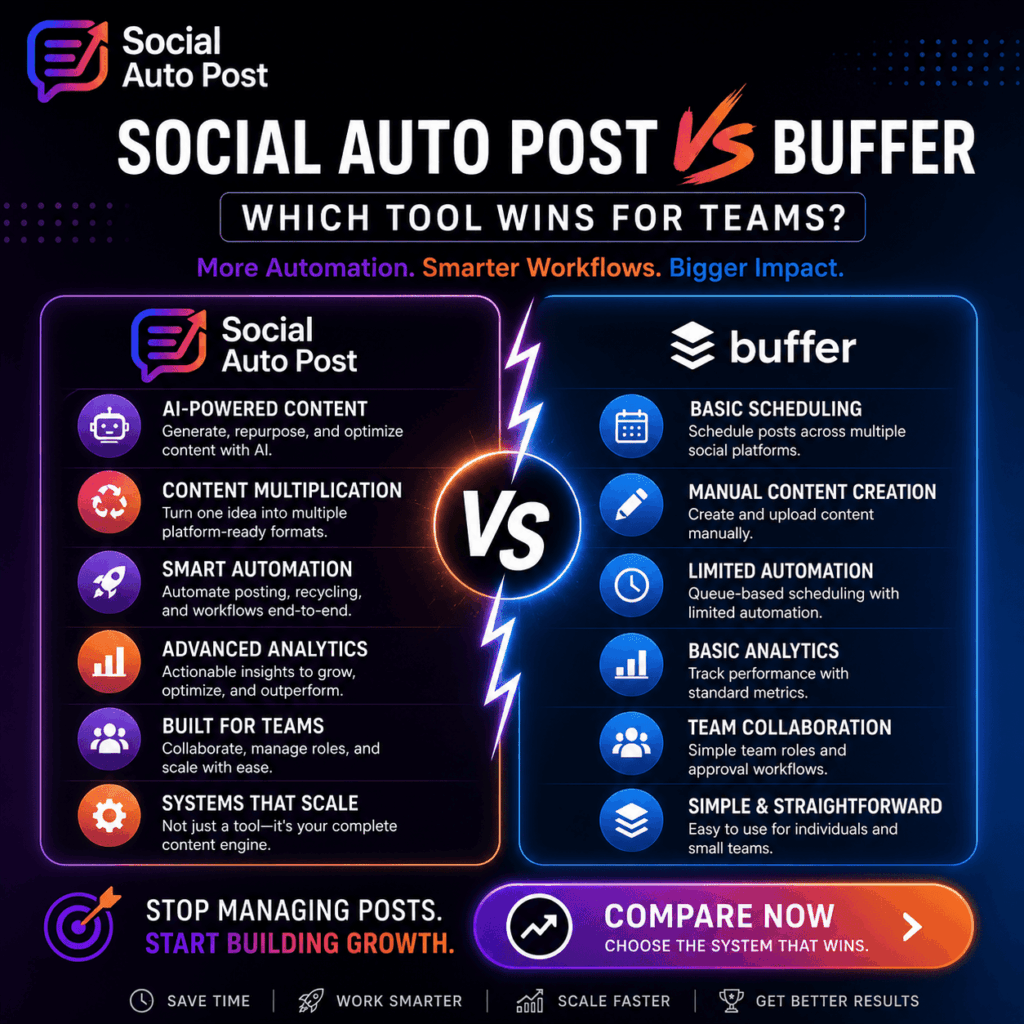
Social Auto Post vs Buffer: Which Tool Wins for Teams?
When comparing Social Auto Post vs Buffer, many teams start with the basics.
For example, they look at pricing, features, and how many social accounts each tool supports. While these points matter, they don’t show the full picture.
Instead, the real question is simple:
Which tool helps your team grow faster, save time, and get better results?
In this guide, we’ll compare Social Auto Post vs Buffer in terms of features, workflows, automation, scalability, and long-term value. By the end, you’ll know exactly which platform fits your needs.
1. Platform Philosophy: Simplicity vs Scalability
Buffer: Simple and Easy to Use
Buffer is known for its clean design and ease of use. Because of this, it’s a great choice for beginners.
It focuses on:
- Scheduling posts
- Managing accounts
- Basic analytics
As a result, it works well for individuals and small teams with simple needs.
Social Auto Post: Built for Growth
In contrast, Social Auto Post is designed as a complete content system.
Instead of focusing only on scheduling, it helps teams:
- Automate workflows
- Create content faster
- Scale across platforms
Because of this, it’s better suited for growing teams and agencies.
2. Core Features Comparison
Scheduling & Publishing
Buffer offers a simple queue system. However, most tasks still require manual setup.
On the other hand, Social Auto Post includes:
- Smart scheduling
- Bulk posting
- Content recycling
Winner: Social Auto Post
It reduces manual work and saves time.
AI and Content Creation
Buffer provides basic AI support. However, its features are limited.
In comparison, Social Auto Post allows you to:
- Generate ideas
- Write captions
- Expand one idea into multiple posts
Winner: Social Auto Post
AI is part of the workflow, not just an add-on.
Content Repurposing
Buffer does not offer built-in repurposing tools. Therefore, users must duplicate content manually.
Meanwhile, Social Auto Post helps you:
- Turn one post into many formats
- Adapt content for different platforms
- Reuse top-performing posts automatically
Winner: Social Auto Post
Analytics and Insights
Buffer keeps analytics simple and easy to understand.
However, Social Auto Post provides deeper insights along with suggestions for improvement.
Verdict:
- Choose Buffer for simplicity
- Choose Social Auto Post for detailed insights
Automation
This is where the biggest difference appears.
Buffer relies on manual workflows. As a result, scaling takes more time.
In contrast, Social Auto Post offers:
- Full automation
- Workflow-based execution
- Ongoing optimization
Winner: Social Auto Post
3. Workflow Comparison
Using Buffer
To begin with, you log in and create a post. After that, you choose platforms and schedule it.
While the process is simple, it becomes repetitive over time. Because of this, managing large amounts of content can be slow.
Using Social Auto Post
In contrast, the process is more efficient. You start with an idea, and the system builds from there.
Next, AI creates variations for different platforms. Then, the tool schedules and publishes content automatically.
In addition, it continues to optimize and reuse content in the background.
Because of this, your workflow becomes faster and easier to scale.
4. Team Collaboration and Scaling
Buffer offers basic team features. However, they are limited for larger teams.
On the other hand, Social Auto Post includes:
- Role-based workflows
- Better collaboration tools
- Support for growing teams
Winner: Social Auto Post
5. Strategy Alignment
Buffer mainly helps you publish content. In other words, it focuses on execution.
However, it does not support:
- Content planning
- Idea generation
- Scaling strategies
In contrast, Social Auto Post supports both strategy and execution. Because of this, it fits modern content teams much better.
6. Ease of Use
Buffer is very easy to learn. Therefore, beginners can start quickly.
Meanwhile, Social Auto Post has a small learning curve. However, the extra power makes it worth the effort.
Winner: Buffer (for simplicity)
7. Pricing vs Value
Buffer has a lower starting price. As a result, it’s good for individuals or small teams.
On the other hand, Social Auto Post focuses on long-term value. It helps teams save time and scale faster.
Therefore:
- Choose Buffer for lower cost
- Choose Social Auto Post for better ROI
8. Effort vs Results
Buffer requires ongoing manual work. Because of this, results depend on how much time you invest.
In contrast, Social Auto Post builds systems that work for you.
As a result:
- Buffer = effort-based output
- Social Auto Post = system-driven growth
9. Who Should Use Each Tool?
Choose Buffer if:
- You work alone
- You post occasionally
- You want a simple tool
Choose Social Auto Post if:
- You manage multiple platforms
- You want automation
- You plan to scale your content
10. Final Verdict: Social Auto Post vs Buffer
If your goal is simple scheduling, Buffer is a solid choice.
However, if your goal is growth, efficiency, and automation:
Social Auto Post is the better option.
Because today, success on social media depends on systems—not manual effort.
Final Thoughts
Most teams choose tools based on what they need right now.
However, smarter teams think about the future.
Call to Action
Stop managing posts one by one.