
Introduction
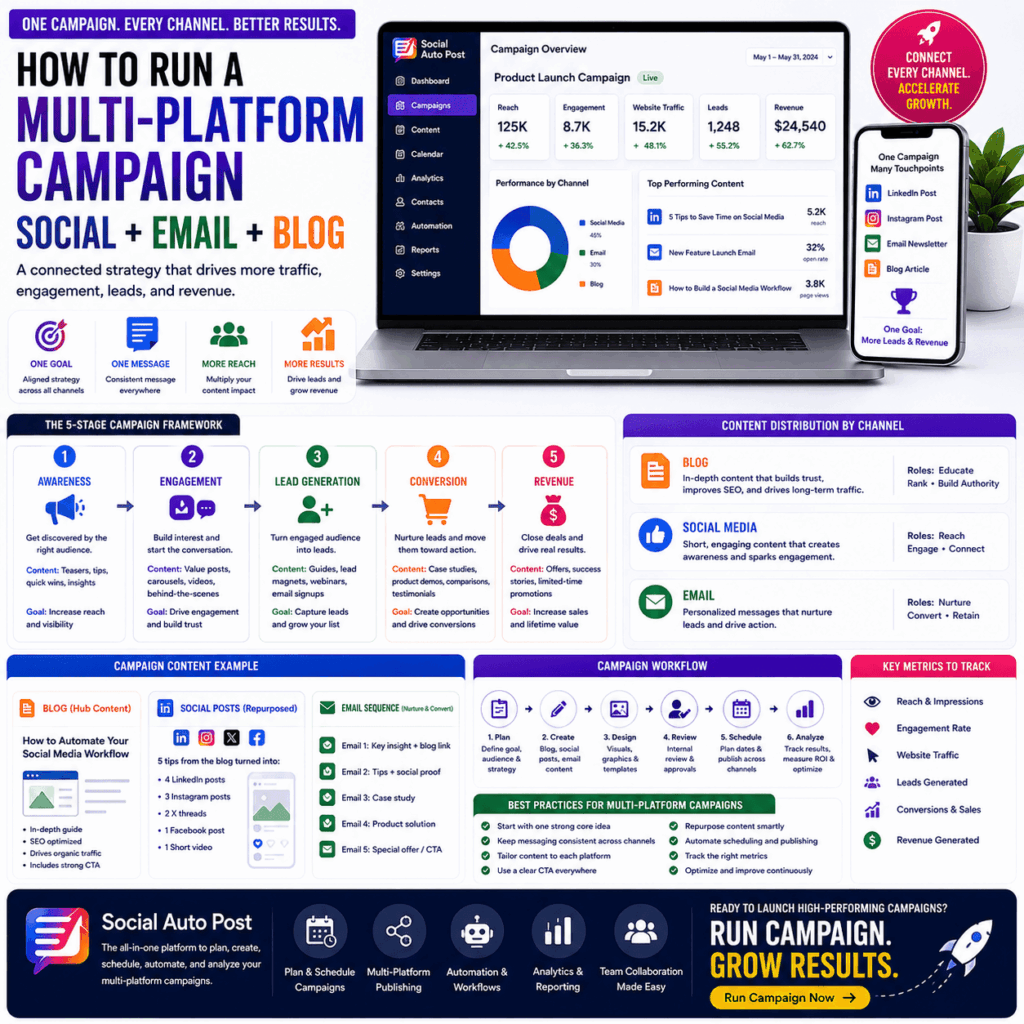
A successful multi platform marketing campaign does not treat social media, email, and blog content as separate activities. Instead, it connects all channels into one system that works toward a shared business goal.
However, many marketing teams still work in silos. One person manages social media, another handles email campaigns, and someone else writes blog content. Because of this, messaging often becomes inconsistent, campaigns feel disconnected, and opportunities are lost.
In contrast, a strong multi platform marketing approach turns one core idea into a coordinated campaign. As a result, every channel supports the same objective and drives more meaningful results.
Start With a Clear Campaign Goal
Before creating any content, you need a clear goal. Otherwise, your campaign will lack direction.
Your goal might be:
- Generate leads
- Increase product signups
- Launch a new feature
- Promote a webinar
- Drive ecommerce sales
- Build brand awareness
Rather than starting with content, start with the outcome you want.
Ask yourself:
What result should this campaign create?
When the goal is clear, every channel becomes easier to align.
Define One Core Message
After setting the goal, define one simple message for the entire campaign.
This message should be easy to understand and repeat.
For example:
“Manual posting slows teams down.”
This single idea can be reused across multiple formats, such as:
- Blog posts
- Social media content
- Email subject lines
- Video scripts
- Carousel graphics
Although formats differ, the message should stay consistent. This improves recognition and strengthens the campaign.
Build a Central Content Hub
Every strong multi platform marketing campaign needs a central content hub.
This hub is usually:
- A blog post
- A landing page
- A guide
- A webinar page
- A product page
This becomes the main source of information.
For example:
Blog: How to Build a Social Media Approval Workflow
From there, all other content should point back to this page. In addition, this improves SEO and keeps messaging unified.
Use Each Channel for a Specific Role
Each platform should serve a different purpose in your campaign.
Blog Content (Depth and SEO)
Your blog explains the topic in detail.
Use it for:
- Educational content
- Guides
- Case studies
- Comparisons
Social Media (Awareness and Engagement)
Social media brings attention to your message.
Use it for:
- Short tips
- Visual content
- Quotes
- Carousels
- Short videos
Email Marketing (Conversion and Action)
Email helps move people toward action.
Use it for:
- Lead nurturing
- Campaign announcements
- Product promotions
- Follow-ups
When each channel has a clear role, the entire system becomes more effective.
Create a Simple Campaign Timeline
Instead of posting randomly, structure your campaign over time.
Week 1: Awareness
First, introduce the topic and publish your blog content. Then share teaser posts on social media.
Week 2: Engagement
Next, focus on value-driven content like tips, examples, and insights. At the same time, send supportive email updates.
Week 3: Conversion
After that, share case studies, testimonials, and stronger calls to action.
Week 4: Follow-Up
Finally, review performance and repurpose the best content.
This step-by-step approach keeps your campaign organized and consistent.
Repurpose Content Across All Channels
One of the biggest advantages of multi platform marketing is repurposing.
For example, one blog post can become:
- Multiple LinkedIn posts
- Email newsletters
- Social media threads
- Carousel designs
- Short videos
In this way, you get more value from a single idea. Moreover, repurposing saves time while increasing reach.
Keep Messaging Consistent
Consistency is essential for campaign success.
Therefore, make sure every channel uses:
- The same campaign message
- A consistent tone
- The same CTA
- Similar visuals
For example:
Campaign Name: Run Smarter Campaigns
Core Message: One idea. Every channel. Better results.
CTA: Start Campaign
As a result, your audience recognizes your message everywhere.
Build a Simple Workflow
A clear workflow helps teams stay aligned.
For example:
- Define campaign goal
- Write blog content
- Create social posts
- Write email copy
- Review content
- Approve everything
- Schedule posts
- Launch campaign
- Measure results
Although simple, this process prevents confusion and delays.
Schedule Everything in Advance
Planning ahead reduces stress and improves consistency.
Therefore, schedule:
- Blog publishing dates
- Social media posts
- Email sends
- Follow-up content
In addition, scheduling helps maintain steady communication across channels.
For reference, you can use tools like Google Analytics and planning systems such as Google Digital Marketing Resources.
Measure What Actually Matters
To improve performance, track meaningful metrics.
Blog Metrics
- Traffic
- Time on page
- CTA clicks
Social Metrics
- Engagement rate
- Shares
- Clicks
Email Metrics
- Open rate
- Click-through rate
- Conversions
Business Metrics
- Leads generated
- Sales
- Revenue
Most importantly, focus on outcomes, not just activity.
Improve Efficiency With Automation
Automation makes multi platform marketing easier.
For example, it can help with:
- Scheduling content
- Repurposing posts
- Sending emails
- Tracking performance
As a result, teams spend less time on manual work and more time on strategy.
Review and Improve Each Campaign
After the campaign ends, review results carefully.
Ask questions like:
- Which channel performed best?
- What content got the most engagement?
- Which email drove the most clicks?
- What should be reused next time?
Then use those insights to improve future campaigns.
Final Thoughts
A successful multi platform marketing strategy does not rely on random content. Instead, it builds a structured system where every channel works together.
Blogs build trust.
Social media builds awareness.
Email drives action.
Together, they create a complete marketing engine that is easier to manage, scale, and measure.