
Introduction
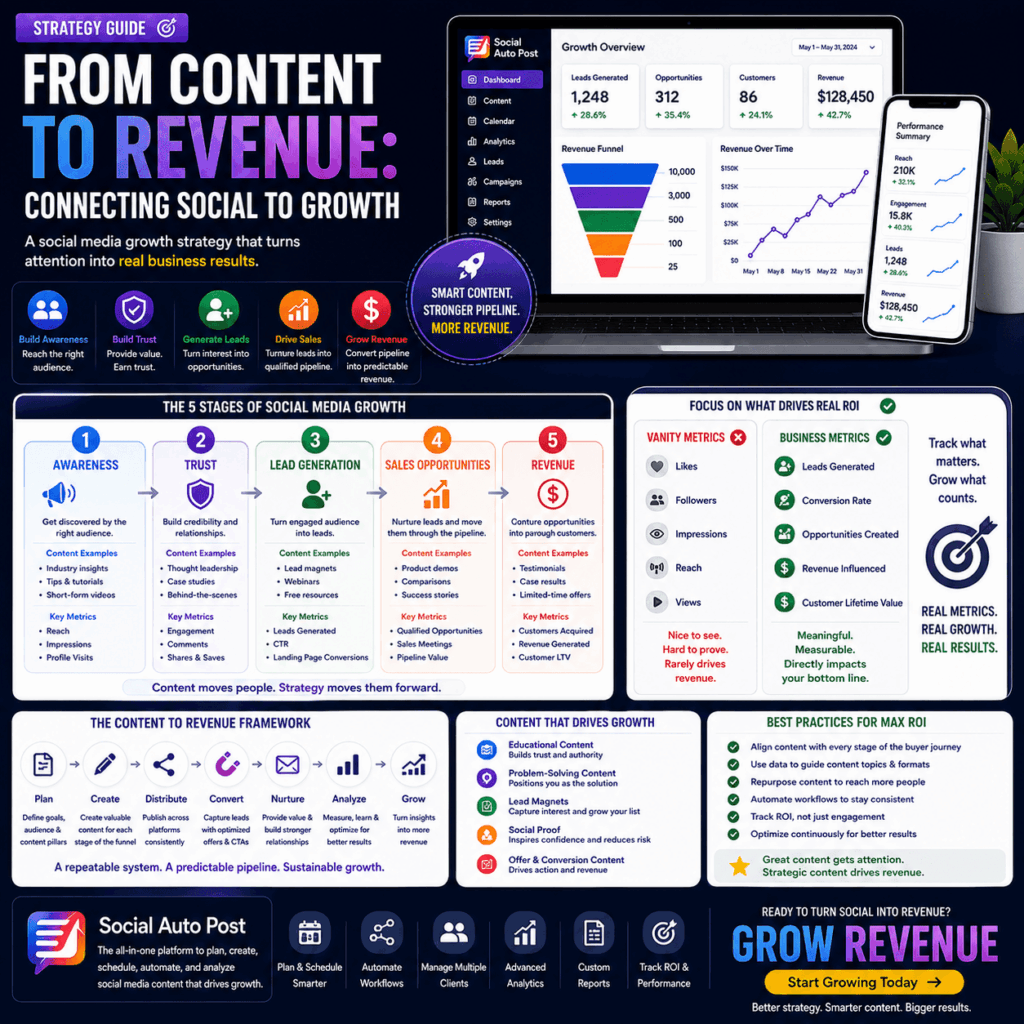
A successful social media growth strategy is not about collecting likes, followers, or views. Instead, it is about turning attention into leads, customers, and revenue.
Many businesses still treat social media as the destination. They celebrate metrics such as likes, shares, impressions, and reach. However, these numbers rarely tell the full story. While engagement can indicate interest, it does not automatically create business growth.
The companies winning in 2026 understand a different reality: social media is the top of the revenue funnel, not the end goal. Therefore, every piece of content should support a larger system designed to generate trust, create opportunities, and drive revenue.
Why a Social Media Growth Strategy Matters
Many businesses operate with a simple process:
- Create content
- Publish content
- Check engagement
- Repeat
Unfortunately, this approach often disconnects content from business outcomes.
As a result:
- ROI becomes difficult to measure
- Growth becomes unpredictable
- Content feels random
- Revenue impact remains unclear
By contrast, a structured social media growth strategy connects every piece of content to measurable business objectives.
The journey looks like this:
Content → Trust → Leads → Opportunities → Customers → Revenue
This shift changes how success is measured.
Instead of asking:
“How many likes did this post get?”
Successful businesses ask:
“How much pipeline did this content influence?”
The Five Stages of a Social Media Growth Strategy
Every effective growth framework moves prospects through five key stages.
Stage 1: Awareness
The first goal is visibility.
Potential customers discover your brand through:
- Educational posts
- Industry insights
- Short-form videos
- Thought leadership content
At this stage, prospects are not ready to buy. Instead, they are simply becoming aware of your business.
Awareness Metrics
- Reach
- Impressions
- Profile visits
- Brand mentions
Stage 2: Building Trust Through Content
Awareness alone does not create revenue.
Trust does.
People buy from businesses they trust. Therefore, credibility must be developed consistently over time.
Trust-building content includes:
- Case studies
- Customer success stories
- Educational guides
- Industry expertise
- Founder insights
Trust Metrics
- Comments
- Shares
- Saves
- Engagement quality
- Return visitors
For additional ideas, see our Content Marketing Strategy Guide.
Stage 3: Lead Generation Through Social Media
Once trust is established, content should encourage action.
This is where social media begins influencing the sales funnel directly.
Examples include:
- Demo requests
- Consultation bookings
- Newsletter subscriptions
- Trial registrations
- Resource downloads
Lead Generation Metrics
- Leads generated
- Conversion rates
- Landing page performance
- Cost per lead
To improve tracking accuracy, consider using Google Campaign URL Builder for campaign attribution.
Stage 4: Converting Leads Into Opportunities
Not every lead becomes a customer immediately.
Instead, prospects often require additional education and reassurance before making a purchase decision.
Content that supports this stage includes:
- Product walkthroughs
- Customer testimonials
- Comparison content
- Educational webinars
Opportunity Metrics
- Sales meetings booked
- Qualified opportunities
- Pipeline value
- Opportunity conversion rates
Businesses can further improve measurement using Google Analytics.
Stage 5: Revenue and Business Growth
This is where social media becomes measurable business value.
The goal is no longer engagement. Instead, the focus shifts to revenue outcomes.
Revenue Metrics
- Customers acquired
- Revenue generated
- Customer lifetime value
- Marketing ROI
Many organizations fail to connect social activity to this stage. However, businesses that do gain a significant competitive advantage.
Content Types That Support a Social Media Growth Strategy
Different content serves different purposes throughout the customer journey.
Awareness Content
Examples:
- Industry trends
- Quick tips
- Educational graphics
- Short-form videos
Purpose:
Generate visibility and attract new audiences.
Trust-Building Content
Examples:
- Thought leadership
- Expert opinions
- Detailed guides
- Founder insights
Purpose:
Build authority and credibility.
Lead Generation Content
Examples:
- Free templates
- Downloadable resources
- Webinars
- Newsletters
Purpose:
Capture contact information.
Conversion Content
Examples:
- Case studies
- Testimonials
- Product demos
- Comparison articles
Purpose:
Increase buying confidence.
How Content Repurposing Drives Business Growth
High-performing teams do not necessarily create more content.
Instead, they create more value from existing content.
For example, a single blog post can become:
- A LinkedIn post
- A Facebook update
- An X thread
- An Instagram carousel
- A short-form video
- An email newsletter
As a result, reach increases without significantly increasing workload.
More reach creates more opportunities. More opportunities create more revenue.
For practical workflows, see our Social Media Automation Guide.
Why Consistency Is Essential for Revenue Growth
Many businesses underestimate the value of consistency.
A single great post may generate temporary engagement. However, a repeatable system creates long-term growth.
Consistency helps build:
- Trust
- Audience growth
- Lead generation
- Pipeline development
Therefore, successful brands focus on systems rather than viral moments.
How Automation Strengthens a Social Media Growth Strategy
Automation has become one of the biggest growth multipliers available to modern businesses.
Without automation:
- Publishing becomes inconsistent
- Content production slows down
- Opportunities are missed
With automation:
- Content output increases
- Workflows scale efficiently
- Publishing remains consistent
- Teams save valuable time
Consequently, businesses improve both operational efficiency and revenue potential.
For platform insights, marketers can explore HubSpot Marketing Analytics.
Measuring the Revenue Impact of Social Media
To understand performance, businesses must track more than engagement metrics.
Awareness Metrics
- Reach
- Impressions
- Brand mentions
Trust Metrics
- Shares
- Saves
- Engagement quality
Lead Metrics
- Form submissions
- Trial signups
- Demo requests
Revenue Metrics
- Pipeline value
- Customers acquired
- Revenue generated
When these metrics are connected, social media becomes a predictable growth engine rather than a branding exercise.
Common Mistakes That Limit Revenue Growth
Creating Content Without Goals
Every piece of content should support a measurable objective.
Chasing Virality
Viral content may generate attention, but it does not always generate customers.
Ignoring Lead Capture
Attention without conversion creates limited business value.
Measuring Only Engagement
Engagement matters. However, revenue metrics matter more.
Publishing Inconsistently
Consistency is essential for building trust and generating opportunities.
What High-Growth Companies Do Differently
Organizations that connect content to revenue typically:
- Create content strategically
- Build trust consistently
- Capture leads systematically
- Measure pipeline influence
- Automate repetitive workflows
- Scale content efficiently
Rather than viewing social media as a standalone marketing channel, they treat it as a business growth system.
The Future of Social Media Growth
The future is moving away from:
- Vanity metrics
- Random posting
- Isolated campaigns
Instead, businesses are focusing on:
- Revenue attribution
- Workflow automation
- Scalable content systems
- Predictable pipeline growth
The companies that connect content directly to business outcomes will have the strongest advantage in the years ahead.
Final Thoughts
Social media growth is no longer about collecting likes.
Instead, it is about creating a system that transforms attention into revenue.
The most effective businesses understand that every piece of content serves a purpose:
Awareness creates trust.
Trust generates leads.
Leads create opportunities.
Opportunities generate revenue.
That is how content becomes growth.
Grow Revenue With a Smarter Strategy
Stop treating social media as a standalone activity.
👉 Grow revenue with a smarter social media growth strategy today.