
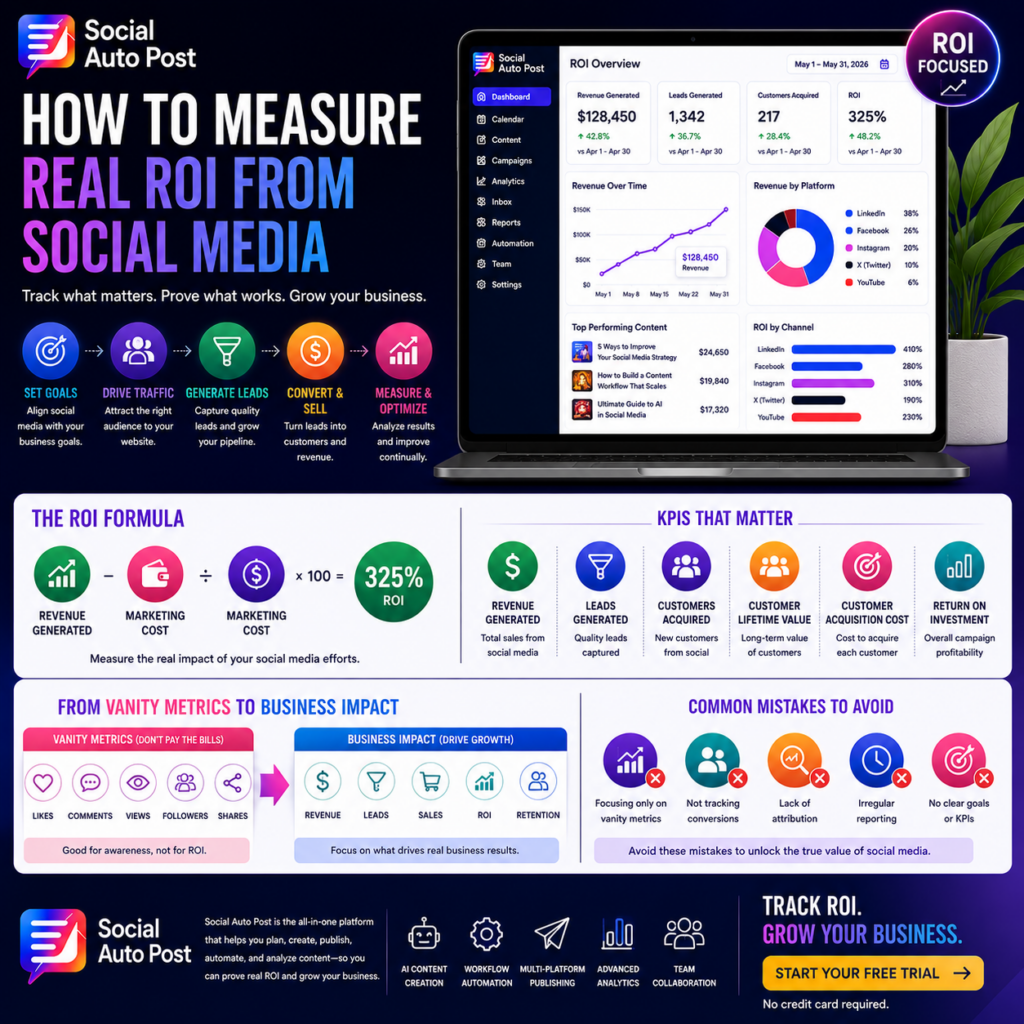
Introduction: Social Media ROI Goes Beyond Likes
Social media ROI is the metric that truly determines whether your marketing efforts contribute to business growth. While likes, shares, comments, followers, and impressions can indicate engagement, they don’t necessarily translate into revenue or long-term success.
Today, business owners, executives, and marketing leaders are asking a more important question:
“How much revenue is our social media generating?”
That is the true measure of success.
In 2026, leading organizations no longer judge social media by popularity alone. Instead, they focus on social media ROI, measuring how campaigns influence leads, sales, customer retention, and profitability.
Understanding ROI helps businesses invest confidently, optimize campaigns, and transform social media into a measurable growth engine.
What Is Social Media ROI?
Social media ROI (Return on Investment) measures the business value generated from your social media activities compared to the resources invested.
The standard formula is:
ROI = (Revenue Generated − Marketing Cost) ÷ Marketing Cost × 100
However, modern ROI measurement goes far beyond a simple calculation.
It also includes:
- Revenue influenced
- Qualified leads
- Customer acquisition
- Pipeline contribution
- Customer lifetime value (CLV)
- Brand awareness
- Customer retention
The objective isn’t just proving social media works—it’s understanding exactly how it contributes to business growth.
Why Measuring Social Media ROI Matters More Than Vanity Metrics
Many marketing reports still focus on vanity metrics such as:
- ❌ Likes
- ❌ Followers
- ❌ Reach
- ❌ Impressions
While these metrics measure visibility, they rarely demonstrate business impact.
Instead, successful organizations prioritize metrics that align directly with company goals and improve social media ROI.
Define Business Goals Before Measuring Social Media ROI
Before tracking performance, define what success looks like.
Common business goals include:
- Generate qualified leads
- Increase online sales
- Book more product demos
- Grow ecommerce revenue
- Build an email list
- Improve customer retention
Every KPI should support a measurable business objective.
If a metric doesn’t help decision-making, it probably doesn’t belong on your dashboard.
Measure Website Traffic From Social Media
Social media often introduces customers to your business.
Track metrics such as:
- Website sessions from social channels
- Landing page performance
- Bounce rate
- Average session duration
- Returning visitors
Traffic alone isn’t ROI, but it is the first step in the customer journey.
Track Lead Generation to Improve Social Media ROI
Lead generation bridges the gap between engagement and revenue.
Monitor:
- Contact form submissions
- Demo requests
- Newsletter signups
- Free trial registrations
- Quote requests
- Resource downloads
These indicators show whether your content attracts potential customers rather than casual visitors.
Use Revenue Attribution to Measure Social Media ROI
Revenue attribution connects social media activity to actual sales.
For example:
A customer may:
- Discover your company on LinkedIn
- Read a blog post
- Subscribe to your newsletter
- Request a demo
- Become a paying customer
Although social media wasn’t the final interaction, it significantly influenced the purchase.
Modern attribution models help businesses understand these customer journeys and calculate more accurate ROI.
Monitor Customer Acquisition Cost (CAC)
Customer Acquisition Cost (CAC) helps evaluate marketing efficiency.
Calculate:
Marketing Spend ÷ New Customers
Compare acquisition costs across:
- Organic social media
- Paid advertising
- Email marketing
- Search traffic
Understanding CAC helps businesses invest in the most profitable marketing channels.
Measure Customer Lifetime Value (CLV)
Not every customer generates the same long-term value.
Track:
- Average purchase value
- Repeat purchases
- Subscription renewals
- Customer retention
Sometimes a campaign with fewer customers generates significantly higher long-term revenue.
Customer Lifetime Value provides a clearer picture of marketing performance.
Improve Conversion Rates to Increase Social Media ROI
Engagement alone doesn’t produce revenue.
Monitor conversion metrics including:
- Click-through rate (CTR)
- Landing page conversion rate
- Lead-to-customer conversion
- Checkout completion rate
- Demo-to-sale conversion
Improving conversion rates often increases ROI without increasing marketing spend.
Measure Campaign-Level Performance
Every marketing campaign should have measurable objectives.
Examples include:
Product Launch Campaign
- Revenue generated
- Sales influenced
Educational Content Campaign
- Leads generated
- Newsletter growth
Webinar Promotion
- Registrations
- Qualified opportunities
Campaign-level reporting identifies which strategies deserve additional investment.
Measure Operational ROI
ROI isn’t limited to revenue.
Operational efficiency also contributes to profitability.
Track improvements in:
- Content production time
- Approval turnaround
- Campaign launch speed
- Workflow automation
- Team productivity
Reducing repetitive work enables teams to achieve more without increasing costs.
Build Executive Dashboards That Focus on Social Media ROI
Executives prefer concise reports focused on business performance.
A useful dashboard should include:
- Revenue influenced
- Qualified leads
- Pipeline created
- Customer Acquisition Cost
- Customer Lifetime Value
- Marketing ROI
- Top-performing campaigns
- Recommended next actions
Focus on actionable insights instead of overwhelming spreadsheets.
Common Mistakes When Measuring Social Media ROI
Avoid these common mistakes:
❌ Measuring Only Engagement
Engagement is valuable, but revenue determines business success.
❌ Ignoring Attribution
Customers usually require multiple interactions before converting.
Measure the complete customer journey.
❌ Tracking Too Many KPIs
Focus on metrics that support business decisions.