
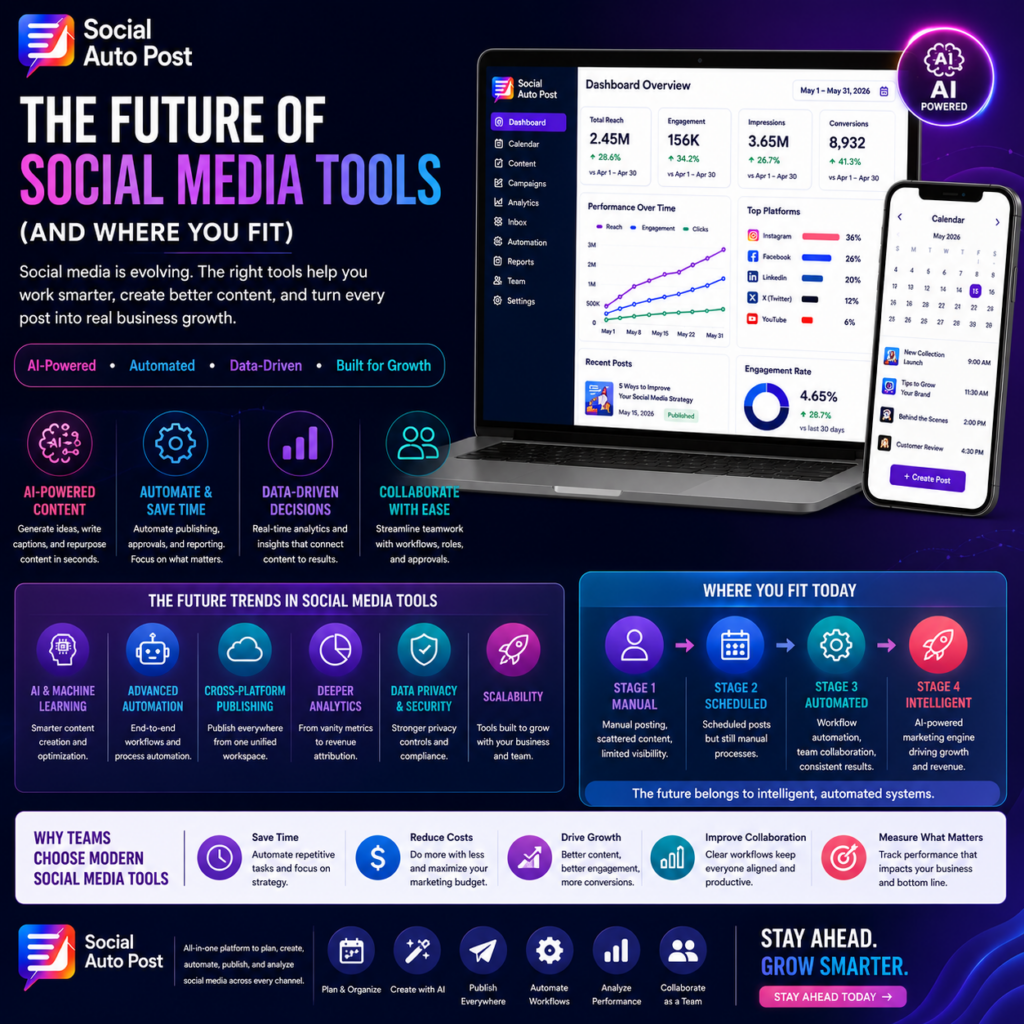
Introduction
Social media management has changed dramatically over the past decade.
What started as simple scheduling software has evolved into intelligent marketing platforms capable of managing entire content operations.
In the early days, businesses only needed a tool to publish posts across Facebook or Twitter.
Today, modern marketing teams require much more.
They need platforms that can:
- Generate content with AI
- Automate repetitive tasks
- Coordinate team approvals
- Publish across multiple platforms
- Track performance in real time
- Connect social media efforts directly to business growth
The future of social media tools is no longer about scheduling posts.
It’s about building intelligent systems that help businesses create better content, collaborate more efficiently, and turn social media into a measurable growth engine.
The companies that embrace this shift today will be the ones leading tomorrow.
The Evolution of Social Media Management
The first generation of social media software focused on one problem:
Publishing.
The second generation introduced:
- Analytics
- Scheduling
- Multi-platform management
The next generation is focused on intelligence.
Today’s platforms are evolving into complete marketing operating systems that help teams manage every stage of the content lifecycle.
Instead of asking:
“When should this post go live?”
Businesses now ask:
“How can this content generate leads, support sales, and drive revenue?”
AI Is Reshaping Everything
Artificial Intelligence has become one of the biggest innovations in marketing technology.
Modern AI can now assist with:
- Content ideas
- Caption generation
- Blog outlines
- Repurposing long-form content
- Campaign optimization
- Audience insights
- Performance summaries
Rather than replacing marketers, AI removes repetitive work so creative teams can focus on strategy, storytelling, and customer relationships.
The result is higher productivity without increasing headcount.
Automation Is Becoming the New Standard
Publishing content manually across several platforms is no longer practical.
Modern businesses expect automation to handle:
- Multi-platform publishing
- Approval workflows
- Content scheduling
- Team notifications
- Performance reporting
- Evergreen content recycling
Automation creates consistency while reducing administrative work.
Small marketing teams can now accomplish what once required an entire department.
Workflows Matter More Than Scheduling
Many businesses still believe a content calendar is enough.
It isn’t.
The future belongs to organizations with structured workflows.
A modern workflow includes:
Idea
↓
Research
↓
Content Creation
↓
Design
↓
Review
↓
Approval
↓
Publishing
↓
Performance Analysis
↓
Optimization
Scheduling is only one step in a much larger process.
Platforms that automate these workflows deliver significantly greater business value than scheduling tools alone.
Data Will Drive Content Decisions
The next generation of social media platforms will rely heavily on data.
Instead of guessing which content will perform, businesses will use analytics to understand:
- Audience interests
- Engagement trends
- Conversion rates
- Lead generation
- Revenue attribution
Data-driven marketing removes assumptions and helps teams create content that aligns with business goals.
The future of content is informed—not intuitive.
Collaboration Will Become a Competitive Advantage
Marketing is no longer handled by one person.
Successful campaigns often involve:
- Content writers
- Designers
- Marketing managers
- Product teams
- Sales teams
- Agency partners
- Leadership
Future-ready platforms simplify collaboration with:
- Shared calendars
- Approval systems
- Team workspaces
- Asset libraries
- Workflow visibility
The faster teams collaborate, the faster they can execute campaigns.
Multi-Platform Publishing Is Essential
Your audience is no longer on one platform.
Customers may discover your brand through:
- X
- YouTube
- Blogs
- Email newsletters
Future social media tools help businesses create content once and distribute it everywhere.
This approach:
- Saves time
- Increases consistency
- Improves ROI
- Expands reach
Cross-platform publishing is quickly becoming the standard.
Social Media Is Becoming a Revenue Channel
The most successful businesses no longer measure success by:
- Followers
- Likes
- Comments
Instead, they track:
- Qualified leads
- Website traffic
- Sales opportunities
- Pipeline influenced
- Customer acquisition
- Marketing ROI
Social media is evolving into one of the most measurable growth channels in digital marketing.
Future tools will increasingly connect content directly to business performance.
Where Does Your Business Fit?
Most organizations fall into one of four stages.
Stage 1: Manual Marketing
Posting directly on each platform with little consistency.
Stage 2: Scheduled Marketing
Using a scheduling tool but still managing workflows manually.
Stage 3: Automated Marketing
Publishing, approvals, reporting, and collaboration are streamlined.
Stage 4: Intelligent Marketing
AI assists with planning, creation, optimization, reporting, and workflow management.
The future belongs to businesses operating at Stage 4.
Signs It’s Time to Upgrade
You may have outgrown basic scheduling software if:
- You’re managing multiple brands or clients
- Content approvals slow your team down
- Reporting takes hours every month
- Your team collaborates remotely
- You’re publishing across multiple platforms
- You want to connect marketing to revenue
- You’re looking to leverage AI
These are signs that your business needs a complete marketing workflow—not just another scheduler.
Why Social Auto Post Is Built for the Future
Social Auto Post was designed with modern marketing teams in mind.
Instead of simply publishing content, it helps businesses:
- Plan campaigns
- Automate workflows
- Create content with AI
- Publish across multiple platforms
- Collaborate with teams
- Manage approvals
- Analyze performance
- Track meaningful business results
At just $12.50 per month, it delivers enterprise-inspired workflow capabilities at a price accessible to startups, agencies, ecommerce brands, and growing businesses.
The focus isn’t simply posting content.
It’s building a scalable marketing system.
Final Thoughts
The future of social media tools isn’t about adding more features.
It’s about creating smarter marketing systems.
AI, automation, collaboration, analytics, and workflow management are reshaping how businesses approach social media.
The organizations that adopt these technologies today will be better positioned to grow tomorrow.
The future isn’t about working harder.
And the right platform can make all the difference.