
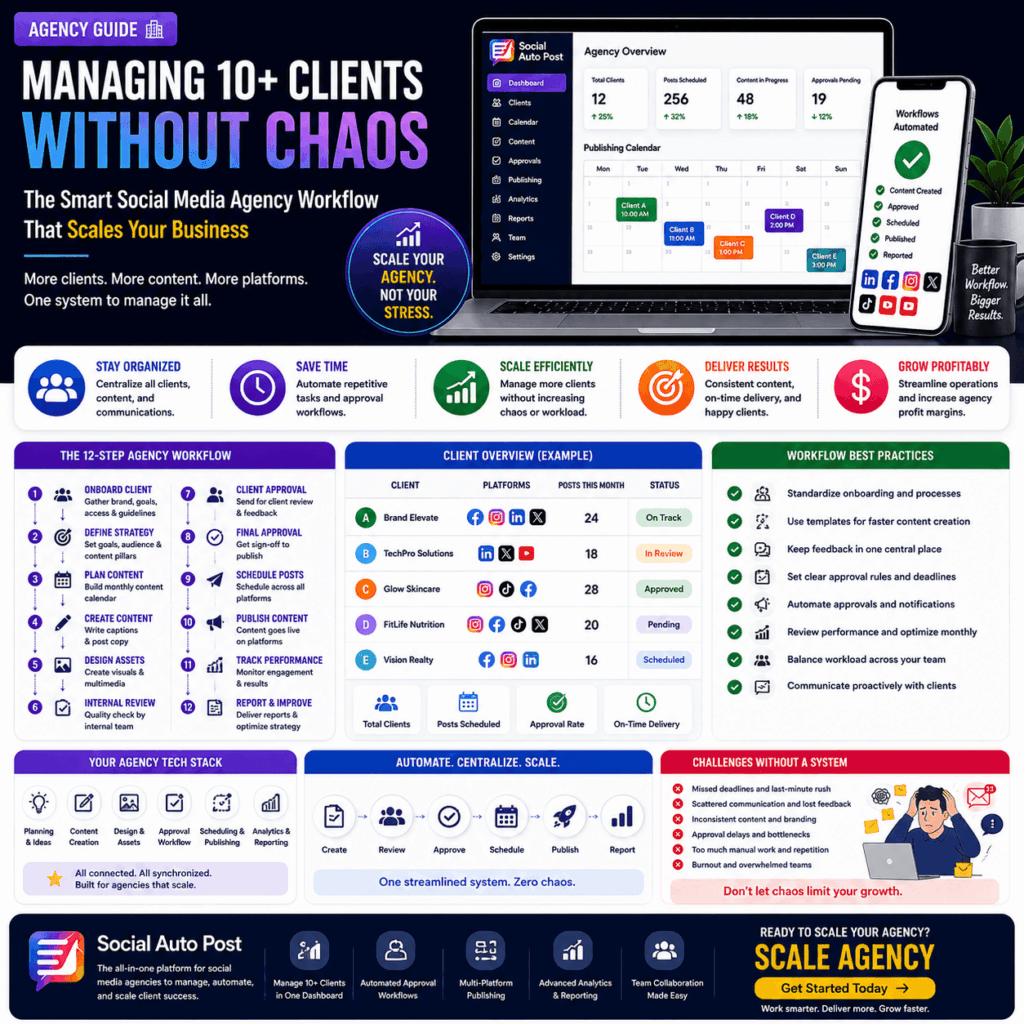
Social Media Agency Workflow: Managing 10+ Clients Without Chaos
Introduction: Why a Social Media Agency Workflow Matters
A social media agency workflow is essential when managing multiple clients at scale. While handling one or two accounts is relatively simple, managing 10 or more clients requires structured systems, clear processes, and strong communication.
Without a defined workflow, agencies often face missed deadlines, scattered feedback, delayed approvals, inconsistent posting schedules, and team burnout.
However, with the right social media agency workflow, teams can stay organized, deliver content consistently, and scale operations without creating chaos.
1. Build One Central Client Dashboard
The first rule of scaling agency operations is simple: avoid managing clients through scattered spreadsheets, emails, and chat messages.
Instead, create a centralized dashboard that tracks:
- Client name
- Social platforms
- Campaign objectives
- Content volume
- Approval status
- Deadlines
- Creative assets
- Notes
- Performance metrics
As a result, your team always has one reliable source of information.
2. Standardize Your Client Onboarding Process
Many agency problems begin during onboarding.
Therefore, every client should follow the same setup process.
Include:
- Brand guidelines
- Target audience
- Content pillars
- Platform access
- Approval contacts
- Posting frequency
- Campaign priorities
- Reporting expectations
- Brand voice
When onboarding is consistent, execution becomes significantly easier.
3. Create Content Pillars for Every Client
A successful social media agency workflow starts with clear content categories.
For example:
- Educational content
- Product promotions
- Testimonials
- Thought leadership
- Behind-the-scenes content
- Industry insights
- Promotional campaigns
As a result, teams spend less time brainstorming and more time creating valuable content.
4. Use a Repeatable Monthly Planning System
Rather than planning content randomly, create a structured monthly process.
For example:
Week 1
Strategy, research, and content ideas
Week 2
Content writing and production
Week 3
Design creation and approvals
Week 4
Scheduling, publishing, and reporting
This approach creates consistency across every account.
5. Segment Clients by Service Level
Not every client requires the same level of attention.
Therefore, organize clients into categories:
High-Touch Clients
Require frequent approvals, meetings, and custom campaigns.
Standard Clients
Follow a predictable monthly content plan.
Low-Touch Clients
Need basic content publishing and reporting.
Consequently, teams can prioritize resources more effectively.
6. Build a Social Media Agency Workflow for Approvals
Approval delays are one of the largest bottlenecks for agencies.
A simple workflow might look like:
Idea → Draft → Design → Internal Review → Client Approval → Scheduled → Published → Reported
Additionally, every content item should have a visible status.
Useful status labels include:
- Drafting
- Needs Design
- Internal Review
- Client Review
- Approved
- Scheduled
- Published
This visibility reduces confusion and speeds up collaboration.
7. Keep Feedback in One Place
Feedback becomes difficult to manage when it is spread across multiple tools.
For example:
- Slack
- Google Docs
- Project management tools
Instead, keep all comments attached to the content itself.
As a result, revisions become easier to track and approvals become clearer.
8. Create Templates for Everything
Templates help agencies scale efficiently.
Create templates for:
- Client onboarding
- Content calendars
- Captions
- Approval requests
- Campaign briefs
- Monthly reports
- Performance reviews
- Revision requests
Furthermore, templates reduce errors while improving consistency.
9. Automate Repetitive Tasks
Manual work eventually limits agency growth.
Therefore, automate repetitive processes whenever possible.
Examples include:
- Post scheduling
- Status updates
- Approval notifications
- Reminder messages
- Content recycling
- Report generation
- Multi-platform publishing
Consequently, team members can focus on higher-value work.
10. Assign Clear Ownership
Ownership removes confusion.
Every client should have a primary account owner.
Likewise, every content item should have a responsible team member.
A common structure includes:
- Account Manager — client communication
- Content Writer — captions and copy
- Designer — creative assets
- Editor — quality control
- Publisher — scheduling
- Strategist — reporting and optimization
When responsibilities are clearly defined, projects move faster.
11. Track Team Capacity Before Growing
Many agencies increase revenue faster than they improve operations.
As a result, workloads become difficult to manage.
Track metrics such as:
- Posts per client
- Approval turnaround time
- Revision rounds
- Team workload
- Missed deadlines
- Monthly output
This helps determine whether your agency can realistically support additional clients.
12. Use Performance Reviews to Improve Your Workflow
Reporting should do more than measure content performance.
It should also improve agency operations.
Review questions such as:
- Which content performed best?
- Which clients caused delays?
- Which approval stages created bottlenecks?
- Which platforms generated the most engagement?
- Which templates need improvement?
As a result, reporting becomes a tool for both growth and operational improvement.
Example Social Media Agency Workflow for 10+ Clients
A scalable process often follows this sequence:
- Client onboarding
- Goal setting
- Content pillar creation
- Monthly planning
- Content production
- Design creation
- Internal review
- Client approval
- Scheduling
- Publishing
- Performance tracking
- Monthly reporting
- Strategy optimization
This structure ensures every client follows the same proven system.
Common Mistakes Agencies Make
Avoid these common workflow issues:
- Too many approval layers
- Unclear ownership
- Scattered feedback
- Missing deadlines
- No automation
- Inconsistent onboarding
- Lack of reporting processes
Instead, focus on creating repeatable systems that scale.
Final Thoughts: Agencies Scale Through Systems
Managing 10+ clients is not about working harder.
Instead, it is about building better systems.
A strong social media agency workflow helps teams centralize communication, standardize onboarding, automate repetitive tasks, and maintain consistent quality.
Without systems, growth creates chaos.
However, with the right workflow in place, growth becomes predictable, manageable, and profitable.
Scale Your Agency
Stop managing client work through scattered messages, spreadsheets, and manual processes.