
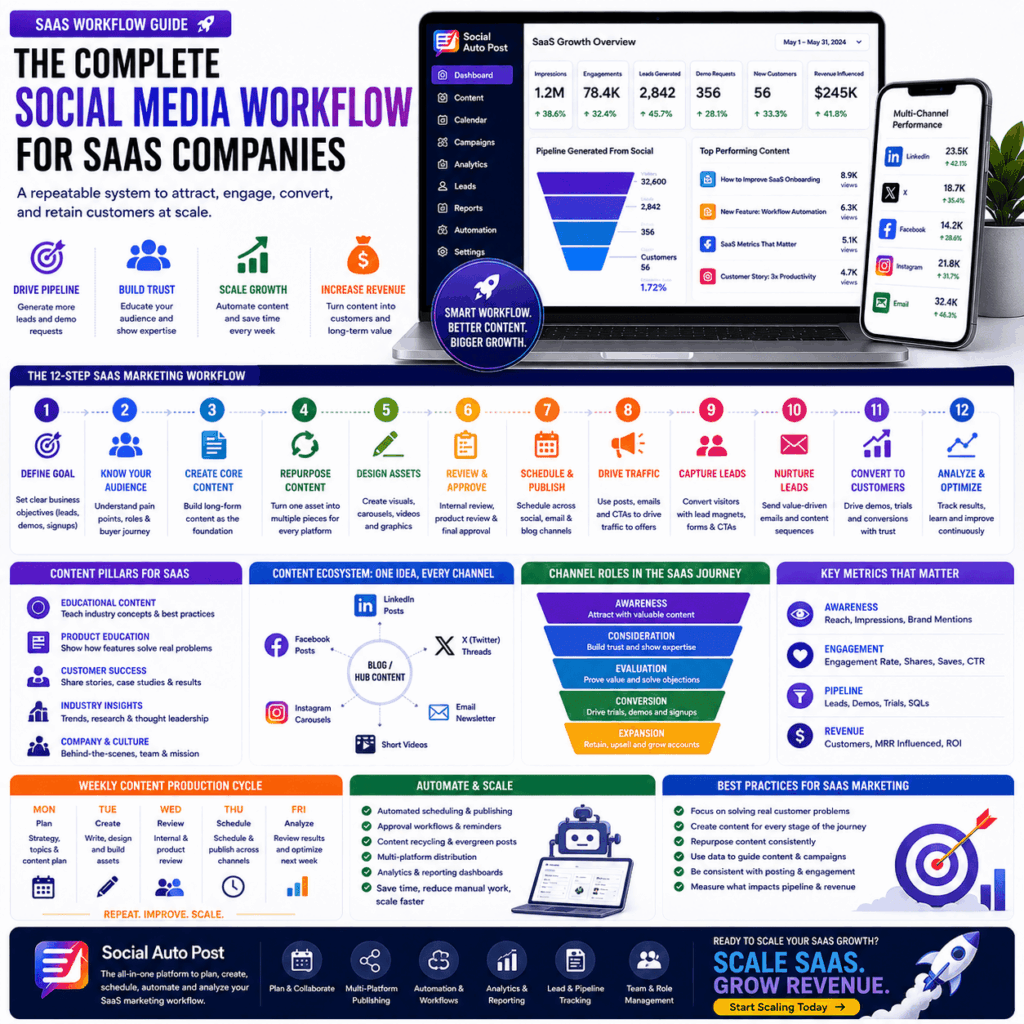
Introduction: Why Most SaaS Social Media Efforts Fail
Many SaaS companies invest heavily in product development. However, they often treat social media as a side task instead of a structured system.
As a result, their efforts usually lead to:
- Inconsistent posting
- Weak engagement
- Low-quality leads
- Disconnected campaigns
- Poor attribution
- Limited business impact
However, the main issue is rarely content quality. Instead, it is the lack of a clear SaaS marketing workflow.
In contrast, high-growth SaaS companies use structured systems that consistently attract prospects, build trust, and generate revenue.
1. Start With Business Goals, Not Content Ideas
Instead of asking, “What should we post today?”, successful teams begin with clear business outcomes.
For example, common SaaS goals include:
- Free trial signups
- Demo bookings
- Product adoption
- Feature awareness
- Customer retention
- Expansion revenue
Therefore, every piece of content should support at least one of these outcomes.
2. Build Content Around the Customer Journey
A strong SaaS marketing workflow always aligns with the buyer journey.
Typically, SaaS buyers move through these stages:
Awareness
The user identifies a problem.
Consideration
They explore possible solutions.
Evaluation
They compare tools and vendors.
Conversion
They become a customer.
Expansion
They upgrade or expand usage.
Because of this structure, content must support each stage instead of focusing only on awareness.
3. Create Core Content Pillars
Furthermore, most successful SaaS companies use 4–6 content pillars to stay consistent.
Common examples include:
- Educational content
- Product education
- Customer success stories
- Industry insights
- Company updates
As a result, teams avoid random posting and maintain a focused strategy.
4. Use Long-Form Content as the Foundation
A strong SaaS marketing workflow starts with one core asset.
For example:
- Blog post
- Case study
- Webinar
- Research report
- Product guide
Then, one asset becomes the foundation for multiple smaller pieces of content.
In other words, one article can generate dozens of social posts.
5. Repurpose Content Across Channels
Additionally, repurposing is one of the most effective growth strategies for SaaS teams.
A single blog post can become:
- LinkedIn posts
- X (Twitter) threads
- Email newsletters
- Short videos
- Carousel graphics
- Founder posts
Because of this, teams scale output without increasing workload.
6. Align Social Media With Email Marketing
However, social media should never operate in isolation.
Instead, it should work together with email like this:
- Blog published
- Social posts promote blog
- Blog captures leads
- Email nurtures leads
- Sales receives demo requests
As a result, the entire system becomes connected and measurable.
7. Create a Weekly Content Workflow
To stay consistent, SaaS teams need a structured weekly system:
- Monday: Planning
- Tuesday: Content creation
- Wednesday: Review and approval
- Thursday: Scheduling
- Friday: Performance analysis
Meanwhile, this rhythm ensures content production never stops.
8. Build a Clear Approval Process
As teams grow, approvals become essential.
A typical workflow includes:
- Draft creation
- Internal review
- Product accuracy check
- Brand review
- Final approval
- Scheduling
Therefore, quality remains consistent even at scale.
9. Connect Content to Product Marketing
Moreover, content must align closely with product updates.
Strong SaaS workflows include:
- Feature launches
- Product updates
- Customer feedback
- Use cases
- Success stories
For example, see product-led growth strategies at https://openviewpartners.com/
10. Track the Right Metrics
Instead of focusing only on likes or shares, SaaS teams should track business impact.
Awareness Metrics
- Reach
- Impressions
- Brand mentions
Engagement Metrics
- Comments
- Shares
- CTR
Pipeline Metrics
- Leads generated
- Demo requests
- Trial signups
Revenue Metrics
- Opportunities created
- Customers acquired
- Revenue influenced
Consequently, teams can clearly measure ROI.
11. Use Automation to Scale
Additionally, automation helps remove manual bottlenecks.
It can handle:
- Scheduling
- Publishing
- Content recycling
- Reporting
- Multi-platform distribution
For example, tools like https://buffer.com/ or https://www.hootsuite.com/ help automate workflows efficiently.
12. Build a Content-to-Revenue System
Ultimately, the best SaaS companies treat content as a revenue engine.
A simple flow looks like:
Content → Audience → Leads → Email nurture → Demo → Sales → Revenue
Because of this, every post plays a role in business growth.
Example SaaS Marketing Workflow
A practical workflow includes:
- Define business goal
- Identify customer pain point
- Create long-form content
- Repurpose into social assets
- Publish across channels
- Capture leads
- Nurture via email
- Drive demos
- Track pipeline impact
- Optimize performance
As a result, this becomes a repeatable growth system.
Common SaaS Workflow Mistakes
Avoid these mistakes:
- Posting without strategy
- Ignoring customer research
- Skipping email marketing
- Tracking only engagement
- Not repurposing content
- Inconsistent publishing
- Treating social as standalone
What High-Growth SaaS Companies Do Differently
High-growth SaaS teams:
- Build repeatable workflows
- Align content with business goals
- Connect social + email
- Repurpose aggressively
- Use automation
- Focus on revenue metrics
- Optimize continuously
Therefore, they don’t just create content—they build systems.
Final Thoughts
Social media is no longer just a branding channel for SaaS companies. Instead, it is a core part of demand generation and revenue growth.
However, success does not come from posting more content. It comes from building a scalable SaaS marketing workflow.
Ultimately, companies that win are those that systemize their marketing, connect content to revenue, and continuously improve performance.
CTA: Scale SaaS Marketing Workflow
Stop treating social media as a disconnected activity.
👉 Scale your SaaS marketing workflow today with Social Auto Post.